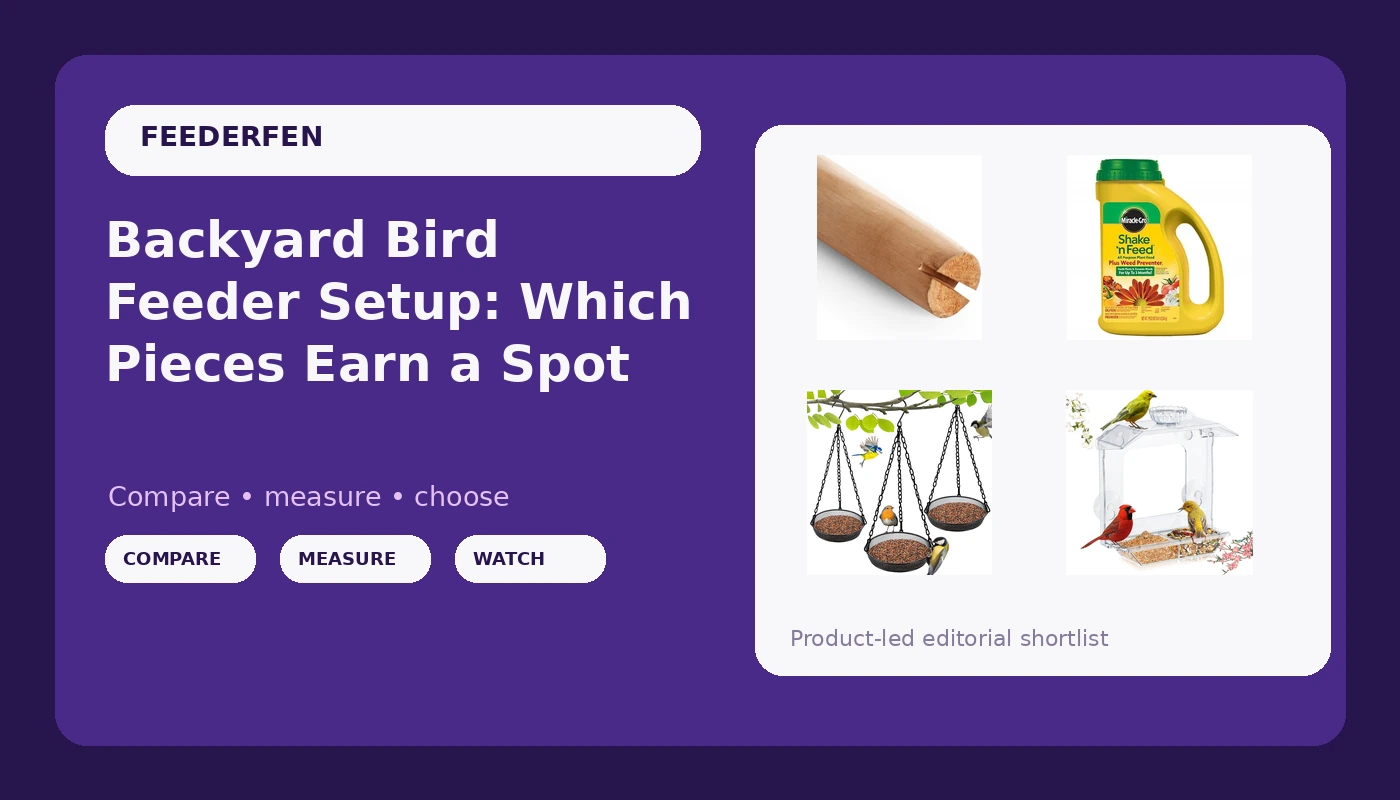
A backyard bird feeder setup is never one purchase. It is a small system: something to hold the seed, a perch that stays sound, a close-view option for the window, and the yard care that keeps the ground under the pole from turning into a weed patch. Get the order wrong and you end up with a feeder nothing uses, a tray that molds because taking it apart is a chore, or a window mount that lets go in the first hard freeze. This explainer covers four pieces that turn up in a typical setup, what each one is actually for, and where each one stops being useful.
Related: Window Strike Prevention: Where to Hang a Feeder So Birds Survive It →
Quick answer
Match the feeder to the birds you want and to the cleaning routine you will actually keep. A hanging metal mesh tray is a sensible starting point because it drains, it suits platform feeders and clinging birds, and it is easy to take down. A clear window feeder is for close viewing, and it only belongs on glass you can reach, where a fall will not break anything. A replacement wooden perch is a repair part for a feeder you already own, not a new feeder. The all-purpose plant food and weed preventer is yard maintenance rather than bird feeding gear, and it does not belong near seed, feeders, or drinking water.
Four useful options
| Model | Best fit | What stands out |
|---|---|---|
| Bird Feeder, Hanging Bird Feeders for Outdoors Metal Mesh Birdfeeder Tray | A first hanging feeder on a pole, hook, or branch | Metal mesh tray that drains and suits both platform feeders and clinging birds |
| Clear Window Bird Feeder with Strong Suction Cups, Clear Bird Feeding Station with Dual Seed Tray & Water Bowl, Easy to Install and Clean for Outdoor Viewing | Close viewing through a window | A clear unit with a dual seed tray and a water bowl, mounted with suction cups |
| Replacement Wood Bird Perch | Repairing an existing feeder with a worn perch | A wooden perch sold as a replacement part |
| Miracle-Gro Shake 'N Feed All Purpose Plant Food + Weed Preventer1, 4.5 lb. | Beds, borders, and containers in the yard | All-purpose plant food with a weed preventer in a 4.5 lb container |
The everyday hanger: Bird Feeder, Hanging Bird Feeders for Outdoors Metal Mesh Birdfeeder Tray
The mesh tray is the least fussy shape in bird feeding, and drainage is the reason. Seed that sits in a puddle turns to paste, and paste is what grows the things you do not want anywhere near a feeder. Mesh lets rain and snowmelt fall straight through and dries faster than a solid base. A tray also asks less of the birds: cardinals and doves can stand in it, while chickadees and nuthatches hang off the rim. That range is why a hanging tray makes a reasonable first feeder. The trade-off is exposure. An open tray has no roof, so seed gets wet in a hard rain, and a squirrel can sit in it. Plan on smaller, more frequent fills, and hang it where a baffle or a pole can do the work.
The window seat: Clear Window Bird Feeder with Strong Suction Cups, Clear Bird Feeding Station with Dual Seed Tray & Water Bowl, Easy to Install and Clean for Outdoor Viewing
A window feeder buys something no pole feeder can: birds at arm's length, with the light behind them. The dual tray and water bowl design covers seed and drinking water in one unit, and water is worth having because it draws species that never touch seed. The suction cups are the part to think hardest about. Cups hold well in mild weather and can let go in a hard freeze, so this is a mount for glass you can reach, on a wall where a fall will not break anything, and a feeder you are willing to bring inside when temperatures drop. Placement is the other half of the job. Keep it within about three feet of the glass, where a bird leaving the feeder cannot build up enough speed to hurt itself. Clean it often, because a clear feeder shows every smudge.
The repair part: Replacement Wood Bird Perch
Perches wear out before anything else on a feeder. A dowel can crack, split, or work loose at the screw, and a perch that wobbles makes a feeder look unsteady to the birds using it. This is a replacement part, so check the feeder you already have before you order: measure the old perch, note whether it screws in or slides through the port, and confirm the diameter is close to what came out. Diameter matters more than most people expect, because birds grip a perch rather than stand on it, and a dowel that is too thick is hard to hold. Wood is also a friendlier surface than bare metal in January, since it does not conduct cold the way a metal rod does. Inspect perches whenever you clean the feeder, and swap a split one before it pinches a foot.
The yard-care extra: Miracle-Gro Shake 'N Feed All Purpose Plant Food + Weed Preventer1, 4.5 lb.
This one is not bird feeding gear, and pretending otherwise would be dishonest. It is plant food with a weed preventer built in, meant for beds, borders, and containers. If a feeder pole stands in a lawn or a garden bed, you may already be managing that ground, and this is a product for that job. Two rules apply. First, the label is the authority on where and when it can be used, how much to apply, and what to keep it away from; read it and follow it. Second, keep treated areas, the container, and the applicator away from seed, feeders, and drinking water. Do not shake anything onto ground where spilled seed collects, and do not store the bag beside your seed bin. If the feeder is your only reason to buy it, buy seed instead.
Prices and availability may change. Product images, names, and retailer links are matched to verified listings. No current price, rating, stock status, or measured result is stated here without current evidence.
What actually decides whether a feeder earns its spot
Two numbers matter more than capacity or finish. The first is draw, meaning how fast a feeder empties. A feeder that holds five pounds and loses half a cup a week is a decoration; one that empties in days is doing work. The second is cleaning time. If you cannot take a feeder apart, scrub it, rinse it, and dry it in about ten minutes, it will not get cleaned on schedule, and a feeder that is not cleaned on schedule is a disease risk with a perch on it.
Drainage follows close behind. Any surface where seed sits in standing water will grow mold, and moldy seed is seed birds refuse. Mesh, screened bottoms, and open trays beat sealed hoppers in wet climates for that reason alone.
Then there is the squirrel question, and the honest vocabulary for it. Squirrel-resistant is a real thing. Squirrel-proof is a marketing word that gets printed on plastic feeders with short warranties. Assume a determined squirrel gets weeks of effort, not seconds, and plan hardware around that.
Finally, think about freeze and thaw. Metal expands and contracts, plastic gets brittle, suction cups lose grip, and wood swells. Anything you leave out through a Wisconsin winter has to survive that cycle repeatedly, not once.
A five-step way to choose
- Decide which birds you are feeding. Platform feeders and clinging birds use open trays; small perching birds do fine on tubes and hoppers.
- Check your cleaning reality. If the feeder cannot be disassembled and rinsed quickly, pick a different feeder.
- Place it correctly. A window feeder goes within about three feet of the glass; pole feeders go where a baffle can protect them and where you can reach them with a bucket.
- Budget for water, not just seed. A water source, kept clean and unfrozen, brings in species that ignore seed entirely.
- Read the label on anything that is not seed. Plant food, weed preventer, and cleaners all have instructions, and the label is the authority.
Practical guidance for a setup that holds up
- Clean feeders with hot soapy water, rinse thoroughly, and let them dry completely before refilling. A hose spray is not cleaning.
- Replace worn perches and cracked plastic before they fail mid-season, and check screws and hangers at the same time.
- Skip seed blends padded with milo and red millet. Filler sits uneaten, molds in the rain, and doubles your cleaning.
- Bring suction-cup mounted feeders inside before a hard freeze, and reattach them only when you can watch the weather.
- Keep treated beds, fertilizer containers, and applicators away from seed storage, feeders, and water bowls.
Which option should you choose?
Choose the Bird Feeder, Hanging Bird Feeders for Outdoors Metal Mesh Birdfeeder Tray when you want one hanging feeder that drains, suits a range of birds, and comes down easily for cleaning. Choose the Clear Window Bird Feeder with Strong Suction Cups, Clear Bird Feeding Station with Dual Seed Tray & Water Bowl, Easy to Install and Clean for Outdoor Viewing when close viewing matters and the glass is reachable, with the understanding that suction cups need watching in cold weather. Choose the Replacement Wood Bird Perch when the feeder you own is fine except for the perch. Choose the Miracle-Gro Shake 'N Feed All Purpose Plant Food + Weed Preventer1, 4.5 lb. when you are managing the beds and containers around the yard, and keep it away from the feeding station.
One caveat applies to all four. Listing details describe what a product is, not how it performs in your yard, and no feeder earns a permanent spot on the basis of a description alone. Hanging position, seed quality, cleaning frequency, and local weather decide the outcome far more than the box does.
The bottom line
A backyard bird feeder setup works when each piece has a job: a draining hanging tray for everyday feeding, a window unit for close viewing, a spare wooden perch to keep an existing feeder in service, and yard care products kept strictly away from seed and water. Buy the feeder you will actually clean, hang it where birds can use it safely, and treat water and hygiene as part of the setup rather than extras. The seed is the cheapest part of the whole system and the easiest place to waste money.