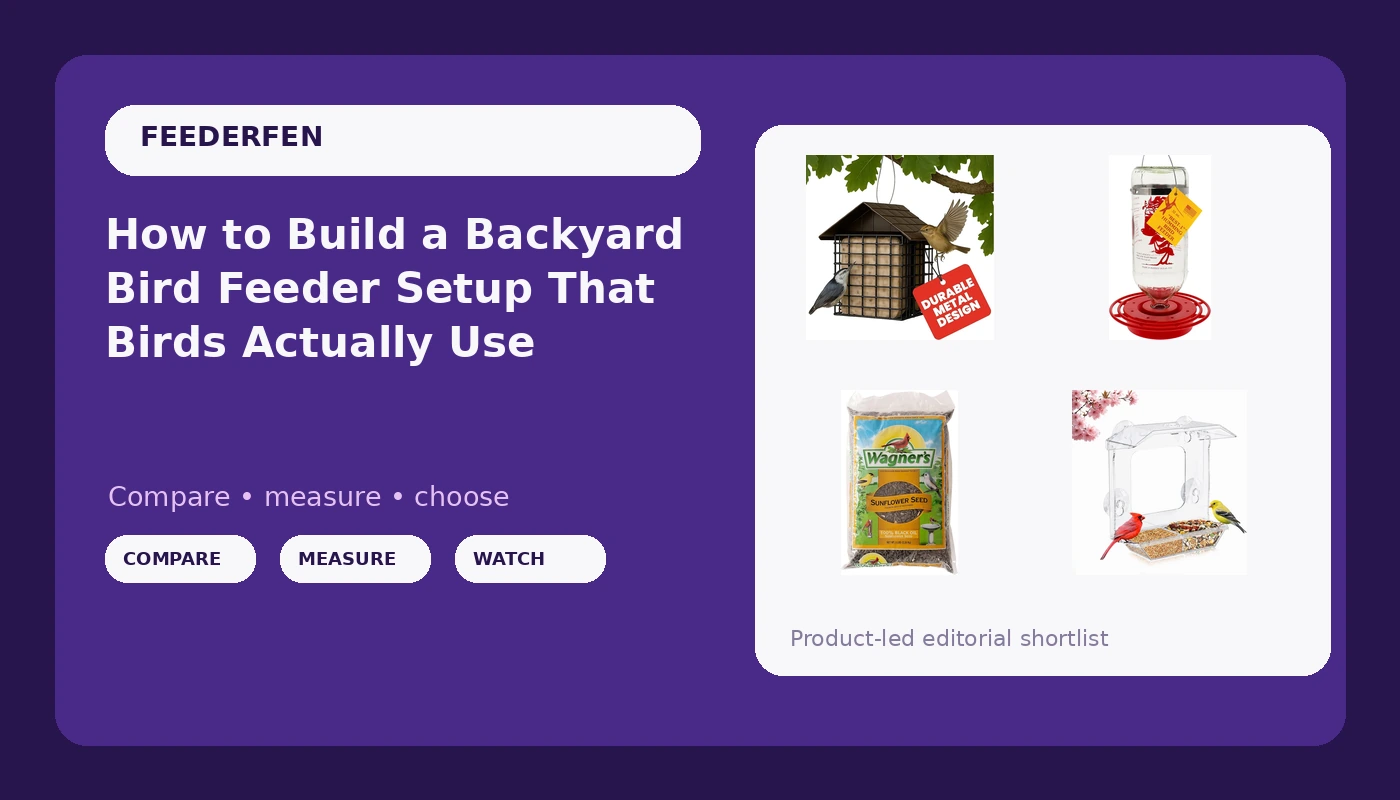
Most bird feeding advice starts with a product and works backward. The better order is to start with the birds you actually have and the spot you actually have, then pick the feeder that fits it. A backyard bird feeder setup can be one window feeder on the kitchen glass or a pole carrying a suet cage, a nectar feeder, and a tray of sunflower seed, and the difference between a yard that stays busy and one that sits empty usually comes down to three things: what food you offer, where you hang it, and how often you take the thing apart and clean it. The four options below cover the most common starting points, and each one is built around a different kind of bird and a different kind of maintenance.
Related: Seed and Suet: What to Feed Backyard Birds in Winter →
Quick answer
Match the feeder to the food and the birds, not to the product photo. A suet cage serves clingers like woodpeckers, nuthatches, and chickadees, and it earns its keep in cold months. A nectar feeder serves hummingbirds and only works if you are willing to rinse it often. Black oil sunflower is the seed a wide range of species will take, and it works in almost any feeder with a port, a tray, or a hopper. A suction-mounted window feeder is the fastest way to watch birds from indoors, and it depends on clean glass and a sheltered window. Start with one or two, keep them clean, and let what shows up decide what you add next.
Four useful options
| Model | Best fit | What stands out |
|---|---|---|
| Window Bird Feeder with 4 Extra Strong Suction Cups (2.5 Inch) | Watching birds from indoors | Four 2.5 inch suction cups mount a clear tray directly on the glass |
| More Birds Double Suet Cake Feeder, Weather Guard, Steel Construction | Winter suet for clingers | Holds two suet cakes, steel body, weather guard over the food |
| Birds Choice Best-1 Hummingbird Feeder, 32oz Nectar Capacity, Clear | Hummingbird season | 32 ounce clear nectar reservoir, so the level is visible at a glance |
| Wagner's 52023 Black Oil Sunflower Seed Wild Bird Food, 5-Pound Bag | Feeding the widest mix of birds | Sold as black oil sunflower rather than a mixed blend |
The window option: Window Bird Feeder with 4 Extra Strong Suction Cups (2.5 Inch)
A window feeder is the only feeder type that solves two problems at once. It puts birds where you can see them without binoculars, and if you mount it within three feet of the glass, birds leaving the tray cannot build up enough speed to hurt themselves on the pane. That close placement is the point, not a compromise. The trade-off is the mount itself. Suction cups depend on a clean, smooth surface and they behave differently as glass goes through freeze and thaw cycles, so a sheltered window that stays out of direct weather will hold better than an exposed one. If your winters run hard, plan on pressing the cups back down after cold snaps, or consider this the warm-season option and a bracketed feeder the winter one.
The suet option: More Birds Double Suet Cake Feeder, Weather Guard, Steel Construction
Suet is the winter food that pulls in the birds a seed feeder misses. Woodpeckers, nuthatches, chickadees, and titmice feed while hanging sideways or upside down, and a cage gives them the grip a perch does not. Double capacity matters more than it sounds, because a single cake in a busy yard can be gone in a day or two, and every extra trip outside in February is a trip you will skip. The weather guard is the other feature worth paying attention to: suet softens and spoils faster when it stays wet, so a roof over the cakes keeps them firm longer. Suet is also the feeder most likely to go rancid in summer heat, which is why most people run it from late fall through early spring and switch the pole over to seed or nectar after that.
The nectar option: Birds Choice Best-1 Hummingbird Feeder, 32oz Nectar Capacity, Clear
Capacity cuts both ways with hummingbird feeders. Thirty-two ounces means fewer refills during peak migration, but nectar is a perishable food, and a large reservoir that sits half full in August heat is a mold experiment. The honest rule is to fill only what the birds will clear in two or three days, then rinse and refill. Clear bodies help here, because you can see the level and see whether anything is growing inside without taking the feeder down first. Use plain sugar water, one part white sugar to four parts water, and skip the red dye entirely. Red on the feeder itself is enough to get attention, and dye adds nothing the birds need.
The seed: Wagner's 52023 Black Oil Sunflower Seed Wild Bird Food, 5-Pound Bag
Seed blends are where most beginners lose money. Bags padded with milo and red millet look like a bargain per pound, but a lot of that grain gets kicked to the ground uneaten, where it molds in the rain and pulls you back out to clean the platform. A single-ingredient bag avoids the whole problem: what goes in gets eaten. Black oil sunflower is the practical default because chickadees, finches, cardinals, nuthatches, jays, and sparrows all handle it, and the thin hull is easier for small beaks than the striped variety. The trade-off is hull litter under the feeder, which is real. If you feed on a deck, a balcony, or anywhere a neighbor can see, sunflower hearts cost more per pound and leave nothing behind.
Prices and availability may change. Product images, names, and retailer links must be matched by verified ASIN. Do not state a current price, rating, stock status, or measured result without current evidence.
What each feeder type actually attracts
The feeder is a delivery system for a food, and the food decides the guest list. Suet is rendered fat, often mixed with seeds, peanuts, or mealworms, and it is calorie-dense in a way that matters when a chickadee needs to survive a night at ten below. That is why it draws the birds that cling: woodpeckers, nuthatches, chickadees, and titmice. Nectar is sugar water, and it draws hummingbirds, plus the occasional oriole or warbler checking a feeder in migration. Sunflower seed is the generalist food, and a tray or tube of it will pull in the widest species list of anything you can hang. Window feeders are not a food category at all; they are a placement choice, and you can run sunflower, hearts, or a no-mess blend in one.
That matters when you are deciding what to buy first. If your goal is a long species list, seed wins. If your goal is woodpeckers on a snowy morning, suet wins. If your goal is birds you can watch from the couch without optics, the window mount wins regardless of what is in it. And if you want the single highest-return addition to a yard, it is not a feeder at all. Moving water brings in birds that never touch seed, and a bird bath or heated bath will show up in a species list more reliably than any second feeder you could hang.
Placement, cleaning, and the rules that matter more than the feeder
A dirty feeder is a disease vector with a perch. House finch eye disease and salmonella both move through feeder crowds, and both trace back to trays and tubes that were never taken apart. Cleaning is not a hose spray. It is disassembling the feeder, scrubbing the ports and the base with a dilute bleach solution, rinsing thoroughly, and letting it dry completely before it goes back up. Once a week in cool weather, more often in heat or when the feeder is crowded.
Placement does the rest of the work. Keep feeders either within three feet of glass, where birds cannot build up striking speed, or more than thirty feet out, where they have room to see the pane and adjust. Skip the middle distance. Keep a feeder where you can see it from a window you actually sit near, because a feeder you forget about is a feeder you stop cleaning. And accept that squirrel-proof is a marketing word. Squirrel-resistant is real, and it is measured in how many weeks a determined squirrel spends failing, not in what the box promises.
- Count what actually visits before you buy anything, and note which species show up in your yard in a normal week.
- Pick the food first: suet for clingers and cold months, nectar for hummingbirds, sunflower for the broadest mix.
- Match the mount to the site: suction cups for sheltered glass, a hanging cage for a pole or branch, a tray or hopper for a post.
- Check that you can take the feeder apart by hand, because anything that only rinses will not get cleaned.
- Fill only what the birds will clear in a few days, and refill rather than letting old food sit.
Practical guidance for a first setup
- Hang one feeder at a time and give it two weeks before you judge it. New feeders get found slowly, then all at once.
- Put the first feeder where you sit, not where it looks best from the yard. Visibility is what keeps you cleaning and refilling.
- Buy seed by ingredient list, not by the picture on the bag. Milo and red millet are filler and will end up on the ground.
- Rinse nectar feeders every two to three days in warm weather and skip red dye. Plain white sugar at one part to four parts water is the whole recipe.
- Store seed in a sealed container indoors. A bag left open in a garage is an invitation to mice and to mold.
- Take feeders down for a deep clean when you see a sick bird at the tray, and leave them down for a couple of weeks.
Which option should you choose?
Choose the Window Bird Feeder with 4 Extra Strong Suction Cups (2.5 Inch) when your main goal is watching birds up close from indoors and you have a sheltered window with clean glass. Choose the More Birds Double Suet Cake Feeder, Weather Guard, Steel Construction when you want woodpeckers and other clingers through the cold months and would rather refill twice a week than daily. Choose the Birds Choice Best-1 Hummingbird Feeder | 32oz Nectar Capacity | Clear when hummingbirds are already in your area and you will commit to rinsing nectar every few days. Choose the Wagner's 52023 Black Oil Sunflower Seed Wild Bird Food, 5-Pound Bag when you want one bag of food that works in whatever feeder you already own.
The caveat is that none of these decisions is permanent, and the sizes are not right for every yard. A five pound bag of sunflower is a sensible amount for one or two feeders and a short shelf life, but it is not the cheapest way to buy seed if you are filling a large hopper every week. A 32 ounce nectar reservoir is too much for a yard with a single pair of hummingbirds, and suet is a cold-season food that most people pull in summer. Buy small first, see what empties, and size up from there.
The bottom line
A backyard bird feeder setup works when the food matches the birds, the mount matches the site, and the cleaning schedule matches the season. Start with one feeder and one food rather than a pole full of hardware you will not maintain. Seed is the widest net, suet is the winter specialist, nectar is the seasonal commitment, and a window mount is the one that keeps you watching. Whichever you pick, plan on taking it apart weekly, filling it with food that will actually get eaten, and letting the birds that show up tell you what to add next.