A backyard bird feeder setup usually fails for unglamorous reasons. The feeder is annoying to take apart, so it stops getting cleaned. The seed is the wrong size for the port, so most of it ends up on the ground. The mount cannot handle a hard freeze, or a squirrel, or both. None of that shows up in a product photo, and all of it decides whether birds actually use what you hang.
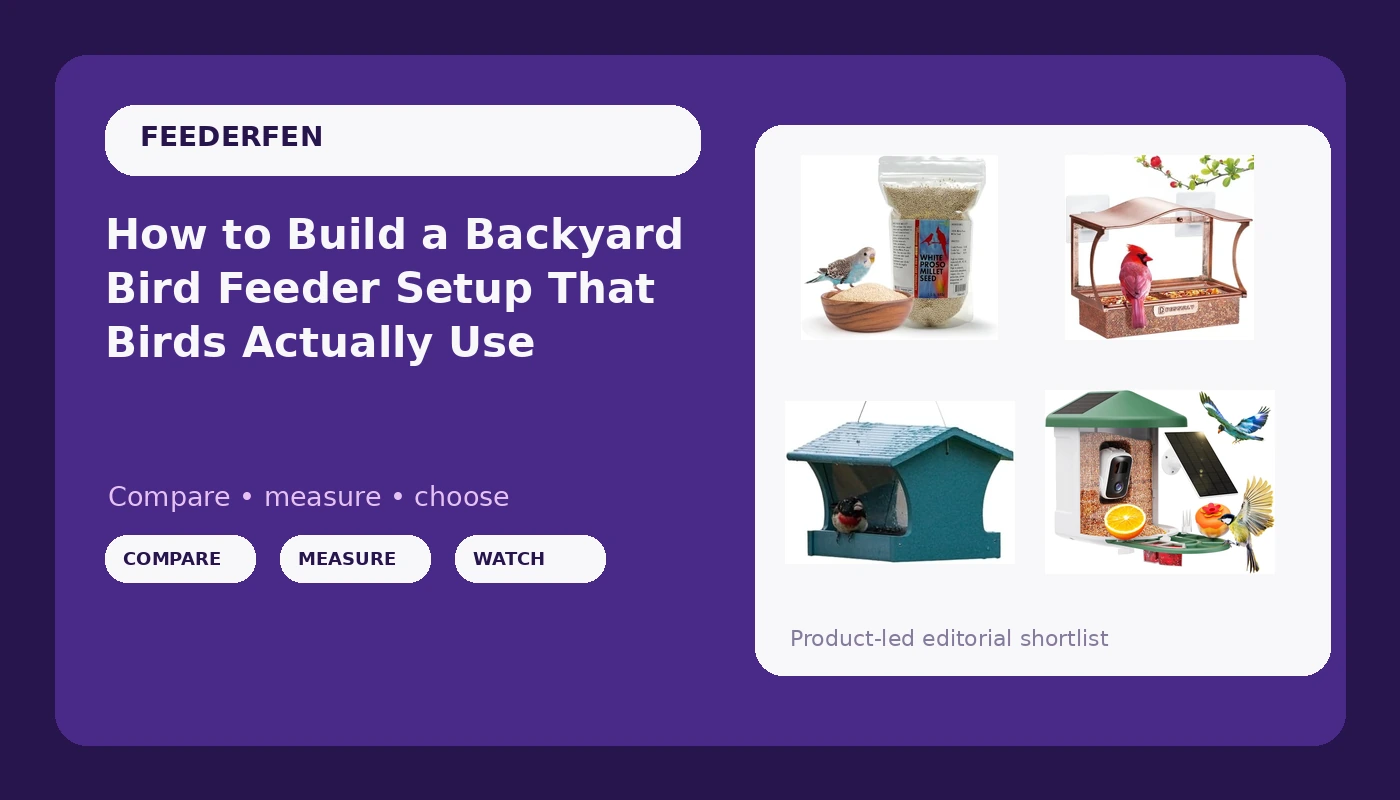
The four products below cover four different jobs in a backyard bird feeder setup: a camera feeder that identifies and records visitors, a window feeder for close viewing, a hopper feeder for larger seed capacity, and a straight bag of white proso millet for the small-beaked birds that ignore bigger seed. They are not really competitors. Plenty of yards end up using two or three of them at the same time, on different mounting points, serving different birds.
Related: Where to Hang a Feeder So Birds Do Not Hit Your Windows →
Quick answer
The right feeder depends on which birds you want to see and where you can physically mount something. A suction-cup window feeder gives the closest view and suits clean, flat glass. A hopper feeder with a 3 lb capacity handles mixed seed and larger birds, and it refills from the top in seconds. A solar-powered camera feeder adds species identification, arrival alerts, and video so you are not glued to the window. Loose white proso millet is a single-ingredient seed for small birds like finches and sparrows, and it belongs on a tray, platform, or ground-feeding setup rather than in a tube with wide ports.
Four useful options
| Model | Best fit | What stands out |
|---|---|---|
| HARYMOR Smart Bird Feeder with Camera - AI Identify Birds Species, Solar Powered Bird House with Cam, 2L Large Capacity, 2K HD Video Live Stream, Instant Arrival Alerts - Green | Watching and identifying visitors remotely | Camera, solar power, and a 2L seed capacity in one housing |
| Window Bird Feeder with Strong Suction Cups, Metal Outdoor Gift - Curved | Close viewing from inside the house | Suction mounting directly on glass, metal body, curved shape |
| Birds Choice Medium Hopper Bird Feeder | 3lb Capacity | Lake Blue | Mixed seed and a steady stream of larger birds | Covered hopper design with a 3 lb seed capacity |
| Morning Bird White Proso Millet 1.5 lbs, Unhulled Natural Bird Seed, Supports Feather Growth & Balanced Nutrition, High Energy Delicious Seed - Ideal for Finches, Parakeets & Pet Birds | Small seed-eating birds and tray feeding | Single-ingredient white proso millet, unhulled, in a 1.5 lb bag |
The camera feeder: HARYMOR Smart Bird Feeder with Camera - AI Identify Birds Species, Solar Powered Bird House with Cam, 2L Large Capacity, 2K HD Video Live Stream, Instant Arrival Alerts - Green
This is the option to consider if you want a record of what visits without standing at the glass with binoculars. The trade-offs are the usual ones for connected gear: an app, a power source to think about, and the possibility that the identification feature is a convenience rather than a substitute for knowing your local birds. The 2L capacity matters more than it sounds, because a feeder you fill less often is a feeder you are more likely to keep filled through a busy week. Treat the camera as an addition to a normal feeding setup, not a replacement for one.
The window option: Window Bird Feeder with Strong Suction Cups, Metal Outdoor Gift - Curved
Window feeders are the fastest way to get a non-birder interested, because the bird is close enough to see without optics. The catch is the mount. Suction cups depend on clean, smooth, flat glass and on temperature, and a cup that lets go in a cold snap takes the feeder with it. Before you commit, check the glass surface, plan a fallback mounting height above anything that would break, and re-seat the cups when you clean. Placing a window feeder close to the glass also shortens the distance a bird can build up speed, which is the practical reason this style is popular with people who care about window strikes.
The hopper feeder: Birds Choice Medium Hopper Bird Feeder | 3lb Capacity | Lake Blue
Hoppers are the least fussy feeder design for a mixed crowd. The roof keeps rain off the seed, the seed flows down into a tray, and a bird of almost any size can stand in the tray and eat. That openness is also the weakness: a tray with no drainage or a hopper that stays damp is where seed starts to clump and mold, and moldy seed is a genuine health problem rather than a cosmetic one. The 3 lb capacity is a reasonable middle ground, big enough that you are not refilling daily, small enough that you can empty and dry the whole thing in one session.
The seed: Morning Bird White Proso Millet 1.5 lbs, Unhulled Natural Bird Seed, Supports Feather Growth & Balanced Nutrition, High Energy Delicious Seed - Ideal for Finches, Parakeets & Pet Birds
This is a niche purchase, and it is worth being clear about that. White proso millet is a small, round seed that small-beaked birds handle well, and buying it as a single ingredient means you know exactly what you are putting out. What it is not is a general-purpose blend for a hopper feeder full of cardinals and jays. Millet is also the seed most often accused of being filler in cheap mixes, and that reputation comes from blends where it is included for birds that will not eat it. Offered on its own, to the birds that do eat it, it is a useful and inexpensive addition. A 1.5 lb bag suits a small tray or a cage feeder rather than a large platform.
Prices and availability may change. Product images, names, and retailer links must be matched by verified ASIN. Do not state a current price, rating, stock status, or measured result without current evidence.
How feeder design decides which birds show up
Birds do not shop by brand. They respond to port size, perch style, and how exposed the food is. A few design facts explain most of what you will see.
Small seed needs small openings. Millet and nyjer fall straight through the ports of a feeder built for striped sunflower, which is why small seed usually goes on a tray, a platform, or a mesh feeder. If you fill a large-port tube with millet, you are mostly feeding the ground beneath it.
Perch birds and clingers are different customers. Chickadees, nuthatches, and woodpeckers are comfortable hanging sideways or upside down and will use mesh and cage designs that perch birds avoid. Finches, sparrows, and doves want a flat place to stand. A hopper tray serves the second group well; a cage or mesh serves the first.
Cover changes the weather math. A hopper roof keeps rain and snow off the seed, which slows spoilage. An open tray dries faster after rain but soaks faster during it. Neither is better in the abstract; they fail in different seasons.
Height and distance from cover change the guest list. Feeders near shrubs and trees get used faster, because birds approach cover before they approach food. Feeders in the open get used too, but usually by species already comfortable in the open.
Placement near glass is a safety decision, not a viewing decision. A feeder mounted close to a window keeps departing birds from reaching full speed before they cross the glass, which is why window-mounted feeders are common in yards that have had a strike.
Seed choice, cleaning, and the routine that keeps birds healthy
Feeder hygiene is the part of this hobby that actually affects bird populations. Dirty feeders concentrate birds in one spot and let pathogens move between them, and a feeder that has been sitting with damp seed for weeks is a disease vector with a perch. The practical rule is simple: take the feeder apart, wash it with hot soapy water, rinse it, let it dry completely, and refill. A hose spray over the outside does not count.
Frequency matters more than method. In cool, dry weather, every couple of weeks is workable. In warm or wet stretches, that interval should shorten considerably. If seed is clumping, if the tray smells sour, or if you see seed sprouting in the tray, the feeder is overdue.
Seed storage is the other half. Seed kept in a damp garage or an open bag goes moldy before it ever reaches a port. A sealed bin in a dry spot keeps a bulk bag usable longer and makes refilling a thirty-second job.
Water is worth the effort. A bird bath draws species that never touch seed, and in the warm months it will out-draw every feeder in the yard. The maintenance is the same as a feeder's: empty it, scrub it, refill it.
Squirrels are a design constraint, not a moral failing. Most feeders marketed as squirrel-proof are squirrel-resistant at best, and resistance is measured in weeks of determined effort, not in the wording on the box. Plan for baffles, distance from launch points, and a weight-activated design if squirrels are a real problem in your yard.
- Decide which birds you actually want. Small seed eaters, larger tray feeders, and clinging species need different hardware, and one feeder will not serve all three well.
- Pick the mounting point before the feeder. Window glass, a pole, a deck rail, and a shepherd's hook each rule out certain designs.
- Match seed to feeder, not the other way around. Millet and small seed go on trays or in mesh; sunflower and mixes go in tubes and hoppers.
- Build a cleaning routine you will actually keep. If taking the feeder apart is a ten-minute job, you will skip it.
- Add water and cover before you add a fifth feeder. A bath and a shrub do more for species count than another port.
Practical guidance for a first setup
- Start with one feeder and one seed type, then watch what empties. What draws birds tells you more than any label does.
- Hang a window feeder only on clean, flat glass, and check the cups after every cold snap.
- Keep seed in a sealed, dry bin, and buy smaller bags until you know how fast your feeder empties.
- Clean on a schedule rather than a mood. Disassemble, wash, dry fully, refill.
- Put a bath in the yard before you buy a third feeder. Water brings species that seed never will.
Which option should you choose?
Choose the HARYMOR Smart Bird Feeder with Camera - AI Identify Birds Species, Solar Powered Bird House with Cam, 2L Large Capacity, 2K HD Video Live Stream, Instant Arrival Alerts - Green when you want identification, alerts, and video, and you are comfortable running a connected device on your feeder pole. Choose the Window Bird Feeder with Strong Suction Cups, Metal Outdoor Gift - Curved when your priority is close viewing through glass and you have a suitable window. Choose the Birds Choice Medium Hopper Bird Feeder | 3lb Capacity | Lake Blue when you want a low-fuss feeder for mixed seed that a wide range of birds can use. Choose the Morning Bird White Proso Millet 1.5 lbs, Unhulled Natural Bird Seed, Supports Feather Growth & Balanced Nutrition, High Energy Delicious Seed - Ideal for Finches, Parakeets & Pet Birds when your yard's small seed eaters are the target and you want a single ingredient rather than a blend.
One caveat applies to all four: the features listed here come from the product records, not from a season of observation in your yard. Squirrel resistance, bird traffic, and durability depend on your mounting point, your weather, and your cleaning habits, and none of those transfer from someone else's setup.
The bottom line
A backyard bird feeder setup is really three decisions stacked together: where you can mount something, which birds you want to serve, and how much maintenance you will honestly do. The camera feeder answers the first question with a record of visitors, the window feeder answers it with proximity, the hopper answers it with capacity and easy filling, and the millet answers it for the smallest beaks in the yard. Get the cleaning routine right and any of them will hold up. Skip it and the best feeder on the pole becomes the worst thing in the yard.