Related: Squirrel-Proof vs Squirrel-Resistant: How to Tell the Difference
My backyard bird feeding setup has been through four versions in twelve years, and every version ended up smaller than the one before it. The log did that. Ten years of cups-per-week counts and first-of-season dates will talk you out of a yard full of gear faster than any forum thread, because a spreadsheet does not care how a feeder looks in a product photo. It only tells you which pieces the birds actually use.
What survived is four things: a tube feeder that shuts its ports when something heavy climbs aboard, a heated bath, a wrap-around baffle on the pole, and a clear window feeder mounted three feet from the glass. If I were starting from zero in September, that is the order I would buy them in, with one adjustment. If you already have seed covered, move the water up. From June through August, the bath racks up more log entries in my yard than every feeder combined.
One warning about the word squirrel-proof. It is a marketing word, not a spec. I do not use it for anything until a fox squirrel has spent three weeks trying to beat the feeder and failed. Until then, the honest label is squirrel-resistant, and the honest label is the one that survives a Wisconsin February.
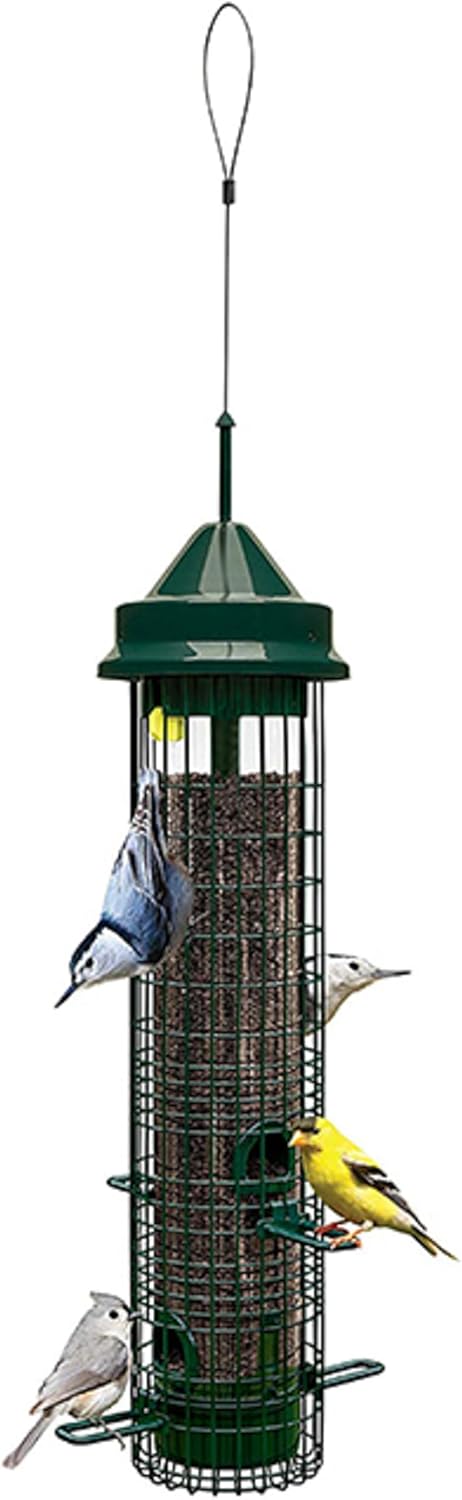
Best Overall: Squirrel Buster Classic Squirrel-Proof Bird Feeder
This is the feeder I would hang first. The Classic holds 2.4 pounds of seed across four feeding ports, and that capacity is the number I want you to think about. A small hopper is not a compromise in a small yard. Seed that sits for three weeks in humid air clumps and molds, and a feeder you dread emptying is a feeder that eventually sits empty while the birds move down the street to somebody else's pole. Four ports will host chickadees, nuthatches, house finches, and the occasional cardinal at the same time, and a tube suits the clingers in your yard as well as the perch birds.
The squirrel mechanism is a shroud that drops when weight lands on it, which is the design I trust more than any cage. My three-week fox squirrel test is the gate every feeder has to pass, and weight-activated ports are what pass it. The listing says squirrel-proof. I say squirrel-resistant for the first three weeks and squirrel-proof after, and that is not a small distinction.
Then there is cleaning, which is where tube feeders are usually a disappointment. The base comes off and the whole tube goes in the sink, which matters more to me than any claim printed on the box. Wash it in a bleach solution every couple of weeks, and more often in wet weather.
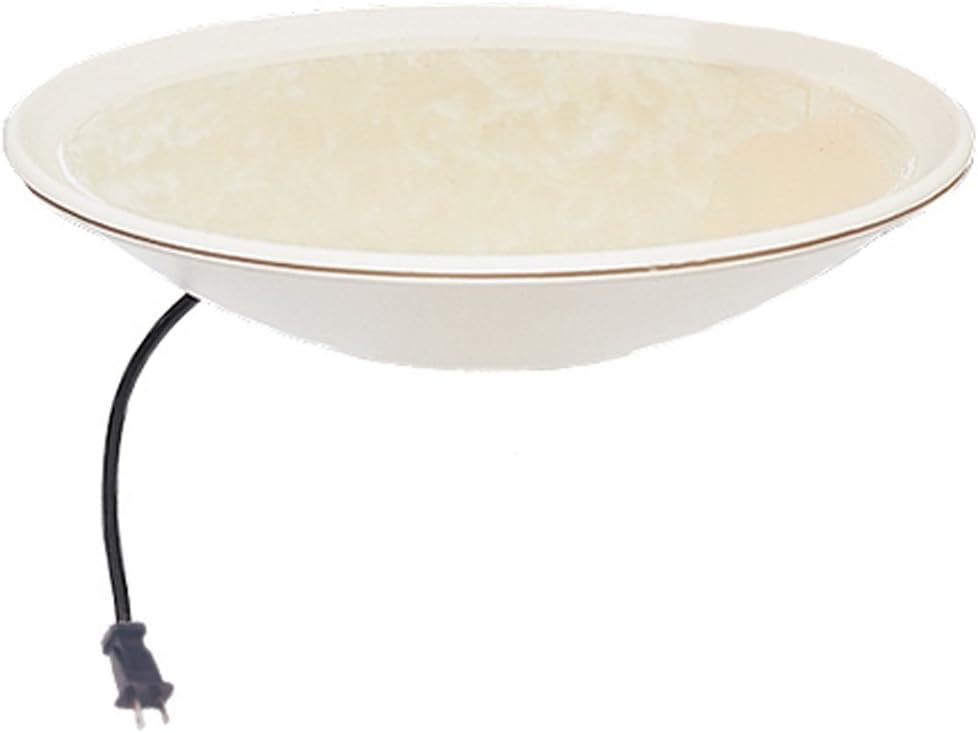
Best Water Source: Allied Precision Industries API 600 Heated Bird Bath Bowl
This is the piece that brings in species which never touch a seed feeder, and it is also where most people stop short. Read the listing carefully: this is the 20-inch bowl on its own, in light stone, with no stand in the box. Budget the mount before you buy the bowl, or plan to set it on a deck rail bracket you already own. A bowl that arrives with nowhere to sit is how a good idea turns into a return.
A bowl this wide gives a flock room to queue up and bathe without jostling, which is how you end up with several birds in the water at once instead of one nervous one that flies off at the first splash. Heated water is the entire point in January, when everything else in the yard is frozen solid.
Before you buy any heated bath, including this one, check two specs: the wattage and the thermostat. A bath that runs hot in a mild December is a hazard with a cord attached, not a feature, and I will not recommend one without seeing both numbers. Keep it as clean as you keep a feeder. A bath that grows algae is a disease vector with a nice stone finish, and the birds will tell you by staying away.
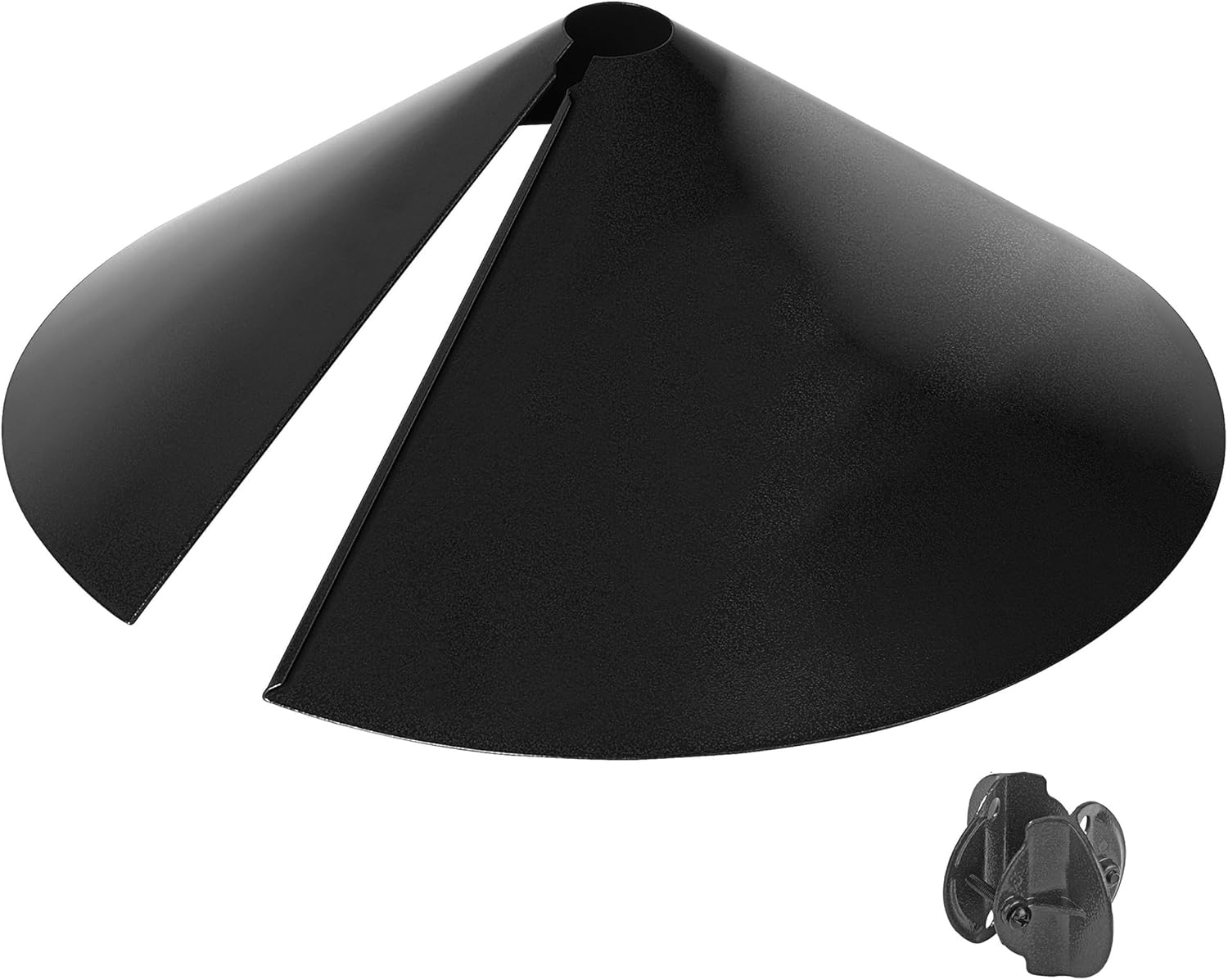
Best Squirrel Deterrent: More Birds Squirrel-X Wrap Around Baffle
The Squirrel-X is an 18-inch metal wrap that mounts around a pole below the feeder. The logic is simple: a squirrel has to climb the pole, and a baffle turns that pole into a surface with nowhere to grip. It is the least glamorous piece in the setup and the one that decides whether your seed budget goes to birds or to squirrels.
Here is the part nobody puts on the box. A wrap-around baffle only works on a pole with clear air around it. If a fence, a shed roof, a low branch, or an overhanging gutter puts a squirrel within jumping distance of the feeder itself, the baffle is decoration. Walk your setup before you buy, and look up as well as across. Then check the mounting height. A baffle set too low is a step stool, and a baffle mounted with a gap underneath leaves a climbing lane.
Clean beneath it too. Baffles catch hulls, hulls hold moisture, and a wet pile of sunflower shells at the base of the pole is exactly the kind of thing that grows mold by week three. Sweep it or hose it, then let it dry.
Best Window Seat: SUNALLY Window Bird Feeder
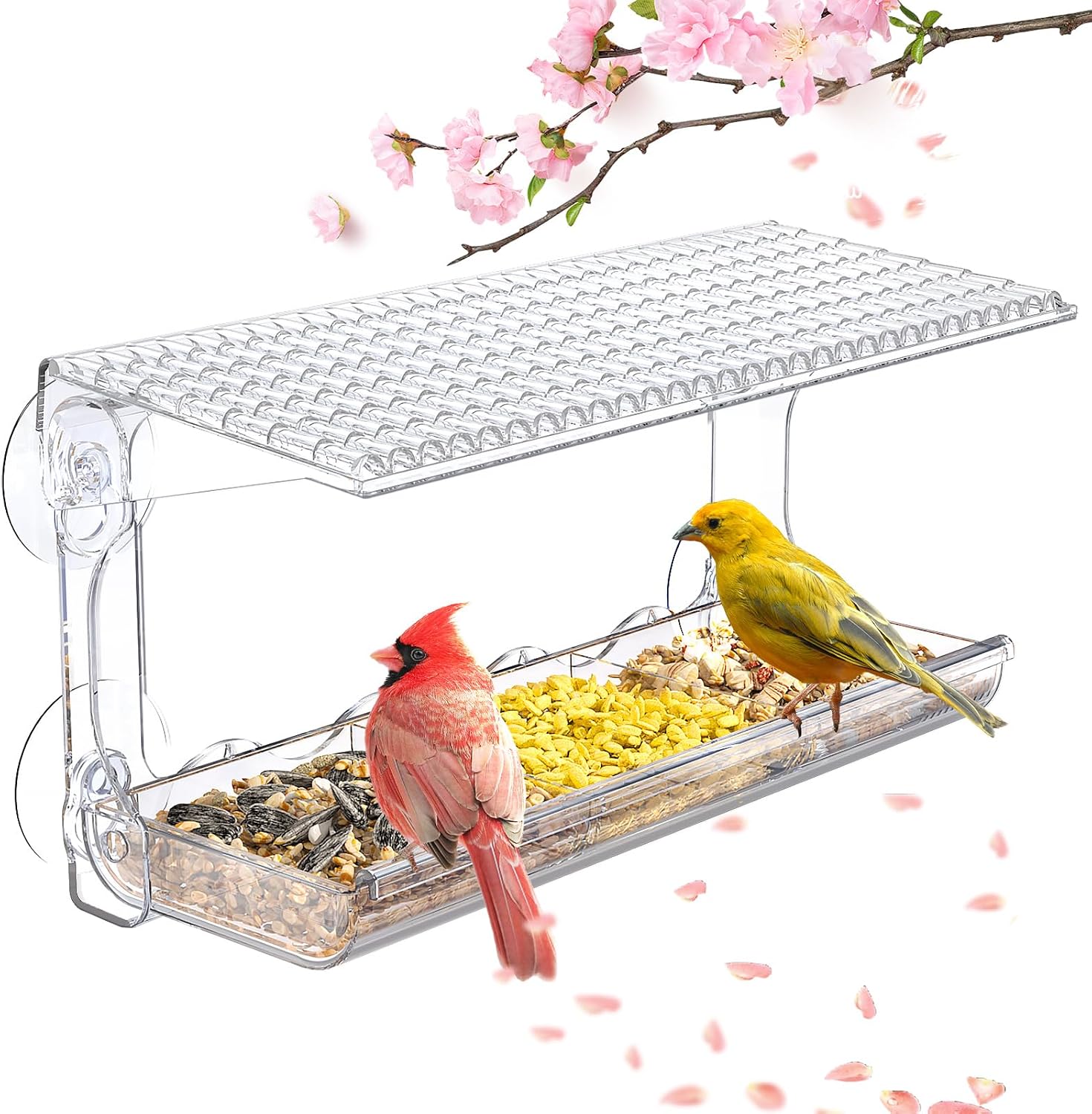
A clear window feeder does something no pole feeder can: it puts birds at arm's length of the kitchen table. This one mounts directly on the glass so you can watch from inside, and for anyone who works from home, or who has a kid who needs a reason to look up from a screen, it earns its spot fast. It is also the easiest feeder in the setup to check on, because you are already looking through the glass it hangs on.
Placement is the whole game, and it is also a safety rule. Mount it within three feet of the glass, not across the yard. Inside three feet, a bird leaving the perch cannot build up the speed that makes a window strike fatal. My white-throated sparrow taught me that lesson the hard way, and every window feeder I hang now hangs at that distance.
The honest caveat is the suction mount. I have watched a suction-cup window feeder let go in a Wisconsin January, and I do not trust any of them through a hard freeze. Treat this as a three-season feeder. Pull it before the first hard freeze, store it indoors, and hang it again in April when the migrants come through. In a mild climate, ignore that advice entirely.
The backyard bird feeding setup reference table
This is the table I keep in the same file as the log. It is sorted by the job each piece does, not by how it looks on a pole. Read the last column before you buy anything, because that is where most setups go wrong.
| Product | Job in the setup | Best placement | What it will not fix |
|---|---|---|---|
 Visit on Amazon → Visit on Amazon →Squirrel Buster Classic |
Main seed feeder | On a pole, baffle below it | A squirrel dropping in from a roof edge |
 Visit on Amazon → Visit on Amazon →More Birds Squirrel-X baffle |
Blocks the pole climb | Wrapped on the pole below the feeder | A squirrel that jumps from a fence |
 Visit on Amazon → Visit on Amazon →Allied Precision API 600 bowl |
Open water, heated | Deck rail or pedestal stand, sold separately | Having nothing to mount it on |
 Visit on Amazon → Visit on Amazon →SUNALLY window feeder |
Close viewing from indoors | On glass, within three feet of the glass | Winter ice, because suction is a three-season mount |
How I test
Every piece in this setup went through the same five questions I ask of any bird product. Will birds actually use it, or will it sit pretty on the pole? Can I take it apart and clean it in under ten minutes? What does a determined fox squirrel do to it in week one? Will it survive a Wisconsin February, freeze, thaw, freeze? And would I still hang it after four seasons?
The squirrel question is the one that takes the longest, because the answer is measured in weeks. No feeder gets the word proof from me without three weeks of fox squirrel attempts and an entry in the log. The cold question is the one that eliminates the most gear. Suction mounts, thin plastic, and anything with a cord that runs hot in a mild spell all fail it. Everything above made it through.
Should you buy the Squirrel Buster Classic?
Yes, if squirrels are the reason you stopped filling feeders. Four ports and a 2.4-pound capacity suit a small yard, the weight-activated shroud is the mechanism I trust most, and the tube comes apart for washing. The capacity is modest, so if you feed a crowd in a big yard you will refill it often. In a normal backyard, that is a feature rather than a flaw.
Should you buy the Allied Precision API 600 bowl?
Yes, if you want the species that never touch seed to show up. Moving water is the single highest-return piece in a yard, and a wide heated bowl keeps it open when everything else is frozen. Buy the stand at the same time, and check the wattage and thermostat before it arrives, not after.
Should you buy the More Birds Squirrel-X baffle?
Yes, if your feeder hangs from a pole with open air around it. An 18-inch wrap is a real physical barrier on a climbable pole, and it costs less than a season of stolen seed. Skip it if a squirrel can reach your feeder from a fence, a roof, or a branch. Metal does not fix geometry.
Should you buy the SUNALLY window feeder?
Yes, if you want birds close enough to see feather detail without binoculars, and if you will honor the three-foot rule. It is the friendliest feeder in the setup for kids and for anyone who spends the day at a desk near a window. Plan to take it down for winter, and it will last for years.
Order the pole feeder and the baffle first if squirrels are eating your seed. Order the bath first if they are not. Then log what shows up, because the log is what tells you whether any of it is working.