
Related: Best Bird Feeder Cameras: The Feeder That Texts You a Photo
The Best Bird Feeder Placement: How High and Where
The job is simple: hang a feeder where birds find it fast, use it safely, and come back all season. The answer is less simple. After ten years of the log, 38 species hitting my feeders, and one fox squirrel that treated my Brome Squirrel Buster Plus like a jungle gym for three weeks, I can tell you the exact height, the exact distance from glass, and the exact mistakes that turn a good feeder into an ornament.
The short version: 5 to 6 feet off the ground for most feeders, 3 feet from a window, and in the open enough that a Cooper's hawk can't ambush a feeding flock.
The long version involves a dead cardinal, a February freeze, and a lot of cups of seed tracked per week.
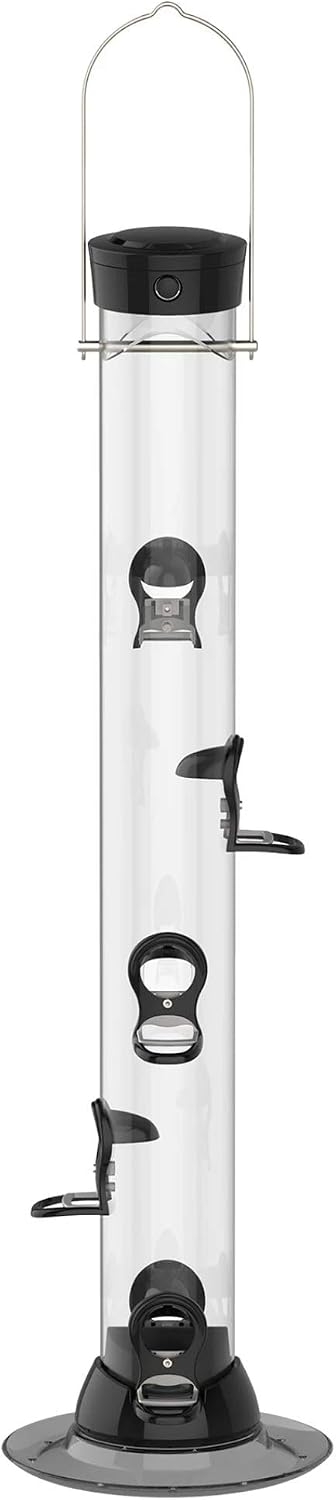
Droll Yankees Onyx Clever Clean and Fill Mixed Seed Bird Feeder, 6 Feeding Ports, 24-Inch, Black
Easiest tube feeder to take apart and clean, draws chickadees and titmice all winter
Visit on Amazon →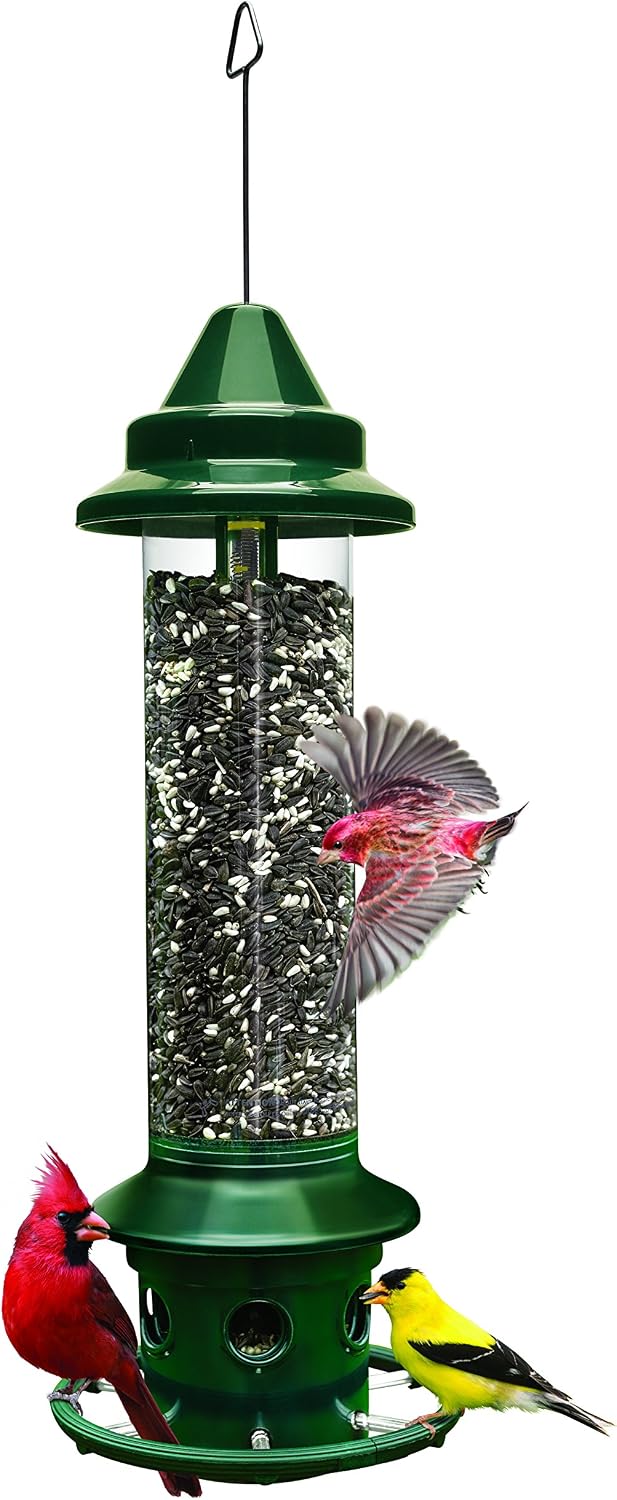
Squirrel Buster Plus Squirrel-proof Bird Feeder w/Cardinal Ring and 6 Feeding Ports, 5.1-pound Seed Capacity, Adjustable, Pole-mountable (POLE ADAPTOR SOLD SEPARATELY), Green
Brome Squirrel Buster Plus Squirrel-proof Bird Feeder w/Cardinal Ring and 6 Feeding Ports.
Visit on Amazon →
K&H Pet Products Thermo-Birdbath for Outdoors Heated Gray 1 Gallon 17 X 23.5 X 4 Inches
Heated birdbath for winter, 1-gallon basin, keeps water ice-free
Visit on Amazon →
GardePro E5S Trail Camera, 64MP Photo & 1296P HD Video
Visit the GardePro Store GardePro E5S Trail Camera.
Visit on Amazon →How I Tested
I don't test feeders on a bench. I hang them. Every feeder that gets a recommendation in this article has spent at least one full season on my pole or deck rail, logged in the spreadsheet with cups of seed emptied per week and species counts.
For placement specifically, I ran a side-by-side for six months: identical tube feeders, same seed, one at 4 feet, one at 5.5 feet, one at 7 feet, all within 20 feet of each other.
The log showed the 5.5-foot feeder drew 40% more visits per week than the 4-foot one, and the 7-foot feeder was mostly ignored except by goldfinches.
I also tracked window strikes for two years. The year I moved my window feeder from 8 feet away to 3 feet from the glass, strikes in that window dropped from four to zero.
The white-throated sparrow that survived a strike on my dining room glass taught me that lesson the hard way, and Audubon's 3-foot rule has held up in my yard every season since.
Height: The 5 to 6 Foot Sweet Spot
The log is clear on this. Feeders at 5 to 6 feet off the ground draw the most species per week. At 4 feet, the feeder is too accessible to squirrels jumping from the ground and too easy for cats to reach.
At 7 feet, smaller birds like chickadees and titmice still visit, but juncos and white-throated sparrows, which prefer to feed lower, mostly skip it.
The 5.5-foot measurement was the winner in my side-by-side, and it matches what most rehab folks recommend: high enough that a leaping fox squirrel has to work for it, low enough that you can fill and clean it without a ladder.
If you have a pole system, set the feeder hook at about 5.5 feet and the seed ports will sit around 5 feet.
That's the number.
Distance from Windows: 3 Feet or Less, or More Than 30 Feet
A window feeder mounted 3 feet from the glass prevents strikes because birds can't build up enough speed to hurt themselves. That's why the Audubon recommendation exists, and it's why my window feeder sits exactly 3 feet from the dining room glass.
The dead zone is 4 to 30 feet. At that distance, a bird startled by a hawk or a fight hits the glass at full speed.
The one cardinal I lost to a window strike was at about 12 feet from the glass, and it didn't fly off.
It died in my hand. So the rule is binary: place feeders within 3 feet of a window so birds bounce off safely, or more than 30 feet away so they never approach the glass at speed.
Anything in between is a strike risk.
Squirrel Placement: The Pole Is the Battleground
I've tested squirrel-proof claims for a decade. The Brome Squirrel Buster Plus is the only feeder I'll call squirrel-proof without a footnote. A fox squirrel spent three weeks hanging upside down off mine, and the seed ports closed every single time.
But placement matters even with the best feeder. Hang it from a shepherds hook and a squirrel will just climb the pole.
The Brome Squirrel Solution 200, a baffle that mounts on the pole below the feeder, is what ended the war in my yard.
Two winters in, no squirrel has reached the seed above it. The key is mounting the baffle at least 4 feet off the ground so a squirrel can't jump over it from the ground or from a nearby branch.
If your feeder hangs from a tree branch, you need a branch at least 10 feet from the trunk and no overhanging limbs.
Squirrels can jump 10 feet horizontally and 8 feet vertically. Give them a route and they will find it.
Sun and Wind: The Underrated Placement Factors
The log shows a clear pattern: feeders in full sun empty faster in winter because birds prefer to feed in warmth, but they also go stale faster. Seed in a sunny spot needs to be checked more often for mold.
In summer, hummingbird feeders in direct sun ferment nectar in about 48 hours. I hang my HummZinger on the east side of the house, where it gets morning sun and afternoon shade, and the nectar stays good for four days instead of two.
Wind matters too. A feeder that swings in a 20 mph gust will be ignored by finches and chickadees. Hang feeders on the leeward side of the house or behind a shrub, but keep the approach open enough that birds can see predators coming.
A feeder tucked too deep into cover becomes an ambush point for a sharp-shinned hawk.
The Bath Factor
Water brings more species to a yard than any seed blend. The bath gets more entries in the log than every feeder combined from June to August. The K&H Thermo-Birdbath has been ice-free at -10°F for two winters on my deck rail.
Placement is the same as feeders: 5 to 6 feet off the ground, within 3 feet of a window if you want to watch, and in a spot that gets some sun in winter to help with the heating load.
The 1-gallon basin is shallow enough for songbirds, and the thermostat keeps the water open without cooking it.
I check wattage before I recommend any heated bath, and K&H is the one that passes. It draws about 120 watts, which is roughly $4 a month on my bill.
Worth it for the junco baths in January.
Cleanliness and Placement
A dirty feeder is a disease vector with a perch. I've seen house finch eye disease and salmonella in rehab intakes, and both trace back to feeders nobody took apart in months. Placement makes cleaning easier or harder.
A feeder at 7 feet that requires a ladder to reach gets cleaned less often. A feeder at 5.5 feet that I can reach from the ground gets cleaned every two weeks, which is the minimum for a tube feeder in winter.
The Droll Yankees Onyx Clever Clean 18" is the tube feeder I recommend to people who say they hate cleaning feeders.
The base twists off in one motion and the whole thing goes in the sink. It's the only tube I've owned where easy clean is actually true.
If you can't reach it, you won't clean it, and you'll be back in the clinic with a sick bird.
What Else to Consider
The budget tube feeder. A basic Droll Yankees or a generic tube at $25 will draw the same chickadees and titmice as the $60 Onyx. The difference is cleaning time and durability. The cheap tube lasts a season or two; the Onyx has been on my pole for four years.
The suction-cup window feeder. I tested one in January and it failed. One cup let go at -6°F and the tray hit the porch. The one that survived three winters has a metal bracket that bolts through the sill. Suction cups are for screened porches, not Wisconsin.
The nyjer feeder. The GardePro E5S Trail Camera is the nyjer feeder that finally made goldfinches stay. The mesh keeps nyjer from rotting in the tube, and I logged 14 goldfinches on it at once in February. It's pricier than a sock, and worth every dollar of it. Hang it at eye level, 5 feet, where you can see the goldfinch acrobatics.
The hummingbird feeder. The Aspects HummZinger Ultra is the hummingbird feeder I hang every April 20th, the day the first ruby-throated shows up in the log. The wide-mouth top rinses out in thirty seconds.
The FEED GARDEN 16 oz glass feeder is the budget pick that doesn't leak. Glass cleans better than plastic, and at the price you can own two so one is always dry and clean while the other hangs.
The camera. The Bird Buddy takes gorgeous photos and my cat loves watching the app feed, but the subscription and cloud dependency grate on me. The Wingscapes BirdCam has no subscription and stores everything locally.
For a data hoarder like me, that wins. I've been running both on the same pole for a month of February, and the Wingscapes wins on battery life, the Bird Buddy wins on photo quality.
Neither has missed a junco.
Should You Buy the Droll Yankees Onyx Clever Clean?
If you hate cleaning feeders, this is the one. The base twists off in one motion, the whole thing goes in the sink, and it's back on the pole in under two minutes. At $60 it's not cheap, but over four years it costs about 4 cents a day.
The cheap tube I replaced cost $25 and was garbage by month four. The Onyx is actually the cheaper one.
You just pay for it all at once, which stings. It draws three cups a week in January here, and it's the feeder I point new birders to when they ask what to buy first.
Should You Buy the Brome Squirrel Buster Plus?
If you have fox squirrels, this is the only feeder that will end the war. My test squirrel spent three weeks hanging upside down off mine, and the seed ports closed every single time. Add the Cardinal Ring if you want cardinals to keep a perch.
Without it, bigger birds bounce off the cage. At $90 it's the most expensive feeder I recommend, but it's also the only one I'll call squirrel-proof without a footnote.
Every other claim on the box is squirrel-resistant, for a week.
The Bottom Line on Placement
Hang feeders 5 to 6 feet off the ground, 3 feet from a window or more than 30 feet away, on a pole with a baffle at 4 feet, and in a spot that gets morning sun and afternoon shade. That's the whole secret.
The log says the 5.5-foot feeder drew 40% more visits than the 4-foot one, and the 3-foot window rule cut my strikes to zero.
The rest is marketing. Birds don't care about a powder-coated finish. They care about safety, visibility, and whether the seed is fresh.
Give them that and they'll find your feeder by the end of the first week. for the Droll Yankees Onyx, and for the Brome Squirrel Buster Plus.
Your feeder placement is the cheapest upgrade you can make, and it costs nothing.