Most feeders fail for reasons that have nothing to do with the feeder. The pole is in the wrong place, the seed is padded with filler nobody eats, or the thing has not been taken apart since October. A backyard bird feeder setup is really three decisions in a row, and the product is the last of them.
I have fed backyard birds for twelve years and kept the log for ten of them. The log is a spreadsheet: every species that visits, first-of-season dates, and how many cups of seed each feeder draws per week. Ten years of cups and grams decides every recommendation I make. Not the powder-coated finish. Birds do not care about a powder-coated finish.
This is how I would build a two-feeder station from scratch: one window feeder for close viewing, one large hanging feeder to carry the winter volume. Placement first. Product second.
Why you should trust me
I am a licensed wildlife rehabilitator in Madison, Wisconsin. I work part time at a small animal clinic and run the songbird side of a county wildlife rescue out of my garage, which means the incubator lives in the laundry room and the scale lives on the kitchen counter. My county life list sits at 214 species, and 38 of them have hit my feeders.
Feeder hygiene is not a hobby for me. Every salmonella case that has come through intake traced back to a feeder nobody took apart in months, and house finch eye disease works the same way. So when I say a feeder is easy to clean, that is the highest compliment I hand out. When I say it is not, believe me the same way.
I also let fox squirrels work on a feeder for three weeks before I write a word about squirrel resistance. If a squirrel reaches seed once, my write-up says resistant, not proof. That standard applies to everything below.
How I chose these two feeders
Every feeder in my yard has to pass five questions before it earns a spot on the fence:
- Will birds actually use it, or will it sit pretty on the pole?
- Can I take it apart and clean it in under ten minutes?
- What does a determined fox squirrel do to it in week one?
- Will it survive a Wisconsin February, freeze, thaw, freeze?
- Would I still hang it after four seasons?
The two feeders below are the pair I would buy for this station today, judged against those five questions and against what the log says about how a feeder actually gets used. One hangs on glass and puts birds eighteen inches from your coffee. One hangs from a bracket and holds enough seed that you are not refilling in a snowstorm.
They are not the same tool and they are not interchangeable. That is the point.
Start at the window, not the pole
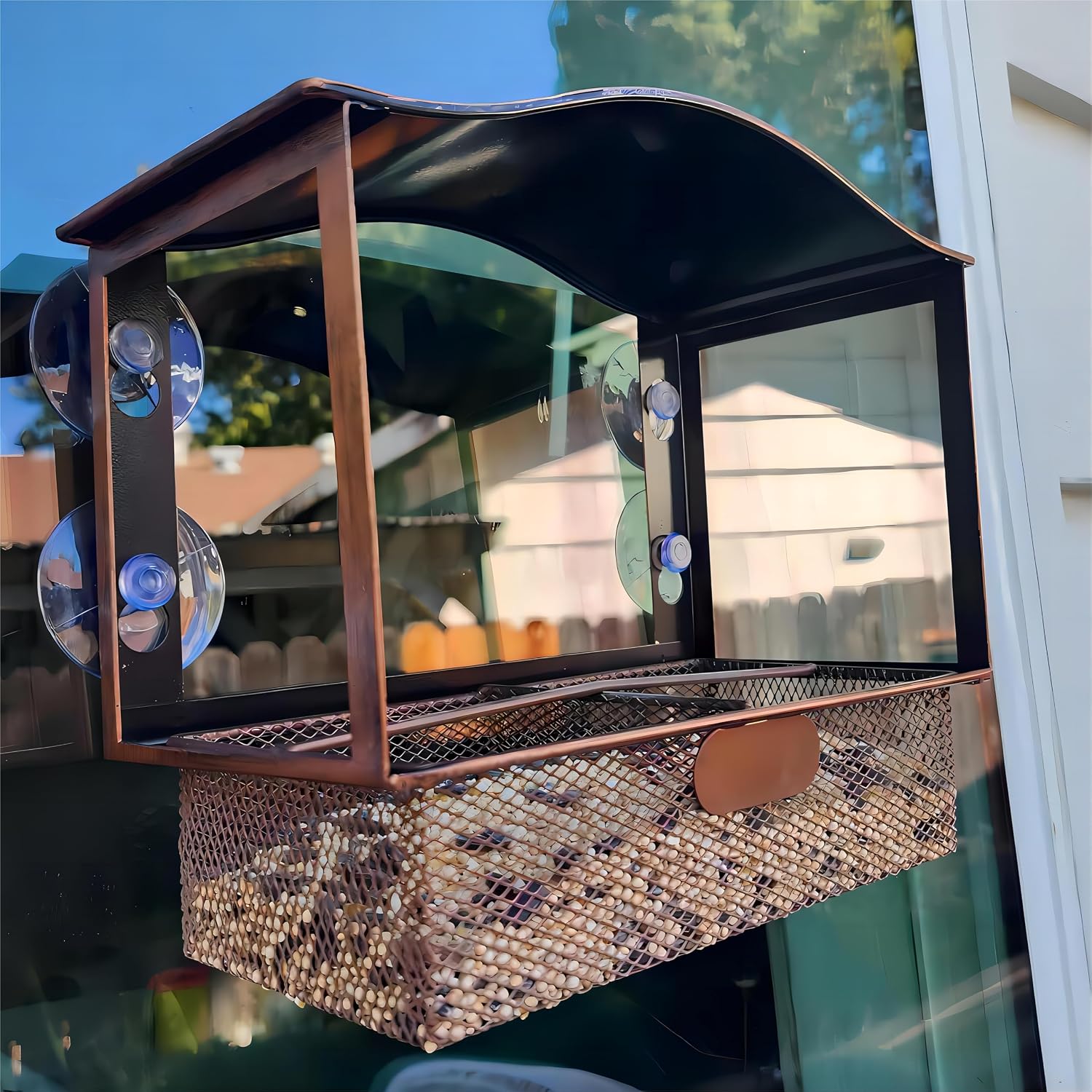
Best for close viewing: Lilyang Window Bird Feeder with Strong Suction Cups
 Visit on Amazon →
A window feeder is the best birding tool you can hang for the price of a bag of seed, and the reason is distance. At a window you are not identifying a silhouette forty feet out through dirty binoculars. You are watching a chickadee take one seed, fly to the lilac, hull it, and come back for another. That round trip is the entire education, and it happens about three feet from your face.
Placement matters more than the model. Mount it within 3 feet of the glass. Inside that distance a bird leaving the feeder cannot build enough speed to hurt itself on the window, which is the whole reason I hang a window feeder at all. I learned that from a white-throated sparrow that hit my dining room glass and spent three days recovering in a shoebox. Hang the same feeder 10 to 15 feet from the glass and you have built a launch pad into the strike zone.
The cups are the weak point of any suction design, and I say that as someone whose January tray let go at minus six and hit the porch. Treat the mount as maintenance, not as installation. Wipe the glass clean before you press the cups on, press from the center outward, and check them every few days once the temperature drops below freezing. Install on a mild afternoon rather than a cold morning, because the seal takes better when the glass is not already stiff with cold. If your window swings forty degrees between sun and shade all day, plan on re-seating the cups.
Flaws but not dealbreakers: The tray is small, so it is a one or two bird at a time feeder, and the seed gets wet in blowing rain unless you have an overhang. Neither bothers me at a window, where the draw is measured in a handful of cups a week, not in gallons.
Anyone who wants to learn bird behavior up close, or who has a kid who will sit still for ten minutes, gets more out of this than out of any feeder on a pole.
The hanging feeder that carries the winter
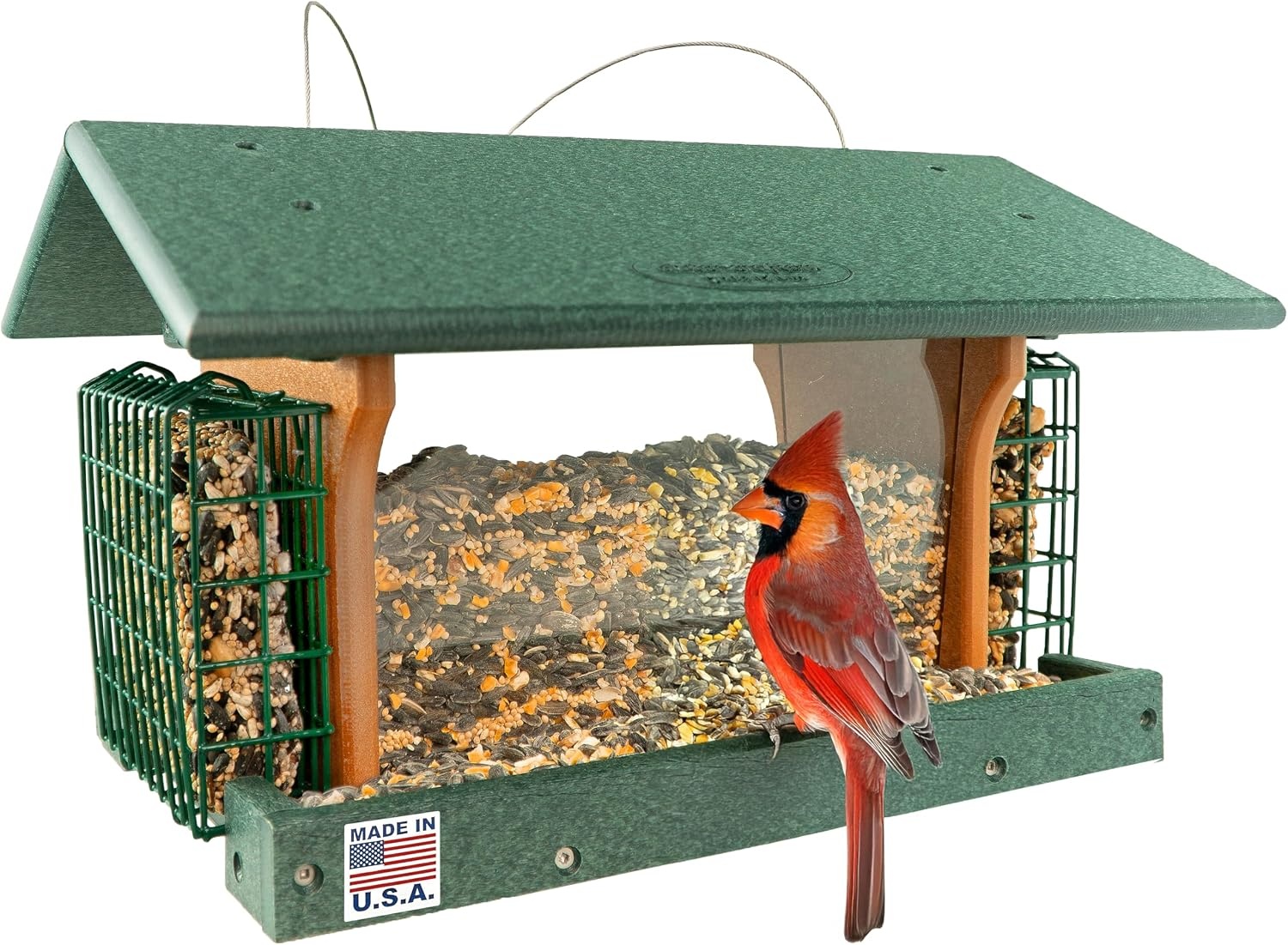
Best for volume and suet: DutchCrafters Poly Hanging Large Hopper Bird Feeder with Two Suet Cake Holder Cages, Durable Long Lasting Outdoor Bird Feeder - Amish American Made in USA (Turf Green & Cedar)
 Visit on Amazon →
A hopper is volume. It gives perch birds a stable tray to land on instead of a perch they have to balance on, and the birds in my log that care about that most are cardinals, house finches, grosbeaks, and jays. It also means one fill carries you through a week of January instead of one morning.
The two suet cages on the sides are the part I would pay for. Suet cages are built for clingers, and woodpeckers, nuthatches, and chickadees feed hanging sideways or upside down, which is exactly what a cage allows and a flat tray does not. Downy and hairy woodpeckers find a fresh suet cake within the first week of every winter in my log, and a cage that holds the cake off the floor keeps it out of the wet.
Poly lumber is the right material for something that hangs outside all four seasons. Recycled poly does not rot, does not splinter, and does not care about the freeze, thaw, freeze cycle that cracks cedar and warps cheap pine. It is heavier than wood, and that matters at hanging time. Check the capacity of your bracket or pole hook before you lift it, and plan on a baffle above or below.
The honest caveat on any hopper is what is sitting at the bottom of it. Large capacity means seed sits longer, and seed that sits in humidity cakes and molds. Fill it to what the birds clear in a week, not to the top because it looks tidy, and empty it completely before you clean it.
On squirrels: hang this 8 to 10 feet from the nearest branch or fence line, 5 to 6 feet off the ground, with a baffle, and it is squirrel-resistant. There is no squirrel-proof hopper. I let fox squirrels work a feeder for three weeks before I call anything proof, and almost nothing survives that test.
Flaws but not dealbreakers: It is heavy, and the hanging hardware is on you. Also, a hopper with two suet cages is a lot of food in one spot, so if you have never cleaned a feeder on a schedule, this is the one that will teach you.
Anyone feeding through a real winter, or anyone whose seed bill says they are already filling a tube every other day, will get the most out of this.
The actual setup workflow
Step one: pick the window. South or east facing if you can get it, near the chair where you actually sit, and within 3 feet of the glass. If the window is more than 3 feet from where you want the feeder, either move the feeder or accept the strike risk. Those are the only two options.
Step two: mount the window feeder. Clean the glass, press the cups on from the center outward, and give it a firm hold before you walk away. Fill it with a small amount of seed, not a full tray, because a half-empty tray you refill often stays fresher than a full one that sits.
Step three: choose the hopper location. 8 to 10 feet from anything a squirrel can launch from, 5 to 6 feet off the ground, and in sight line with the same chair as the window feeder. If it is not visible from where you drink your coffee, you will not watch it, and if you do not watch it, you will not notice the mold.
Step four: seed. Black oil sunflower or sunflower hearts, and read the ingredient list before you buy anything else. Milo and red millet are automatic disqualifiers in my house, because filler gets kicked to the ground, molds in the rain, and makes you clean the platform twice as often. If you have a deck or an HOA, a no-mess blend costs more per pound and buys you quiet.
Step five: water. From June to August the bath gets more entries in the log than every feeder combined. A shallow basin with a rough landing edge beats a deep one. In winter, a heated bath keeps water open, but check the wattage and the thermostat before you trust it. A bath that runs hot in December is a hazard, not a feature.
Step six: suet. Load the cages in October and keep them loaded through March. If you render your own, peanut butter and mealworms mixed into the cake is the version the woodpeckers clear fastest.
Step seven: clean on a schedule. Once a week, take the feeders apart. Hot soapy water on everything, a dilute bleach soak on anything that smells like a cellar, a full rinse, and a complete dry before it goes back up. A hose spray is not cleaning. A dirty feeder is a disease vector with a perch.
Step eight: write it down. Cups per week per feeder, and first-of-season dates. The draw number tells you whether the seed is right. If a feeder empties slowly, the problem is usually the location or the blend, not the birds.
What this setup does not cover
Two feeders is a station, not a yard. Nyjer feeders for finches, nectar feeders for hummingbirds, and camera feeders are all separate decisions with their own rules, and each one has a hygiene requirement that is stricter than a seed feeder. Water is the one thing I would add before a third feeder, because it brings in species that never touch seed.
What this all costs
Both feeders are listed at Check current Amazon price. The purchase is the cheap part.
Seed is the recurring cost, and cheap seed is the most expensive seed you will buy. Filler sits in the tray uneaten, molds in the rain, and sends you out to scrub a platform you would not have had to scrub if you had bought hearts in the first place. A 40 pound bag of sunflower hearts costs less per pound than small bags and leaves zero hull litter under the feeder, which matters if you have a deck or a neighbor with opinions.
The other recurring cost is your time, and it is not optional. Twenty minutes a week, taken apart, dried, back up. Over four seasons that is the difference between a station the birds use and a station that quietly makes them sick.
Do the placement first, buy the two feeders, and start the log on the day you hang them. The first-of-season date you write down in April is the entry you will still be reading in ten years.