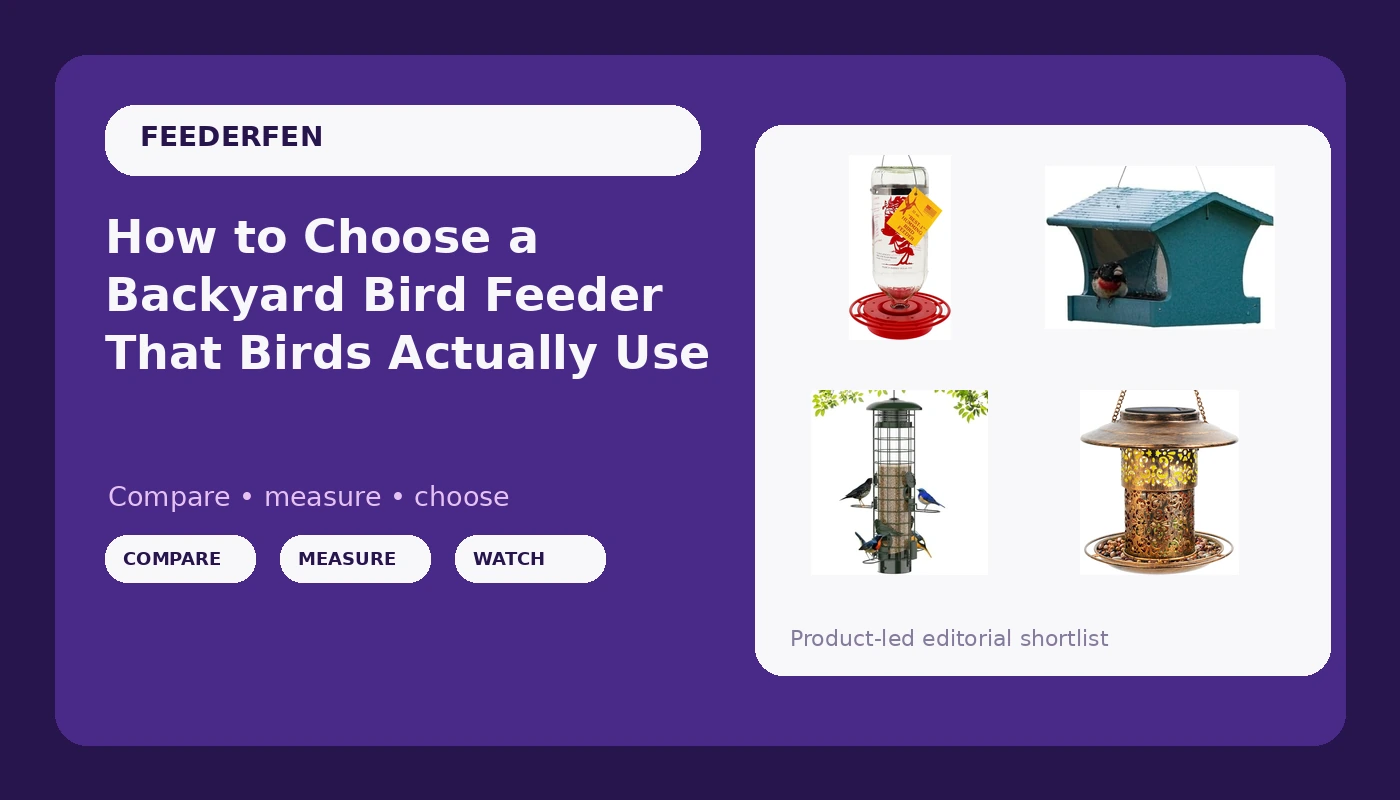
Backyard bird feeders are one of the few pieces of outdoor gear where the listing copy and the reality drift apart fast. A product page promises squirrel-proof and no-mess; the feeder on your pole does something else. After twelve years of feeding birds and ten years of keeping a log of what shows up, I have learned that the useful questions are narrower than the box suggests: what does it hold, who can reach it, and how long does it take to take apart on a Sunday morning. This explainer covers the four backyard bird feeders most people end up choosing between, plus the specs that actually change your week.
Related: Squirrel-Resistant vs Squirrel-Proof: What Those Words Actually Mean →
Quick answer
Match the feeder to the food first, then to the pressure. A hopper holds mixed seed and sunflower for cardinals, finches, and jays, and keeps a lot of seed visible at once. A metal mesh feeder is the shape that suits clinging birds and is the more honest answer to squirrel pressure. A clear nectar reservoir is a hummingbird feeder and nothing else. A decorative metal hanging feeder covers the yard where someone wants the feeder to earn its place as garden decor. Capacity matters less than draw: a 3 lb feeder that empties in four days teaches you more than a 20 lb feeder that sits and molds.
Four useful options
| Model | Best fit | What stands out |
|---|---|---|
| Birds Choice Medium Hopper Bird Feeder | 3lb Capacity | Lake Blue | All-purpose seed feeding | 3 lb capacity, covered hopper design, lake blue finish |
| Squirrel Proof Bird Feeder, Metal Mesh Bird Feeders for Outdoors Hanging | Squirrels and clinging birds | Metal mesh body, gravity-based protection, 3 lb capacity |
| Birds Choice Best-1 Hummingbird Feeder | 32oz Nectar Capacity | Clear | Nectar feeding | 32 oz nectar capacity, clear reservoir |
| DY-SKTY Metal Bird Feeder for Outdoor Hanging | Decorative hanging feeder | Metal body, drainage holes, landing ring, solar light |
Everyday seed feeder: Birds Choice Medium Hopper Bird Feeder
The trade-off with any hopper is the tray. Seed that sits in an open tray gets rained on, and wet seed is where mold starts. A 3 lb capacity means you refill more often than you would with a big platform, but that is not automatically a downside: a feeder you refill every few days is a feeder you look at every few days, and you notice when the seed clumps or the hulls pile up. Hoppers also reward good seed. Fill one with a cheap blend padded with milo and red millet and you will be scooping the sorted-out filler off the tray all season.
Squirrel-resistant option: Squirrel Proof Bird Feeder, Metal Mesh Bird Feeders for Outdoors Hanging
The phrase on this listing is squirrel proof, and that phrase deserves a footnote. Squirrel proof is a marketing word; squirrel resistant is a real thing, and the difference is measured in weeks, not in the claim on the box. My own rule is that no squirrel claim counts until a fox squirrel has had three weeks to work on the feeder, and I have watched enough of them hang upside down by one hind foot to be skeptical of anything that has not been through that. What the mesh design does have going for it is structural: metal survives teeth and freeze-thaw cycles that thin plastic does not, and mesh is the shape clingers like chickadees and nuthatches prefer anyway. Pair it with a baffle on the pole and treat the label as a starting point.
Nectar feeder: Birds Choice Best-1 Hummingbird Feeder
Nectar is the highest-maintenance food you can hang, which is why a clear reservoir matters more than it sounds. You can see the level drop and see when the liquid goes cloudy, and cloudy nectar means it is time to rinse, not top off. Sugar water ferments in heat, so a 32 oz capacity is a two-edged spec: fewer refills, but more volume to dump if the feeder sits in July sun. Make it with plain white sugar and water, one part to four, and skip the red dye, which is unnecessary and is not doing the birds any favors. The one thing I check before recommending any hummingbird feeder is how fast it comes apart, because a feeder that is a chore to clean becomes a mold experiment by August.
Decorative pick: DY-SKTY Metal Bird Feeder for Outdoor Hanging
Drainage holes are the quiet feature worth pointing out here. In a Wisconsin October, a tray without drainage is a tray full of wet seed by the second rain, and wet seed is a cleaning job. Holes in the base let water out instead of letting it soak in. The solar light is a decoration feature, and it needs sun to do its job, so plan the hanging spot with that in mind rather than tucking it under a maple. As a gift, this is the one on the list that does not require the recipient to already own a pole, a baffle, or a seed budget, which is exactly why it ends up in the "for someone else" column.
Prices and availability may change. Product images, names, and retailer links are matched to verified listings. No current price, rating, stock status, or measured result is stated here without current evidence.
What the specs actually tell you
Capacity is the number every listing leads with, and it is the least useful one on its own. A 3 lb feeder and a 20 lb feeder tell you nothing until you know how fast the seed goes. In my log, cups per week is the number that decides whether a feeder is a convenience or a chore: a feeder that empties in four days is being used, and a feeder that empties in three weeks is either in the wrong spot or full of seed the birds are sorting through.
Port and body design come second. Perch birds like cardinals, house finches, and sparrows need something to sit on, which is what a hopper tray or a landing ring provides. Clinging birds like chickadees, nuthatches, and woodpeckers will hang sideways or upside down and do not need a perch at all. A mesh body is built for that second group. If you want both in one yard, hang two feeders rather than buying one that does neither well.
Material matters more here than in the product photos. Metal mesh and metal bodies survive freeze-thaw cycles and squirrel teeth better than thin plastic. Glass reservoirs rinse cleaner than plastic ones, which matters most for nectar, where sugar water and summer heat turn a dirty feeder into a mold experiment within days.
Then there is the squirrel mechanism. Weight-activated ports, cages, and baffles are all real approaches, and the words on the box are not the same as a result. A feeder can be well built and still get solved by a determined fox squirrel in week one.
Cleaning, and the parts nobody photographs
Every salmonella case I have seen come through rehab traced back to a feeder nobody had taken apart since fall. That is the whole argument for buying a feeder you can disassemble without tools and dry completely before it goes back up. Feeder cleaning that means a hose spray does not count; you have to get the tray out and reach the corners.
Nectar feeders carry the heaviest schedule. Rinse the reservoir every couple of days in summer heat, wash it fully at least weekly, and never top off a feeder that still has old liquid in it. Seed feeders want a weekly scrub with a dilute bleach solution, roughly one part bleach to nine parts water, followed by a thorough rinse and time to air dry. Tray feeders and hoppers collect hulls, droppings, and damp seed, which is exactly where mold starts. If you cannot get the tray out, you will not clean it as often as you should, and the log will show it: the feeder that gets skipped is the one that stops drawing birds.
- Decide what you are feeding: sunflower and mixed seed, nectar, or suet. That choice eliminates most feeders before you compare anything else.
- Count the birds you actually get. Watch for a week and note who lands, perch birds, clingers, or both.
- Assess squirrel pressure honestly. If fox squirrels work your pole daily, budget for a cage or weight-activated mechanism plus a baffle, not just a sturdier feeder.
- Check the cleaning path before you buy. Can you take it apart without tools, reach every surface, and dry it completely?
- Plan for February. Metal and glass hold up to freeze-thaw, drainage holes keep a tray from becoming an ice block, and a feeder you can fill with gloves on actually gets filled.
Placement, seed, and the winter question
- Hang window feeders within three feet of the glass, or push them out past thirty feet. The in-between distance is where birds build up enough speed to strike glass.
- Buy black oil sunflower or sunflower hearts. Filler like milo and red millet gets sorted onto the ground, molds, and buys you a second cleaning.
- Clean on a schedule, not when the feeder looks bad. Weekly in cool weather, more often in wet or hot stretches.
- Add water. From June through August, the bath outdraws every feeder in my yard combined.
- Keep feeding year round. Winter brings the juncos and the woodpeckers, and spring migration is when the yard gets loud.
Which option should you choose?
Choose the Birds Choice Medium Hopper Bird Feeder | 3lb Capacity | Lake Blue when you want one feeder that handles mixed seed and sunflower for the widest range of yard birds. Choose the Squirrel Proof Bird Feeder,Metal Mesh Bird Feeders for Outdoors Hanging,Gravity Protection Squirrel Proof Wild Bird Feeders with Finch Cardinal Chickadee,3LB Large Capacity,Green when squirrels are the limiting factor and you want a metal mesh body with a gravity-based protection mechanism, understanding that the phrase on the listing is a claim to verify in your own yard over several weeks. Choose the Birds Choice Best-1 Hummingbird Feeder | 32oz Nectar Capacity | Clear when you want a dedicated nectar feeder with a clear 32 oz reservoir you can check from the kitchen window. Choose the DY-SKTY Metal Bird Feeder for Outdoor Hanging, Large Capacity Solar light Wild Bird Feeder with Drainage Holes,Landing Ring, Solar Lanterns for Garden Decoration, Unique Bird Watching Gift for Outside when you want a hanging metal feeder that doubles as garden decor or as a gift for someone just starting out.
None of these four replaces placement, seed quality, and a cleaning routine. Capacity figures and squirrel claims are worth checking against your own yard, because a feeder that works on a sheltered deck and a feeder that works on an exposed pole in a squirrel highway are two different problems.
The bottom line
Start with what you are feeding and who is eating it, then buy the shape that matches. A 3 lb covered hopper is the everyday seed feeder for cardinals, finches, and jays. A metal mesh hanging feeder with a gravity-based mechanism is the answer when squirrels are the limiting factor, as long as you treat squirrel proof as a claim and not a guarantee. A clear 32 oz nectar feeder is the hummingbird feeder, provided you commit to rinsing it every few days in summer. A solar-lit metal hanging feeder is the one that earns its spot as decor or as a gift. The feeder that empties is the one that is working, and the feeder you can take apart in ten minutes is the one that will still be hanging in February.