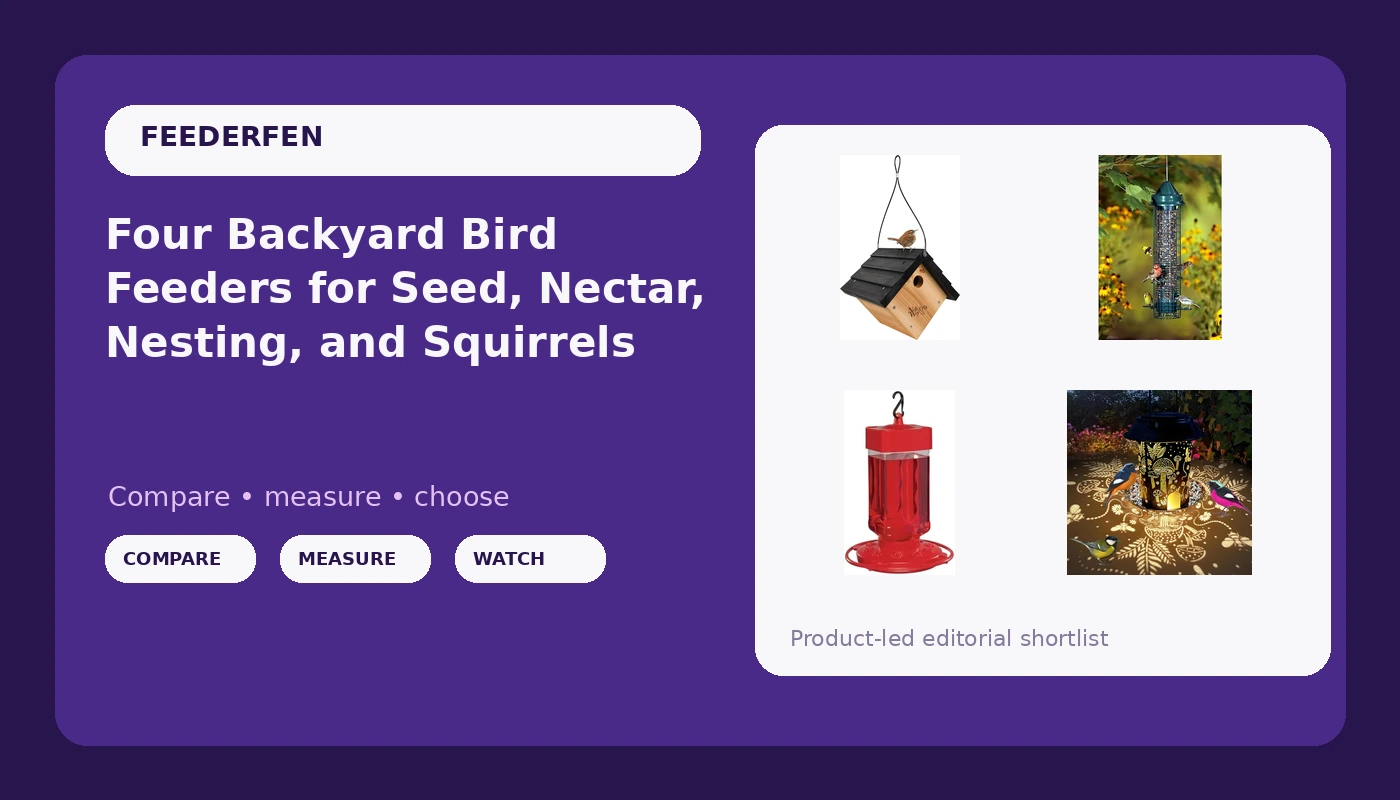
Most people start with one feeder and one bag of seed, and by the second season they own a pole, a baffle, a suet cage, and a bird they still cannot name. The problem is not enthusiasm. It is that "bird feeder" is not a single product. A tube of sunflower seed, a bottle of nectar, and a wooden box for nesting cover three different jobs, attract three different sets of birds, and fail in three different ways. This guide looks at four backyard bird feeders and houses that cover those jobs, what each one is actually for, and how to decide which one earns the first spot on your pole.
Related: Where to Hang a Feeder So Birds Actually Use It →
Quick answer
Match the feeder to the bird you want and to the maintenance you will honestly do. A weight-activated seed feeder suits sunflower and mixed seed in a yard with squirrels. A nectar feeder serves hummingbirds and needs rinsing every few days in warm weather. A cedar house serves wrens and other small cavity nesters, and it holds no seed at all. A decorative hanging feeder suits light mixes, small yards, and the view from a window. None of these replaces another, and none of them works well hung where birds cannot approach it safely.
Four useful options
| Model | Best fit | What stands out |
|---|---|---|
| Brome GC Bird Care - Squirrel Buster Feeder - Classic | Yards with a squirrel problem and a sunflower or mixed-seed menu | A weight-activated design from a maker whose whole line is built around squirrel resistance |
| First Nature 3055 32-Ounce Hummingbird Feeder (Set of 3)3 | Hummingbird season, and anyone who wants a spare bottle ready | Three 32-ounce feeders, so a clean one can go up while another dries |
| Nature's Way Bird Products CWH1 Cedar Wren House | Small cavity nesters and winter roost cover | Cedar construction in a compact footprint listed at 8 by 8.875 by 8.125 inches |
| Solar Bird Feeder,Metal Wild Bird Feeders for Outdoor Hanging, Waterproof Outside Large birdfeeders for Cardinals,Mushroom Shaped Solar Garden Decor Lantern as Gift for Bird Lovers | Decks, gift giving, and a feeder that doubles as garden lighting | A metal body described as waterproof, topped with a mushroom-shaped solar lantern |
The seed feeder: Brome GC Bird Care - Squirrel Buster Feeder - Classic
The trade-off with any weight-activated feeder is that the mechanism is the product, and mechanisms need attention. Seed dust, ice, and pollen all work their way into moving parts, and a feeder that stops sliding freely stops closing. That is why the honest word for this category is squirrel-resistant rather than squirrel-proof: a determined squirrel can still shake seed out of the ports, and no feeder on a pole a squirrel can climb is truly untouchable. What you are buying is a design that removes the easy meal, which is usually enough to send a squirrel looking for a simpler yard. Budget for a baffle and a clear pole run, and expect this feeder to cost meaningfully more than a plain tube. It also needs to come apart for a real wash rather than a hose spray, because the ports and the tube interior are where mold and disease organisms collect.
The hummingbird station: First Nature 3055 32-Ounce Hummingbird Feeder (Set of 3)3
Nectar is a food safety issue in a way that seed is not. Sugar water ferments in heat, and a feeder that sits in full sun with old syrup in it is a hazard rather than a kindness. The rule that matters is simple: plain white sugar at roughly one part sugar to four parts water, no red dye, and a full rinse every few days during the hot months. Three feeders make that routine realistic, because there is always a dry, clean one on the shelf. Hang nectar in shade where you can, add an ant moat and refill it before it dries out, and take the feeders down once hummingbirds have moved on and freezing nights arrive. A 32-ounce reservoir is a lot of nectar for a small yard, so in a cool climate you may fill only part of the bottle rather than dumping most of it out at the end of the week.
The nesting box: Nature's Way Bird Products CWH1 Cedar Wren House, 8" x 8.875" x 8.125", standard, Brown
A house is the piece most feeders skip, and it is the one that keeps birds in the yard after the seed is gone. Small cavity nesters use boxes in spring, and some of them use the same box as winter roost cover, which is worth remembering when you are deciding whether to leave it up through January. The practical concerns are competition and hygiene. House sparrows and starlings will investigate a box, so placement and monitoring matter, and a box that fledged a brood should be opened and cleaned out once the season ends rather than left packed with old nesting material. Mount or hang it where you can reach it without a ladder you do not own, keep it out of the full afternoon sun, and skip the perch below the entrance if you want to discourage larger birds from parking there.
The decor feeder: Solar Bird Feeder,Metal Wild Bird Feeders for Outdoor Hanging
Decorative feeders live or die on drainage and cleaning access. An open tray with a lantern above it will collect rain, and wet seed is spoiled seed, so plan to empty it before a storm or accept that you will be dumping clumps. A metal body resists the freeze-thaw cycle better than thin plastic, and a solar top means the piece is doing something at night when the birds are not. Where it fits best is a deck rail, a shepherd's hook near a window, or a gift for someone who wants birds in view without committing to a pole system and a baffle. It is not a squirrel solution, and it is not the feeder to buy if your priority is drawing a dozen goldfinches at once. As a first feeder for a small yard, though, it does two jobs for one purchase.
Prices and availability may change. Product images, names, and retailer links are matched to verified listings. No current price, rating, stock status, or measured result is stated here without current evidence.
Seed, nectar, and nesting are three different jobs
The single most common mistake in a new bird yard is buying one feeder and expecting it to do everything. It cannot, because the birds themselves are built differently. Seed eaters such as cardinals, finches, chickadees, and nuthatches have stout conical bills for cracking hulls, and they work perches and trays. Hummingbirds have bills built for probing flowers and need liquid sugar, not seed. Cavity nesters such as wrens and chickadees are looking for a hole in a tree, which is why a box works on them and a tube feeder does not. If you want all three groups, you need three different objects on the pole or in the yard, and each one carries its own maintenance schedule.
Seed choice matters as much as feeder choice. Black oil sunflower and sunflower hearts draw the widest range of birds and leave the least waste, and hearts leave no hull litter at all, which matters on a deck. Blends padded with milo and red millet look generous on the label and end up as a mat of uneaten grain at the bottom of the tray. Nyjer belongs in a dedicated fine-port or mesh feeder, and suet belongs in a cage, especially in winter when insect eaters need the fat. Whatever you hang, keep a rough count of how fast it empties. A feeder that goes a month without a refill is not being used, no matter how many birds you saw on the day you hung it.
Squirrel-resistant, easy to clean, and safe to hang
The word "squirrel-proof" on a box is marketing. Squirrel-resistant is a real property, and it is measured in how long a squirrel keeps trying rather than in a claim printed on plastic. Weight-activated ports, a baffle on the pole, and a mounting point well away from a launch pad all push the odds in your favor. Cleaning is the second filter, and it is the one that protects the birds: a feeder that cannot be taken apart will not be taken apart, and a dirty feeder is a disease vector with a perch on it. Use this sequence to sort the options.
- Name the birds you actually see in your yard or want to see, and pick the feeder type that serves them rather than the one with the best photo.
- Check the maintenance reality: can you open it, empty it, scrub it, and dry it in under ten minutes?
- Judge the squirrel exposure of the spot you have in mind, including nearby fences, tree limbs, and the pole itself.
- Match capacity to your routine. A big reservoir is convenient if you refill weekly and wasteful if you do not.
- Decide whether the piece is a feeding station, a nesting structure, or decoration, and stop expecting one object to be all three.
Practical guidance for the first season
- Hang feeders within three feet of a window or more than thirty feet away, and never in the middle distance where birds build up speed before a strike.
- Start with one seed feeder and one bag of black oil sunflower, then add nectar and a house once the first station is drawing birds.
- Wash seed feeders with hot soapy water and let them dry completely before refilling, and rinse nectar feeders every few days in warm weather.
- Skip red dye in nectar, mix roughly one part white sugar to four parts water, and replace the syrup before it clouds.
- Bring nectar in before the first hard freeze and keep seed, suet, and a heated water source going through winter, because water draws birds that seed alone will not.
Which option should you choose?
Choose the Brome GC Bird Care - Squirrel Buster Feeder - Classic when squirrels are already on your pole and you want the feeder itself to do the defending. Choose the First Nature 3055 32-Ounce Hummingbird Feeder (Set of 3)3 when hummingbird season is your priority and you want a rotation that makes frequent cleaning easy. Choose the Nature's Way Bird Products CWH1 Cedar Wren House when you want nesting and winter roost cover rather than another seed station. Choose the Solar Bird Feeder when you want a hanging feeder that also lights the garden and makes a straightforward gift.
The caveat is that no product listing tells you how a feeder behaves in your yard. Local squirrel pressure, shade, wind exposure, and how often you are actually home to refill and wash decide more than the specification sheet does. Buy one piece at a time, hang it where you can watch it, and let the birds tell you what is working.
The bottom line
Four objects, four jobs. A weight-activated seed feeder handles the squirrel problem and the sunflower crowd, a set of nectar feeders keeps hummingbirds supplied without a cleaning backlog, a cedar house serves cavity nesters and winter roosts, and a solar hanging feeder covers the deck, the window view, and the gift list. Pick the one that matches the birds you have and the routine you will keep, add the rest over time, and put the water out first, because water brings more species to a yard than any single bag of seed.