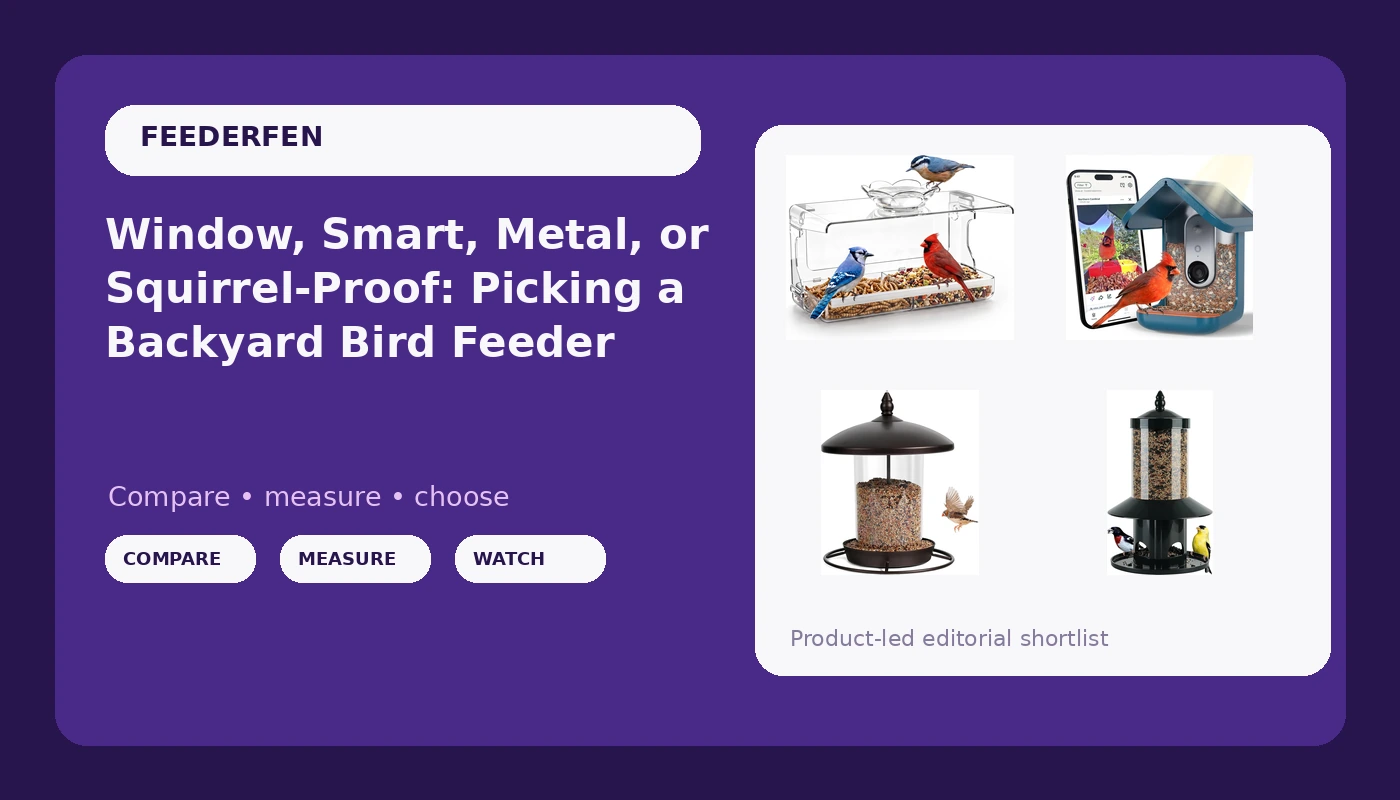
Choosing a backyard bird feeder looks like a five-minute decision and turns into a season-long experiment. Where you mount it decides which species can physically reach the seed. What it is made of decides how it survives a hard freeze, a thaw, and then another freeze. How it comes apart decides whether you actually clean it in week six or leave it hanging until the seed turns into felt.
The four options below answer four different versions of the same question. One mounts to glass, one carries a camera and a solar panel, one leans on metal construction, and one uses a hanging perch tray. None of them is a universal answer, and the order of your own priorities matters more than the number on the tag.
Related: How to Place a Window Feeder Without Window Strikes →
Quick answer
Start with the mount, not the model. If you have no yard, a window-mounted feeder is the only one of these that works at all. If you want species identification and photographs, a camera feeder buys that and very little else. If your problem is weather and chewing animals, metal construction is the relevant specification. If you want a wide mix of birds on one hanging feeder, a 360-degree perch tray is the shape that lets a cardinal, a finch, and a chickadee feed at the same time instead of queuing. Seed choice and cleaning routine will change your results more than the finish on the housing.
Four useful options
| Model | Best fit | What stands out |
|---|---|---|
| WENMIXER Window Bird Feeder with Non-Marking Self-Adhesive Hooks | Renters, apartments, close-range viewing | Mounts to glass with self-adhesive hooks described as non-marking |
| Birdbuddy Pro Solar Smart Bird Feeder with Camera, AI Bird ID, 2K Video | Birders who want photos and species ID | Solar charging, AI bird identification, and 2K video |
| Metal Roof Bird Feeder - Chew Proof for Outdoor | All-weather hanging setups, chewing animals | Metal roof construction marketed as chew proof |
| Squirrel-Proof Bird Feeder 360° Feeding Perch Tray for Outdoor Hanging | Mixed flocks on a single hanging feeder | A full 360-degree perch tray |
The window option: WENMIXER Window Bird Feeder with Non-Marking Self-Adhesive Hooks
A window feeder is the one design on this list that does not require land. That makes it the default answer for apartment dwellers, renters, and anyone whose only outdoor space is a sill. The trade-off is capacity and exposure: a tray hanging on glass holds less seed than a tube or a hopper, it takes weather on all sides, and the mounting method matters enormously in a hard freeze. Adhesive that holds at 40°F is not the same product as adhesive that holds at -6°F, and this is the single most common failure point for window feeders.
Placement also matters for the birds, not just for you. A feeder within roughly three feet of the glass is the placement that reduces window strikes, because a bird leaving the feeder cannot build up enough speed to hurt itself. Move that same feeder out to eight or ten feet and you have created the worst possible geometry. If you take nothing else from this article, take that number.
The smart option: Birdbuddy Pro Solar Smart Bird Feeder with Camera, AI Bird ID, 2K Video
This is a different category of object. A conventional feeder tells you that seed disappeared. A camera feeder tells you who took it, at what time, and how often, which is the same information a written feeder log produces, just generated automatically and with pictures attached. For someone who keeps counts, that is genuinely useful. For someone who wants birds at the window and no app, it is a lot of money and a lot of setup.
The honest trade-offs are power and dependency. Solar charging reduces how often you think about a battery, but a Wisconsin February offers short days, overcast weeks, and snow sitting on a panel, so any solar feeder is worth thinking about in terms of winter, not June. The other consideration is the software side: identification and photo storage typically run through a companion app, and app features can change independently of the hardware you bought. Buy this for the camera and the ID, not for a subscription tier you have not read yet.
The metal option: Metal Roof Bird Feeder - Chew Proof for Outdoor
Most feeder failures are not dramatic. They are a plastic roof that cracks in the second winter, a perch that snaps, or a seed port chewed into an oval by something with incisors. A metal roof addresses the two cheapest failure modes at once, and it does it without changing how the feeder works. Seed stays drier, which matters more than most people expect: wet seed clumps, molds, and then sits uneaten while you wonder why the draw dropped.
Metal is not a complete answer. A metal roof does not make a feeder squirrel-proof, because squirrels attack the perch, the port, and the hanging hardware as often as they attack the roof. It also does not make a feeder chew proof in every location; the claim covers the roof, not the whole assembly. What it does is remove the most common point of weather damage and give you a feeder you can leave out through a full year instead of storing it every November.
The squirrel-resistant option: Squirrel-Proof Bird Feeder 360° Feeding Perch Tray for Outdoor Hanging
Here is where language matters. Squirrel-proof is a marketing word. Squirrel-resistant is a real thing, and the difference is measured in weeks, not in the claim printed on the box. A determined fox squirrel will spend three weeks on a feeder testing every angle, and the feeders that hold up are the ones with a mechanism that reacts to weight, not the ones with a shape that looks difficult.
That said, the 360-degree tray shape has a genuine advantage that has nothing to do with squirrels: it removes the queue. Tube feeders with four ports serve four birds at a time. A tray with a continuous perch ring lets a mixed flock spread out, and it accommodates birds of different sizes, from a small finch to a cardinal, without anyone getting bounced. The cost of that openness is that a tray is also the easiest shape for a squirrel to sit in, which is exactly why the squirrel question has to be settled separately, usually with a baffle or a pole-mounted setup.
Prices and availability may change. Product images, names, and retailer links must be matched by verified ASIN. Do not state a current price, rating, stock status, or measured result without current evidence.
What the mount decides before the seed does
A feeder is a delivery system for seed, and the mount sets the rules before the seed ever gets a vote. Window mounts are limited by glass area and by how much weight an adhesive hook can carry through a freeze-thaw cycle. Hanging mounts are limited by what is above them: a branch, a shepherd's hook, a bracket. Pole mounts are limited by the baffle you put on the pole.
The single most useful piece of geometry to know is squirrel reach. Squirrels launch from the ground and from nearby structures, and a feeder within jumping distance of a fence, a roof edge, or an overhanging branch is reachable no matter what the box claims. The practical fix is distance: place the feeder far enough from launch points that a jump is not possible, or put a baffle on the pole below it. A baffle works because it makes the pole itself unclimbable, which is a different solution from a feeder that closes its ports under weight.
Window placement is the other piece of geometry that people get wrong. Feeders placed within about three feet of glass reduce collisions, because birds leaving the feeder never reach injurious speed. Feeders at ten to fifteen feet produce the opposite result. If your only option is a window feeder on a large pane, consider adding an exterior screen or a window film pattern as well, and remember that a film that has been up for years and is peeling in the corners is not doing the job it was sold to do.
Cleaning, disease, and the specification nobody prints
Feeder hygiene is the part of this hobby that does not photograph well and matters most. Salmonella and house finch eye disease both move through feeders, and both trace back to the same root cause: a feeder that was never taken apart. A hose spray is not cleaning. Cleaning means disassembling the feeder, scrubbing the surfaces birds touch, and letting everything dry completely before it goes back up.
The practical standard is a weekly cycle in warm weather, less often in a hard freeze, plus an immediate scrub any time you see wet, clumped, or discolored seed. A ten percent bleach solution followed by a thorough rinse and a full dry is the routine most wildlife health guidance lands on. If you see a sick bird at the feeder, the correct move is to take the feeder down for a couple of weeks, clean it, and let the birds disperse rather than continuing to concentrate them at a single point.
Seed choice feeds directly into this. Blends padded with milo and red millet get sorted through and left behind, and what is left behind gets wet and molds. Black oil sunflower, sunflower hearts, and no-mess blends all get eaten rather than discarded, which means less waste on the ground and less scrubbing on the tray. The price per pound is higher. The amount of seed you throw away is lower.
- Measure the space you actually have, not the space you wish you had. A sill, a balcony rail, and a fenced yard support three different feeders.
- Decide which birds you want to serve. Clingers like woodpeckers and nuthatches need different hardware than cardinals and finches.
- Set an honest cleaning budget. If you will not disassemble a feeder monthly, buy one with fewer parts.
- Plan the squirrel solution before you hang anything, either through distance, a baffle, or a weight-activated mechanism.
- Match the seed to the feeder and to the season, and buy in bulk once you know what your yard actually empties.
Practical guidance
- Hang window feeders within about three feet of the glass to reduce strike risk, and check the mounting surface before the first freeze.
- Keep one spare feeder so a wet one can dry completely while the other stays up.
- Store seed in a sealed, rodent-proof bin, and never refill on top of old seed.
- Fill only what your birds will clear in about a week, especially in humid or rainy stretches.
- Take feeders down during a disease outbreak in your area, clean them thoroughly, and wait before hanging them again.
- Photograph the seed level on refill day if you want a draw record. Cups per week tells you more than a general impression.
Which option should you choose?
Choose the WENMIXER Window Bird Feeder with Non-Marking Self-Adhesive Hooks when you have no yard, you rent, or you want birds at arm's length through a window and can accept a smaller seed capacity. Choose the Birdbuddy Pro Solar Smart Bird Feeder with Camera, AI Bird ID, 2K Video when species identification and photographs are the point, and you are comfortable with an app and a higher upfront cost. Choose the Metal Roof Bird Feeder - Chew Proof for Outdoor when weather and chewing damage have already ended the life of a cheaper feeder and you want the roof to stop being the weak point. Choose the Squirrel-Proof Bird Feeder 360° Feeding Perch Tray for Outdoor Hanging when you want a single hanging feeder that serves a mixed flock from every angle, and you are prepared to handle squirrels with placement and a baffle rather than with the label.
One caveat applies to all four. This article describes these feeders from their product listings. It does not report hands-on test results, measured draw, or long-term durability data, and squirrel-proof claims in particular should be read as squirrel-resistant until proven otherwise in your own yard over a full season.
The bottom line
The feeder is the cheap part of this hobby and the seed is the expensive part, which is why the decision should be made around waste, cleaning, and access rather than appearance. A window feeder solves access for people without a yard. A camera feeder solves identification for people who want a record. A metal roof solves weather for people who leave feeders out year round. A 360-degree tray solves crowding for people feeding a mixed flock. Pick the one that solves your actual constraint, then spend your attention on seed quality, placement, and a cleaning routine you will genuinely keep.