A squirrel-proof bird feeder setup is a placement problem before it is a hardware problem. That is the first thing I say to anyone who calls the clinic asking why the squirrels are winning. Hang the right feeder in the wrong spot and a fox squirrel will be sitting in the seed tray by the second morning. Skip the window side of the yard entirely and you will spend October watching birds bounce off your dining room glass instead of eating.
I have run this pair of feeders for years in Madison, Wisconsin, and the reason I run two instead of one is that they fail in completely different ways. The pole feeder has to hold seed above a squirrel's reach. The window feeder has to sit so close to the glass that a bird leaving the perch cannot build up speed. Get both right and you cover the two things that make people quit backyard birding in the first year.
This is the setup I would hand a new birder, in the order I would tell them to do it.
Why you should trust me
I am a licensed wildlife rehabilitator. I work part time at a small animal clinic and run the songbird side of a county wildlife rescue out of my garage, which means the incubator lives in the laundry room and the scale lives on the kitchen counter. That is why I think in grams for birds and cups for seed.
I have been feeding backyard birds for twelve years and keeping the log for ten of them: a spreadsheet with every species that visits, every first-of-season date for the migrants, and how many cups of seed each feeder draws per week. My county life list sits at 214 species, and 38 of them have hit my feeders.
I got into rehab because of a window strike. A white-throated sparrow hit my dining room glass and spent three days recovering in a shoebox, and the same year I hung my first window feeder three feet from that glass, which is exactly where it belongs. Two habits came out of that year. I test every squirrel-proof claim by letting the neighborhood fox squirrels work on a feeder for three weeks before I write a word about it. And I take feeders apart. Every salmonella case and every house finch eye disease case I have seen in rehab intake traced back to a dirty feeder, and a dirty feeder is just a disease vector with a perch.
How I picked and how I tested
No feeder gets recommended here without at least one full season in my yard and an entry in the log. When something new shows up on the pole, I run it through five questions:
- Will birds actually use it, or will it sit pretty and draw nothing?
- Can I take it apart and clean it in under ten minutes?
- What does a determined fox squirrel do to it in week one?
- Will it survive a Wisconsin February, freeze, thaw, freeze?
- Would I still hang it after four seasons?
Then the numbers. The one I trust most is draw, which is how fast a feeder empties. A tube feeder's draw tells you more than its capacity. Capacity is what the box promises; draw is what the birds decide. The second number is cleaning time, and I mean real time: disassembly, brush, rinse, dry, reassembly. A feeder you dread cleaning is a feeder that gets cleaned twice a season.
What I do not count is how it looks. Birds do not care about a powder-coated finish, and neither should you. A feeder's real spec is how fast it empties and how easy it is to clean.
The two feeders that carry the setup
This is a two-feeder yard, and each one has a different job. The pole feeder holds seed above a squirrel's reach and carries the winter log. The window feeder sits close enough to the glass that a bird leaving it cannot build up strike speed. Between them they cover the two failure modes that end most people's first year of feeding birds.
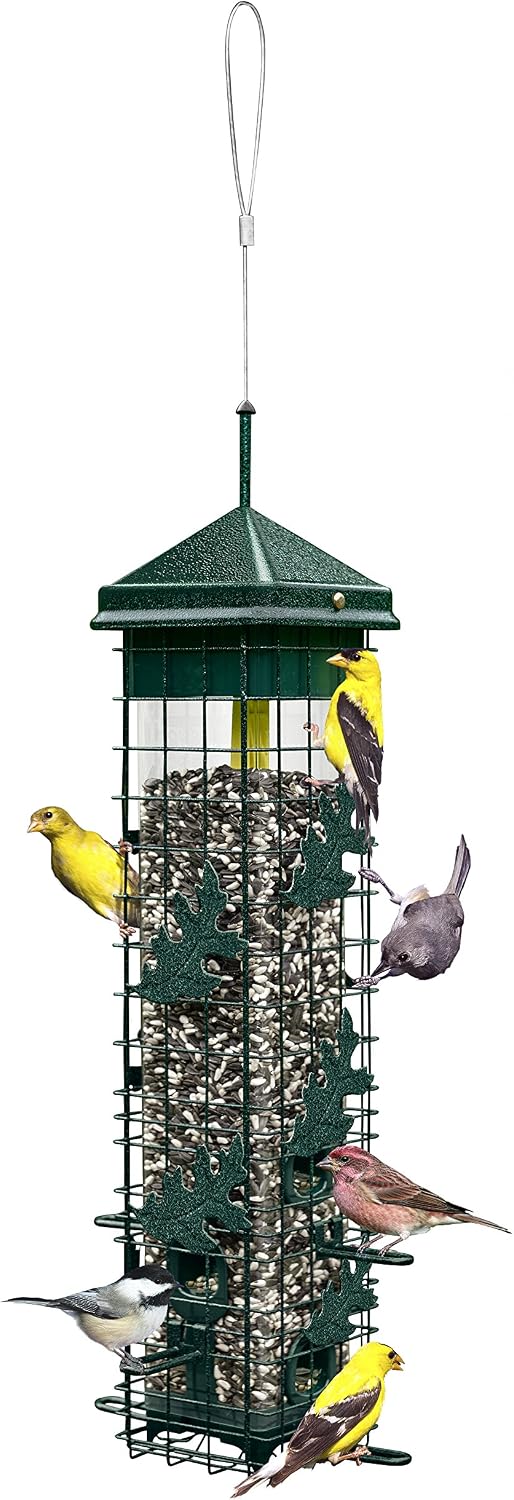
Our pick: Squirrel Solution200 Squirrel-proof Bird Feeder w/6 Feeding Ports, 3.4-pound Seed Capacity, Free Seed Funnel
 Visit on Amazon →
This is what finally ended the squirrel war in my yard. Six feeding ports, a 3.4-pound seed capacity, and a mechanism that does the work: the neighborhood fox squirrels spent three weeks hanging upside down off this thing and never reached seed once. Two winters in, no squirrel has gotten above it. That is the standard I hold every claim to, and this is the feeder on my pole that passes it.
Six ports is more than a marketing number. More ports means more perches, and more perches means more draw, which means the log fills up faster. It also means more places for hulls, droppings, and damp seed to collect, so budget the cleaning time below.
The free seed funnel is the detail I did not expect to care about. Filling a tube from a scoop means seed on the deck and a mess in the seed bin. A funnel that comes with the feeder is one less thing to buy and one less reason to put off a refill.
Flaws but not dealbreakers: A 3.4-pound capacity is a weekend in a busy yard, not a month. In January, when draw is heaviest, you will refill more often than the capacity suggests. And a squirrel-resistant feeder is only one part of the pole. If you leave a launch point within jumping distance, a squirrel will test the feeder from above, not from below. Clear the branches and keep it away from the roof line.
Anyone who has already lost a season to squirrels, and who is willing to take the feeder apart weekly, will get their money's worth here.
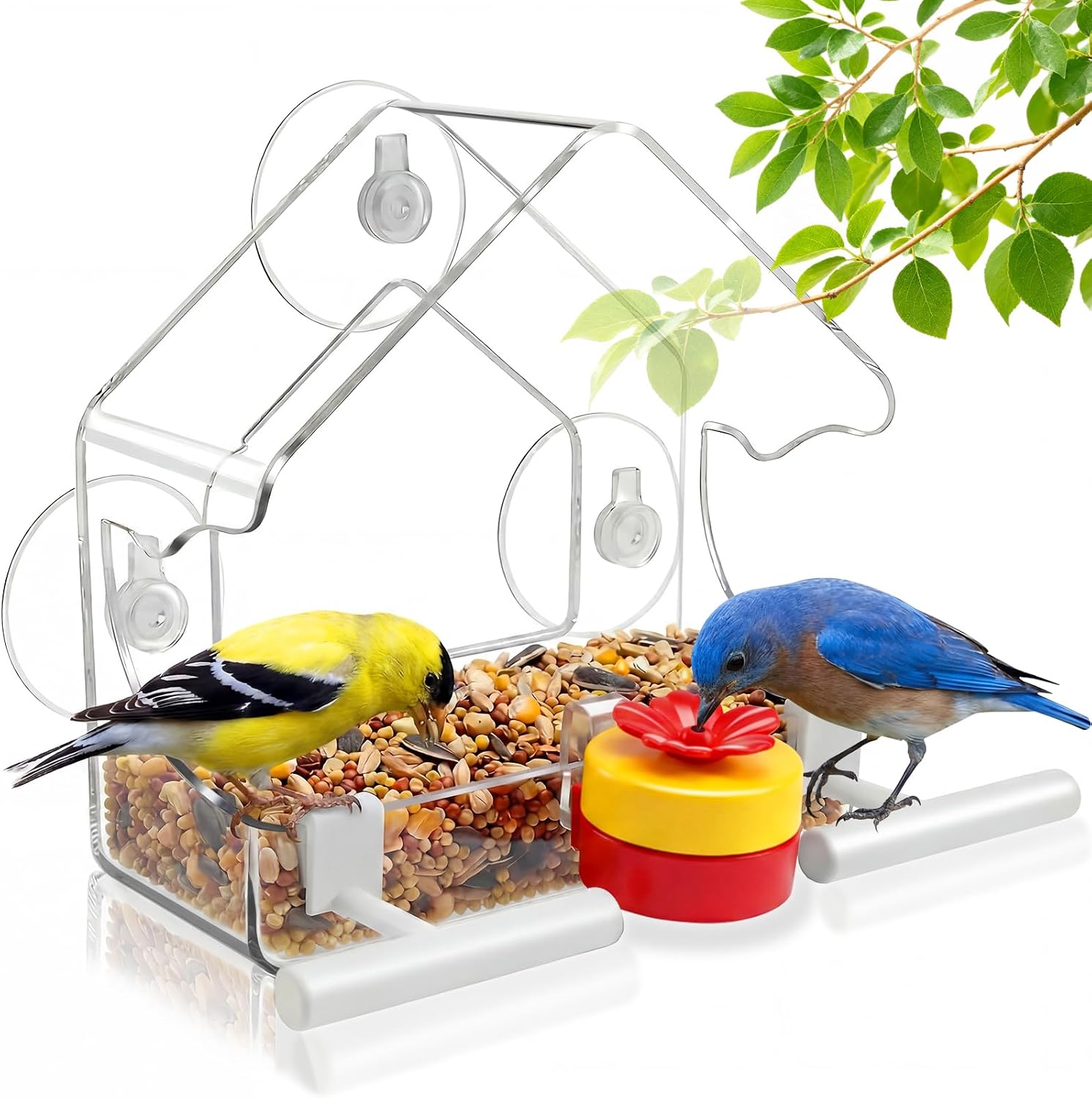
Budget pick: Window Bird Feeders for Outdoors with Flower Hummingbird Feeder
 Visit on Amazon →
A window feeder is the best birding purchase for someone who watches from a kitchen table. It puts birds two feet from your face, and placed correctly, it also cuts window strikes at that pane. The flower hummingbird attachment gives it a second season: seed for the winter log, nectar for the ruby-throated hummingbirds that show up here around April 20th, two years running in the log.
Placement is the whole job with this one. Mount it within three feet of the glass, so a bird leaving the perch has no room to accelerate, or more than thirty feet away, where it can see the pane coming. The middle distance, somewhere around ten feet, is the danger zone, and it is where most people hang feeders. The sparrow in my shoebox was the result of a feeder at that distance.
The honest caveat on window feeders is the mount. I have watched a suction-cup window feeder let go in January at minus six, and the tray hit the porch. That is not a knock on window feeders. It is a knock on suction cups in a freeze-thaw climate. If you live where the temperature swings below freezing, plan on a mount that holds mechanically and check the hardware before you fill it. A window feeder that falls is a window feeder you stop trusting.
Flaws but not dealbreakers: Nectar in a window feeder is a two-day job in July. If you cannot rinse and refill every other day in hot weather, run seed only and save the nectar for spring and fall. And skip the red dye. It is unnecessary, and it is not doing the birds any favors.
Anyone in an apartment, a rental, or a house with a kitchen window that faces a hedge will get the most out of this one.
The setup, step by step
Step one: pick the pole location before you buy anything. Walk the yard and find the spot with no roof line, fence top, or overhanging branch within jumping distance. Squirrels launch from above and from the side, not from a standing start on the ground. Ten feet of clear air in every direction is the goal.
Step two: set the pole, then hang the feeder. Get the feeder six feet or more off the ground, and hang it so the ports sit clear of anything a squirrel can lean on. Fill it with black-oil sunflower or sunflower hearts, not a blend padded with milo and red millet. Filler sits in the tray uneaten, molds in the rain, and doubles your cleaning load.
Step three: start the three-week squirrel test. Write the date in the log and do not touch the setup for three weeks. Watch week one closely, because that is when a squirrel is most motivated. If it reaches seed even once, the honest word for the feeder is resistant, not proof. If three weeks pass with the seed intact, you have a feeder worth recommending.
Step four: choose the window, and measure. Within three feet of the glass, or more than thirty feet away. Nothing in between. Clean the pane inside and out before you mount anything, because a dirty window is a window you will stop looking through.
Step five: mount the window feeder and check the hardware. Whatever holds it, test it by hand with the feeder loaded. If it moves, it will fall in February. If you are in a freeze-thaw climate and the mount is suction cups, treat it as a warm-season feeder and bring it in before the first hard freeze.
Step six: build cleaning into the week. Once a week, take every feeder apart. Not a hose spray, an actual disassembly: brush, hot soapy water, rinse, dry in the sun, reassemble. Once a month, or any time you see a sick bird at the feeder, add a dilute bleach soak and rinse thoroughly. Hummingbird nectar gets changed every two days in hot weather, and the feeder gets rinsed every time.
Step seven: log it. Date, species, first-of-season, and cups per week. The first-of-season dates are the most interesting data you will collect. Cups per week is what tells you whether a feeder is actually working, and it is the number that will talk you out of buying the next pretty feeder you do not need.
What the log says after three weeks
Three weeks is the point where a feeder stops being a new purchase and starts being data.
On the pole, draw is the story. If the seed is going down and hulls are piling up underneath, birds are using it. If the level has barely moved, either the placement is wrong or the seed is wrong, and it is almost always one of those two, not the feeder.
At the window, the log fills up differently. Expect chickadees, nuthatches, and house finches close to the glass, and in my yard the downy and hairy woodpeckers work the suet cage on the same pole. A window feeder three feet from the pane is also the best window strike prevention you can install, because birds leaving it never get to speed. It does not replace the other tools. Keep a screen or an exterior film on the big panes, and put decals on the glass that takes the most hits. Prevention is layered, and the feeder is one layer.
One more thing the log says, and it is the least popular thing I write: water brings more species to a yard than any seed blend. From June to August, the bath gets more entries than every feeder combined. If you are choosing between a third feeder and a heated bath before winter, take the bath. A heated bath that stays ice-free at ten below draws birds that never touch your seed.
And if a squirrel gets there anyway, watch which direction it comes from. It is nearly always a launch point you left open, and moving the pole ten feet is cheaper than replacing the feeder.
What this setup actually costs you
Not in dollars. In the two currencies that decide whether you stick with this: time and seed.
- Cleaning: about ten minutes per feeder per week, more in spring and fall when draw is heavy and rain is frequent.
- Nectar: two minutes every other day in July and August, with a rinse each time.
- Seed: buy in bulk. Sunflower hearts cost less per pound in a large bag than in small ones and leave zero hull litter under the platform, which matters if you feed over a deck.
- Placement mistakes: the most expensive item in this article is a feeder hung in the middle distance from a window. That one costs you birds.
The hardware is the cheap part. Check current Amazon price on both feeders and do the math against a season of seed. Then spend the twenty minutes on placement, because a squirrel-proof bird feeder setup that ignores the pole location is just an expensive squirrel picnic.
The last word
The order matters. Fix the window first if you have already had a strike, because that is the mistake that kills birds. Then set the pole, run the three-week test, and let the log tell you whether the feeder earned its spot.
The birds will tell you the rest. Mine did, one cup at a time.