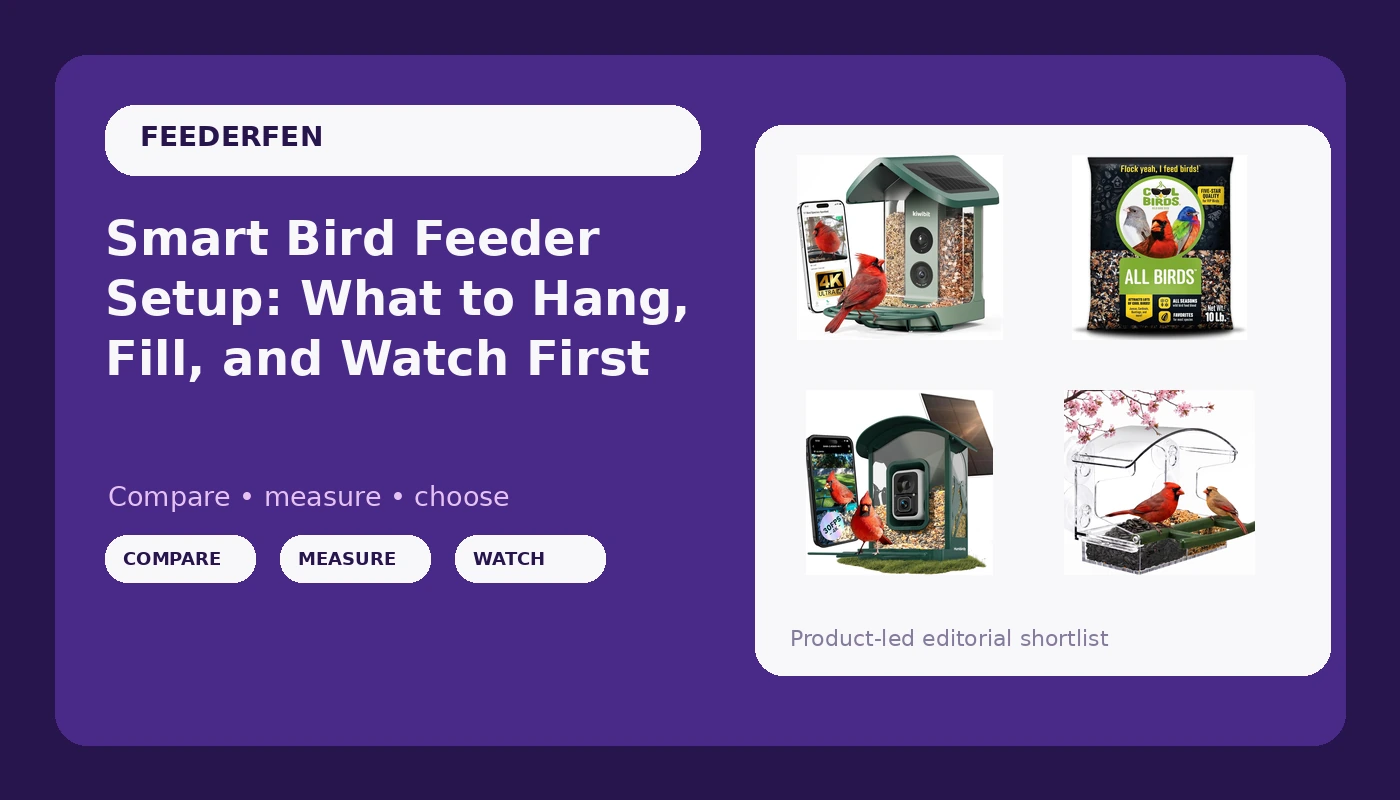
A smart bird feeder setup is really three decisions wearing one coat: where the feeder hangs, what watches it, and what goes inside. Most people buy the camera first, mount it wherever the bracket happens to fit, and then spend a season watching an empty tray. I keep a spreadsheet of every species that visits my yard, the first-of-season dates for migrants, and how many cups of seed each feeder draws per week, and ten years of that log has taught me one thing above all: the mount and the seed decide whether birds show up, and the camera only decides whether you get to see them. This guide walks through the four pieces of a smart bird feeder setup in the order I would buy them, with the trade-offs stated plainly instead of buried at the bottom of a feature list.
Related: How to Hang a Window Feeder Without Window Strikes →
Quick answer
Start with the mount and the seed, then add the camera. A window-mounted feeder plus a bag of seed will bring birds to the glass in most yards, and a camera feeder earns its place once birds are already using the space. If you want footage without a recurring fee, look for a camera feeder that lists no subscription; if you want live 4K HDR video and automatic species identification, expect to pay more upfront for those features. None of these four products is the right answer for every yard, because the right pick depends on your window, your Wi-Fi, and how willing you are to take the feeder apart and wash it.
Four useful options
| Model | Best fit | What stands out |
|---|---|---|
| Kingsyard Window Bird Feeder with 4 Extra Strong Suction Cups | First feeder, apartment windows, close viewing | Mounts directly to glass with four suction cups, so no pole or bracket is needed |
| Kiwibit Solar Smart Bird Feeder with Camera, 4K HDR Live Video, AI Bird ID | Yards where birds already feed and you want labeled footage | Solar charging, 4K HDR live video, and AI bird identification |
| Bird Feeder with Camera, 4K Ultra HD Video with 30fps Live View, 10x Slow Motion, No Subscription, Solar Powered AI Smart Bird Feeder with Camera, 2.4G/5G Wi-Fi, Durable Metal, Bird Lover Gift | Buyers who want no recurring fee | No subscription, 30fps live view, 10x slow motion, dual-band Wi-Fi, metal housing |
| Cool Birds All Birds Wild Bird Seed, 10 lb | Filling any of the three feeders above | A general-purpose 10 lb bag sized for a single feeder |
The window-mount starting point: Kingsyard Window Bird Feeder with 4 Extra Strong Suction Cups
Placement matters more than anything else with a window feeder. Glass kills birds when they hit it at speed, and the fix is counterintuitive: put the feeder within about three feet of the pane, close enough that a bird leaving the perch cannot build up enough momentum to hurt itself. That is the whole reason window feeders exist as a category. They are not just for apartments and rentals; they are the safest spot in the yard for a feeder, and the viewing is better than any pole setup.
The honest trade-off is the suction cups. Glass changes size with temperature, cups dry out, and a cup that was solid in October can let go in a January cold snap. The four-cup design here spreads the load better than a two-cup tray, but it still asks you to press the cups back down and check them every time you refill. If you have ever watched a feeder hit the porch at six in the morning, you already know to check. Clean it in the sink, dry the cups, and press them on a clean pane rather than over a smear of old window cleaner.
The identification camera feeder: Kiwibit Solar Smart Bird Feeder with Camera, 4K HDR Live Video, AI Bird ID
This is the option for someone who already has birds and wants to know what they are. High dynamic range video matters more than resolution in a backyard, because the bird is usually backlit against a bright sky or sitting in deep shade under a porch roof, and that contrast is exactly what HDR is built to handle. Solar charging means no cable run across the yard and no battery swap every few weeks, provided the panel gets real sun rather than a few hours of dappled light through a maple.
Two things to think through before you buy a camera feeder. First, birds need to be using that spot already. A camera pointed at a feeder nobody visits produces a very expensive empty tray. Second, the AI identification is a labeling convenience, not a field guide. Treat the labels the way I treat any automated ID in the log: useful, worth checking, and wrong often enough on sparrows and fall warblers that you should still know the field marks. Position the feeder where the panel gets sun and where you can reach it without a ladder, because a camera feeder still needs to be emptied, rinsed, and dried on a schedule.
The no-subscription camera feeder: Bird Feeder with Camera, 4K Ultra HD Video with 30fps Live View, 10x Slow Motion, No Subscription, Solar Powered AI Smart Bird Feeder with Camera, 2.4G/5G Wi-Fi, Durable Metal, Bird Lover Gift
Subscriptions are the quiet cost of smart feeders, and they are the reason a lot of camera feeders end up in a garage. If the footage you want lives behind a monthly plan, you are renting access to birds that are already in your yard. A feeder that lists no subscription puts that decision back in your hands, and the rest of the feature set here is aimed at the two moments people actually want to rewatch: the landing and the departure. Thirty frames per second is what makes a takeoff look like a takeoff instead of a blur, and 10x slow motion is what lets you see how a chickadee folds its wings before it drops off the perch.
Dual-band Wi-Fi is a practical detail worth more than it sounds. A 5G connection carries high-bitrate video without stuttering when the feeder is within range of the router; 2.4G reaches farther through walls and around the corner of a garage. Metal housing is the other quiet upgrade, because plastic that spends four seasons in freeze-thaw cycles gets brittle, and a feeder that cracks at the mounting collar is a feeder that ends up on the ground. Whatever you hang, put it where you can reach the lid without a ladder, since the cleaning schedule is what keeps birds healthy.
The seed: Cool Birds All Birds Wild Bird Seed, 10 lb
Seed is where most beginners overspend and underdeliver. The single most useful habit is reading the ingredient list before the price: blends padded with milo and red millet look generous on the label and then sit in the tray uneaten, get rained on, and mold. Moldy seed is not just wasted money, it is a disease risk, and in rehab I have seen enough salmonella and house finch eye disease to be blunt about it. Buy a blend the birds actually clear, and buy it in a size you will finish in a few weeks rather than a few months, because seed goes stale and stale seed draws fewer birds.
A 10 lb bag is a sensible starting size for one feeder. It is light enough to carry, small enough to store in a sealed bin in a cool spot, and it lets you rotate stock so nothing sits through a humid summer. Whichever blend you choose, keep the feeder's draw in mind. When a feeder empties in three or four days, the birds have accepted it and the blend is working. When the same tray still has seed in it after two weeks, something is wrong, and the fix is usually the blend, not the feeder.
Prices and availability may change. Product images, names, and retailer links are matched to verified listings. No current price, rating, stock status, or measured result is stated here without current evidence.
What the specs actually tell you
Three specs on a camera feeder do real work, and the rest are decoration. Video resolution and frame rate decide whether you can identify a bird from the footage or just confirm that a bird was there; 4K at 30fps is enough detail to count primary feathers on a perched finch. Power decides whether the thing stays online through a February, and solar charging with a battery is the configuration that avoids running a cord across a lawn. Connectivity decides whether the video arrives at all: dual-band Wi-Fi gives you the speed of 5G near the router and the reach of 2.4G through walls.
On the non-camera side, the specs that matter are almost boring. Suction cups and mounting hardware decide whether the feeder is still hanging in March. Capacity decides how often you refill, and refills are when you notice problems, so a feeder that empties fast is not a flaw. Materials decide whether a feeder survives freeze-thaw cycles. Cleaning access decides whether you actually do the job, and that one spec outweighs every other number on the page, because a feeder that is hard to open is a feeder that becomes a disease vector with a perch.
Placement, cleaning, and the parts nobody photographs
- Put the feeder within three feet of the glass, or more than thirty feet away. The middle distance is where window strikes happen.
- Confirm the birds are already using the spot before you spend on a camera. Watch for a week and count visits.
- Check the ingredient list on any seed blend and skip anything padded with milo or red millet.
- Plan the cleaning before you hang: warm soapy water, a bottle brush for tube ports, and a full dry before refilling.
- Site solar panels where they get direct sun for most of the day, and mount the feeder where you can reach it without a ladder.
Practical guidance
- Clean every feeder at least every two weeks, and more often in warm, wet weather when seed spoils fastest. Take it apart; a hose spray is not cleaning.
- Check suction cups and mounting hardware at every refill, and press cups back onto clean glass rather than over old residue.
- Keep seed in a sealed container in a cool, dry spot, and buy a bag size you will finish within a few weeks.
- Never add dye to nectar or seed. Color is for the buyer, not for the birds.
- After a sick bird shows up at a feeder, take it down, wash it, and leave it down for a couple of weeks before hanging it again.
Which option should you choose?
Choose the Kingsyard Window Bird Feeder with 4 Extra Strong Suction Cups when you want birds at arm's length this week, you rent, or you have no place to set a pole. Choose the Kiwibit Solar Smart Bird Feeder with Camera, 4K HDR Live Video, AI Bird ID when birds already visit your yard and you want high-dynamic-range footage with species labels attached. Choose the Bird Feeder with Camera, 4K Ultra HD Video with 30fps Live View, 10x Slow Motion, No Subscription, Solar Powered AI Smart Bird Feeder with Camera, 2.4G/5G Wi-Fi, Durable Metal, Bird Lover Gift when you want camera footage without a recurring fee and you care about slow motion and a metal body. Add the Cool Birds All Birds Wild Bird Seed, 10 lb to whichever feeder you pick, because none of them work empty.
One caveat that applies to all four: I am describing listed features, not measured results in your yard. Frame rate, solar performance, and identification accuracy vary with light, placement, and Wi-Fi, and the only test that matters is whether birds use the feeder after a full season and whether you still clean it in month four.
The bottom line
Build the setup in the order birds experience it. Mount first, seed second, camera last, because a camera feeder only documents activity that the mount and the blend have already created. If your budget is small, a window feeder and a 10 lb bag of seed will outperform an expensive camera hanging over an empty tray. If your budget is larger, decide between the two camera feeders on one question: do you want automatic identification and HDR video, or do you want to own the footage outright with no subscription? Either answer is defensible. Hanging a camera before the birds arrive is not.