Most bird feeders fail for reasons that have nothing to do with the feeder itself. They hang two feet from a window, or six feet from a fence line a fox squirrel can clear in one leap, or they wobble on a deck rail every time someone bumps the grill. If you want to know how to hang a bird feeder so birds actually use it, the hardware is maybe a third of the job. Placement, height, seed choice, and a cleaning routine you will actually keep are the rest of it.
I have been feeding backyard birds for twelve years in Madison, Wisconsin, and keeping the log for ten of them: a spreadsheet of every species that hits my feeders, first-of-season dates for migrants, and cups of seed each feeder draws per week. The log is why I do not trust a feeder because it looks good on a pole. It is also why I can tell you that a feeder hung in the wrong spot empties slowly, molds fast, and turns into a disease vector with a perch.
What follows is the setup workflow I use in my own yard, plus the two feeder designs that cover most situations: one that clamps to a deck or balcony rail without drilling, and one that hangs.
Why you should trust me
I am a licensed wildlife rehabilitator. I work part time at a small animal clinic and run the songbird side of a county wildlife rescue out of my garage, which means I see the downstream cost of bad feeder setups: house finch eye disease, salmonella intakes, window strikes. Every one of those cases traced back to something a person could have changed in ten minutes.
My county life list sits at 214 species, and 38 of them have hit my feeders. I keep the log in cups per week, not in "the birds seem to like it," and I test any squirrel claim for three weeks with the neighborhood fox squirrels before I write a word about it. Water brings more species to a yard than any seed blend I have ever hung, so treat everything below as the second most important thing you can put outside.
How I judge a feeder before it earns a spot
Five questions, every time. Will birds actually use it, or will it sit pretty on the pole? Can I take it apart and clean it in under ten minutes? What does a determined fox squirrel do to it in week one? Will it survive a Wisconsin February, freeze, thaw, freeze? And would I still hang it after four seasons?
The spec that never appears on the box is draw, which is how fast a feeder empties. A tube feeder's draw tells you more than its capacity. Capacity is storage; draw is whether the ports are sized for the birds in your yard. A feeder that cardinals cannot fit on is a feeder that will still be half full in March.
The two feeders that fit most yards
Most people need one of two mounting styles. If you have a deck, a balcony, or a railing, a clamp gets you feeding without a pole and without drilling. If you have a pole, a hook, or a branch, a hanging feeder is the simpler answer.
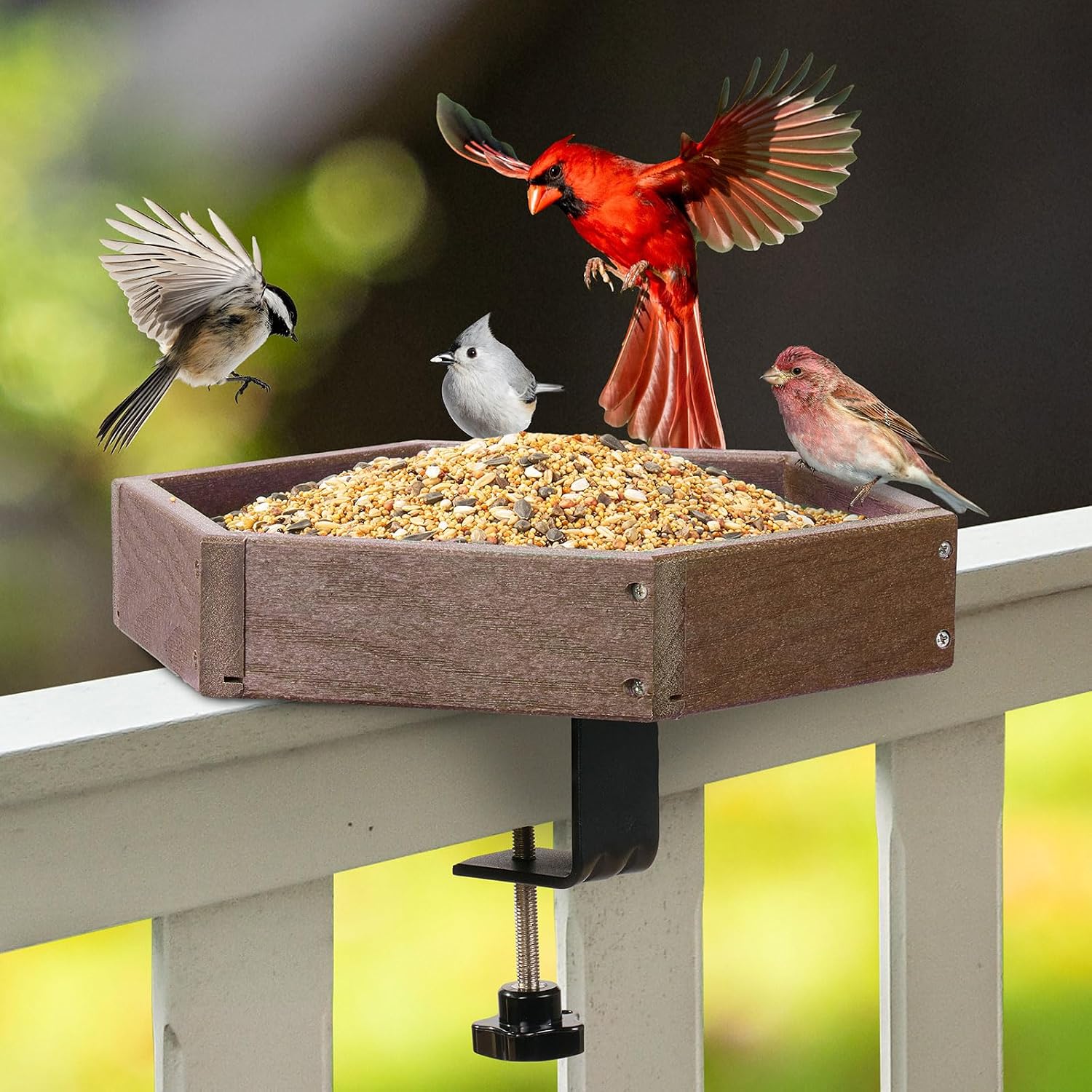
For deck and balcony rails: Kingsyard Clamp-On Deck Bird Feeder for Balcony Railings, No Drill
 Visit on Amazon →
The no-drill part is the reason this style exists. If you rent, or you have a composite rail you would rather not punch holes in, a clamp is the difference between feeding birds and not feeding birds. It also moves easily, which matters in a Wisconsin winter when the windward side of a deck ices up and you want the feeder on the sheltered side by December.
Flaws but not dealbreakers: A clamp is only as good as the surface it bites. Wide flat top rails and 2x4 caps are the sweet spot. A round metal rail or a glass balcony panel gives the clamp nothing to grab, and no amount of tightening fixes geometry. Measure your rail before you order, and check that the clamp clears the rail cap on both sides.
Second caveat: a rail feeder sits low. On a deck that is four feet off the ground, you are hanging seed at cat height. If cats patrol your yard, mount it on the inside of the rail or move it to a second-story balcony.
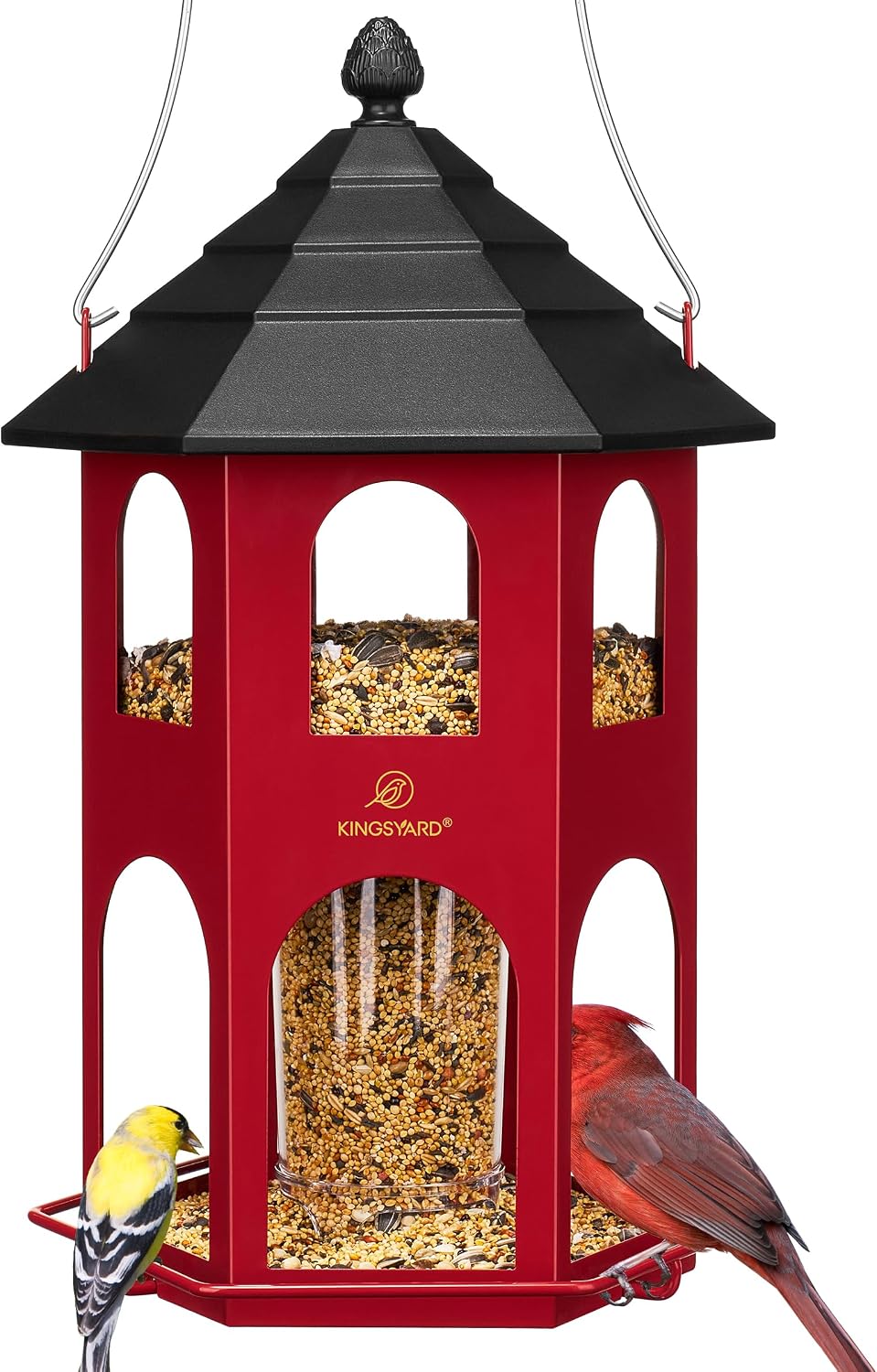
For hanging from a pole, hook, or branch: Kingsyard Metal Bird Feeder for Outdoor Hanging, Wild Bird Feeders with Circular Perch, Easy to Clean & Refill, 4 lbs Large Seed Capacity, Red
 Visit on Amazon →
Four pounds of capacity is the number that matters in January, when a feeder that holds a pound is empty by Tuesday and you are refilling in the dark before work. The circular perch is the second useful detail: perch birds like cardinals and house finches want to sit and look before they drop to the seed, and a ring around the body gives them that. Clingers such as chickadees and nuthatches will work the same feeder from the sides.
Easy to clean and refill is a claim I check before I trust it, because the difference between a feeder you clean weekly and a feeder you clean twice a season is whether the base comes off without a screwdriver. A metal body over a plastic one is also the right call here. Plastic gets brittle after a few freeze-thaw cycles, and a feeder that cracks in February is a feeder that dumps four pounds of seed into a snowbank.
Flaws but not dealbreakers: Capacity works against you in wet weather. More seed sitting in the weather means more seed at risk. In a humid stretch, fill it halfway and let the draw stay ahead of the mold.
The placement rules that matter more than the feeder
The feeder is the easy part. These are the rules that decide whether birds find it.
Step one: Pick the window distance. Either put the feeder within three feet of the glass, or push it out past thirty feet. Nothing in between. Birds that hit windows are the ones that build up speed across the yard, and a feeder three feet from the glass never lets them get going. This is the single change that stopped my own window strikes, and it came after a white-throated sparrow spent three days in a shoebox on my counter.
Step two: Set the height. Five to six feet off the ground for a hanging feeder, high enough that a cat cannot reach it from a standing jump and low enough that you can refill it without a ladder in February. Squirrels will use a low feeder as a launching pad, so keep the bottom of the seed ports above your tallest snowdrift.
Step three: Measure the squirrel distance. Eight to ten feet, minimum, from anything a squirrel can launch from: a tree limb, a fence top, a roof edge, a gutter. Squirrels do not need a running start, they need a jump-off point. If you cannot get eight feet of clearance, put a baffle on the pole and accept that you are managing squirrels rather than stopping them.
Step four: Find the escape cover, and respect it. Ten to fifteen feet from a shrub or a low tree is the range that lets birds dive for cover from a hawk without letting cats ambush from the same bush. Closer than five feet and you have built a cat blind. Farther than twenty and the feeder sits exposed.
Step five: Think about the weather side. Afternoon shade slows mold in the tray, and a feeder on the leeward side of the house stays dry in rain. Wet seed is the fastest route to a feeder you have to throw away, so if you have a choice, hang it where the prevailing wind is not driving rain straight into the ports.
Step six: Put it where you will watch it. This is not decoration. Draw is the only honest measure of a feeder, and you only notice draw if the feeder is in view from the kitchen table. The feeders I fill most often are the ones I can see.
Step seven: Add water nearby. Water brings more species to a yard than any seed blend, especially from June through August, and a bath within ten feet of the feeder gets birds moving between the two. Keep it shallow, keep it clean, and in winter check the wattage before you trust a heater.
The weekly routine that keeps birds healthy
Take the feeder apart, do not hose it down. A spray reaches the tray and misses the seams, the ports, and the inside of the reservoir, which is where the biofilm lives. Warm soapy water and a bottle brush once a week in warm weather, every two weeks in winter, and a diluted bleach soak after a wet stretch. Rinse thoroughly and let it dry completely before it goes back up.
Discard wet seed instead of topping it off. Clumped seed is a sign that moisture got in, and mixing fresh seed into a wet tray just spreads the problem. Every salmonella case I have seen in rehab traced back to a feeder nobody took apart since fall.
What does not work, no matter how you hang it
Suction cups. They hold fine in July and let go at the first hard freeze, and a tray that hits the porch at six in the morning does not come back for a second winter.
Seed blends padded with milo and red millet. The filler sits in the tray uneaten, molds in the rain, and doubles your cleaning schedule. Black oil sunflower or sunflower hearts are what actually empties.
Cheap plastic housings with "squirrel-proof" printed on the box. Squirrel-proof is a marketing word. Squirrel-resistant is a real thing, and the difference is measured in weeks of fox squirrel attention, not in the claim on the package.
Red dye in nectar, and ant moats that dry out by Tuesday. Neither is a feeder problem. Both are setup problems you can skip.
What this all costs
The feeder is the cheap part. Both designs here sit at the low end of the market, and the ongoing cost is seed, which is where the money actually goes. A forty-pound bag of sunflower hearts costs less per pound than small bags and produces zero hull litter, which matters if your feeder hangs over a deck or a patio. No-mess blends cost more per pound and buy you quiet from the neighbors and no sprouts under the platform.
The math I run is cost per cup of seed, not cost per bag, and draw per week, not capacity. A feeder that holds four pounds and empties in a week is doing its job. A feeder that holds four pounds and still has three left in March is telling you the placement is wrong, the seed is wrong, or both.
Get the placement right first. Hang it three feet from the glass or past thirty, eight feet from the nearest launch point, in view of a window you sit at. Then buy the feeder that fits the mount you actually have.