Most people build a backyard bird feeding station backwards. They buy a feeder, fill it, hang it on whatever hook is already in the yard, and then spend November scooping milo out of a tray nobody touched. I've fed birds in the same Madison, Wisconsin yard for twelve years and kept a log for ten of them: every species that visits, first-of-season dates, and how many cups of seed each feeder draws per week. That log is the reason I set a station up in a fixed order, and the order is not the one the product listings suggest.
Placement comes first, because a feeder in the wrong spot is a window strike waiting to happen. Seed comes second, because cheap blends are the most expensive seed you will ever buy. Cleaning comes third, because a dirty feeder is a disease vector with a perch. The hardware comes last, and it matters less than the first three decisions combined.
Here is that order, plus the two feeders I would hang first.
Why you should trust me
I'm a licensed wildlife rehabilitator. I run the songbird side of a county wildlife rescue out of my garage, the incubator lives in the laundry room, and the scale on my kitchen counter weighs rehab birds in grams. Twelve years of feeding, ten years of the log, 214 species on my county list, and 38 of those have landed on my feeders.
The rehab work is what made my feeder opinions strict. Every salmonella case I've handled traced back to a feeder nobody had taken apart since fall, and house finch eye disease arrives in intakes the same way. So I don't recommend a feeder I can't break down and scrub, and I don't call anything squirrel-proof until a fox squirrel has spent three weeks trying to prove otherwise. Most feeders are squirrel-resistant. That's a real and useful thing, and it's measured in weeks, not in the claim printed on the box.
Nothing gets a recommendation from me without a full season in my yard. No first-impression write-ups, no product photos standing in for the log.
How I judge a feeder before it earns a spot
Five questions decide it.
Will birds actually use it, or will it sit pretty on the pole and draw nothing? A feeder's real spec is how fast it empties. The log tracks draw in cups per week, and a feeder that holds three cups and sits full for two weeks is a decoration.
Can I take it apart and clean it in under ten minutes? If a feeder needs a screwdriver and a prayer to open, it becomes a dirty feeder by February.
What does a determined fox squirrel do to it in week one? Squirrels chew plastic ports, ride down hanging feeders, and empty a tray before the cardinals get a turn.
Will it survive a Wisconsin February, freeze, thaw, freeze? Metal and UV-stable plastic survive. Thin acrylic and suction cups do not.
Would I still hang it after four seasons? If the answer is no, it doesn't make the list.
That filter leaves me with a short list every time, and two feeders cover almost everything a new station needs: a weatherproof hanging feeder for seed, and a camera feeder if you want the log to write itself.
The feeders I'd hang first
You don't need six feeders to run a station. You need one that keeps seed dry and one that tells you what's visiting.
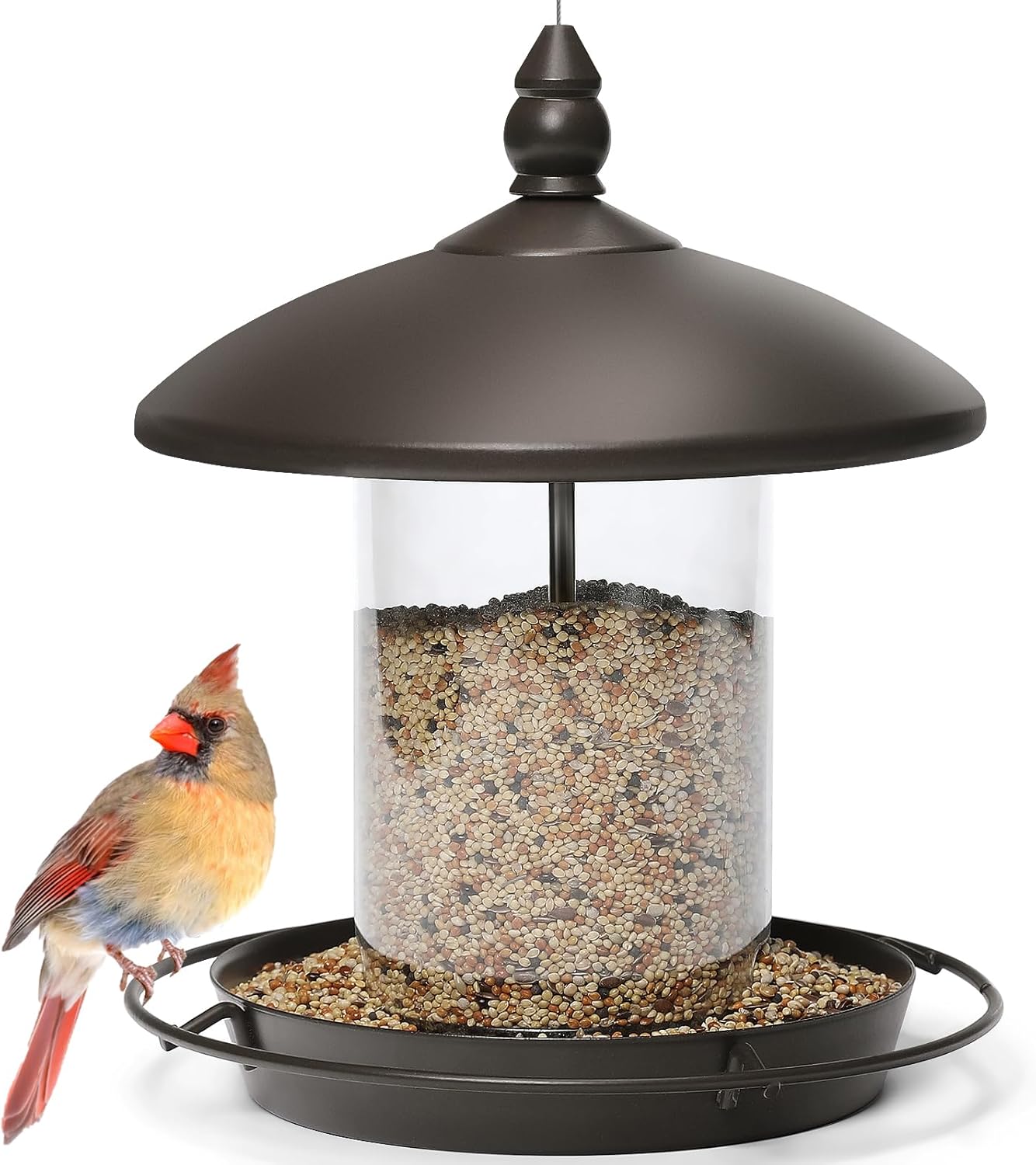
Budget pick: Youvip Metal Roof Bird Feeder - Chew Proof for Outdoor Hanging Wild Bird Seeds. Bronze
 Visit on Amazon →
Check current Amazon price. The metal roof is the feature that matters most in a wet climate, because wet seed clumps, molds, and gets ignored even by birds that would otherwise clean the tray. A roof that actually overhangs the seed keeps the draw steady through a week of rain, and it keeps you from dumping a tray of spoiled seed every third day.
The chew-proof claim is the second thing worth noting, and it's aimed at the right failure point. Squirrels don't usually break a feeder in half. They gnaw the seed ports until the openings widen, and then the feeder leaks seed every time it moves. Metal where the squirrel's teeth land is the honest fix for that, and it's why this one is the feeder I'd hang first for someone starting from zero.
The bronze finish is cosmetic, but it does one practical thing: it disappears against bark and fence line better than bright plastic, which keeps the station from looking like a yard sale from the kitchen window.
Flaws but not dealbreakers: No camera, no species ID, no app. This feeder's job is to hold seed and stay out of the way, and it does that job without a subscription or a battery. If you want to know exactly which sparrow is on the tray, you need the next pick. Also, hanging feeders swing in high wind, so plan on a hook or bracket that holds steady rather than a flimsy branch.
Anyone who wants a durable, low-maintenance seed feeder and doesn't need photos should start here.
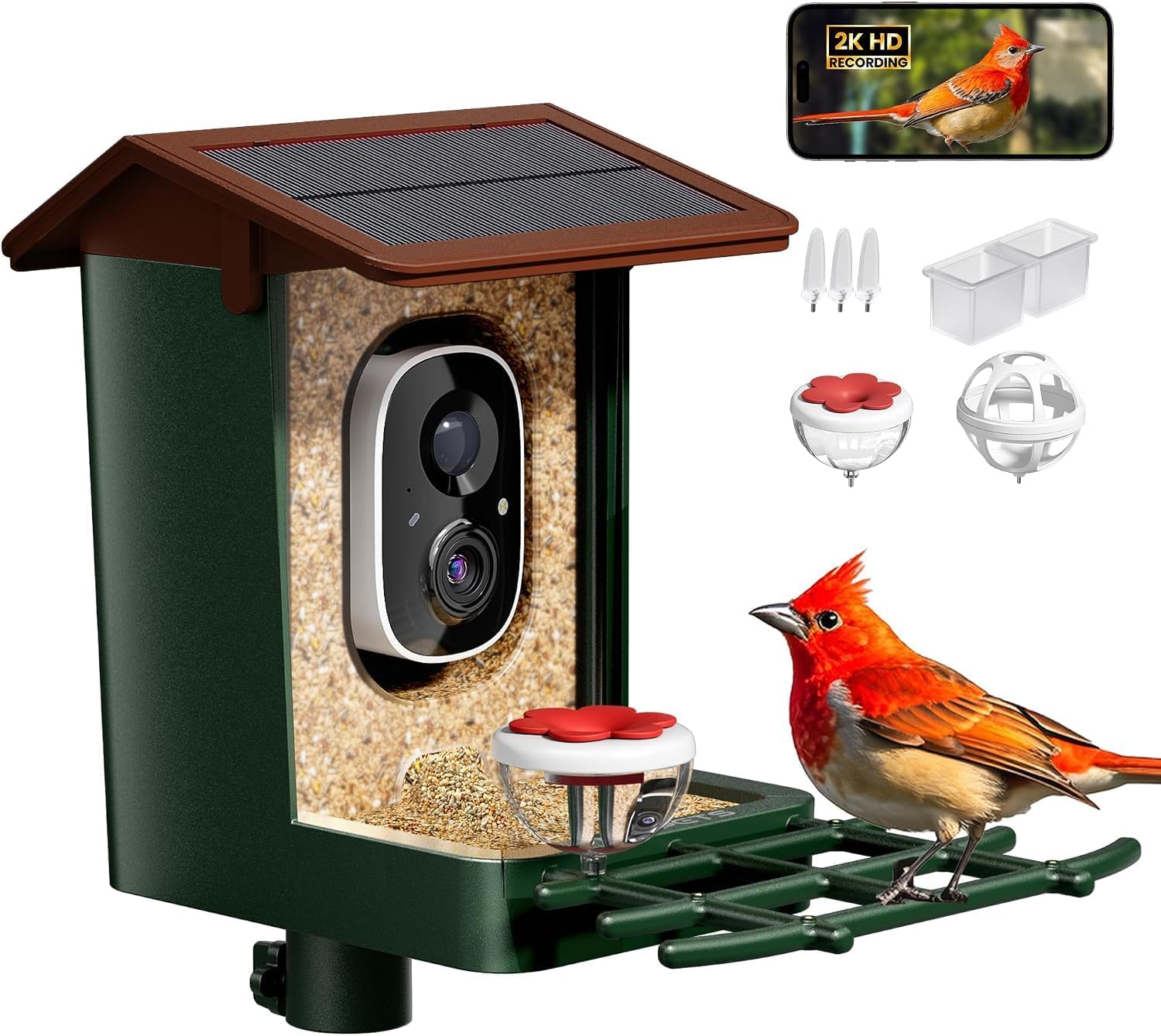
Upgrade pick: Smart Bird Feeder with Camera Solar Powered 2K HD Video, 10,000+ Species AI Recognition, Real-Time App Alerts, and Weatherproof Design for Effortless Birdwatching, Gift for Bird Lovers, Brown
 Visit on Amazon →
Check current Amazon price. This is the feeder for the person who wants the log without the spreadsheet. The camera records in 2K, the solar panel keeps it charged without you running an extension cord across the lawn, and the app sends alerts when something lands. The AI recognition covers a huge species list, which is genuinely useful for a beginner who can't yet separate a house finch from a purple finch at fifteen feet.
Two things about the solar and weatherproof design deserve a straight answer. Solar charging works when the panel gets sun, so mount it where the panel faces open sky rather than under a maple canopy, and expect a slow week in a string of gray December days. Weatherproof is the right claim for this category, and it still means you bring the unit in for cleaning rather than hosing it down on the pole.
Treat the AI identification as a starting point, not gospel. It gets the common yard birds right and it will occasionally guess on a juvenile or a female warbler. Cross-check anything surprising, because the interesting entries in a log are the ones that are wrong until you prove them right.
Flaws but not dealbreakers: It depends on your phone and your Wi-Fi, and it costs more than a plain hanging feeder. If you want zero app involvement, this isn't your feeder. As a gift for a birder who likes photos, it's the pick I'd hand over.
Placement: three feet or thirty, nothing in between
This is the rule that saves birds, and it's the one most people get wrong. A feeder goes either within three feet of the glass or more than thirty feet out. Nothing in the middle.
The reason is physics. A bird launching from three feet away can't build up enough speed to injure itself on impact. A bird launching from thirty feet out has room to see the glass, change course, and flare. The danger zone is the eight to twenty foot range, where birds hit full speed and can't react in time. My first window feeder went up three feet from the dining room glass after a white-throated sparrow survived a strike there and spent three days in a shoebox, and that placement has been my rule ever since.
Three more placement notes:
Hang seed feeders five to six feet off the ground, high enough to be out of a cat's reach and low enough to refill without a ladder.
Put the feeder within ten to fifteen feet of a shrub or evergreen. Birds want cover to retreat to, and a feeder in the middle of open lawn draws fewer species and more hawk strikes.
Add water. A bird bath or heated bath brings in more species from June through August than every feeder in my yard combined. Water first, seed second, is the honest ranking in the log.
Seed: read the ingredient list before the bag
The single most common reason a new feeder sits full is filler. Milo and red millet are cheap, they get swept out of a tray and left on the ground, and they mold after a rain. If either is near the top of the ingredient list, put the bag back.
What the log shows birds actually eat: black-oil sunflower, sunflower hearts, and no-mess blends. Black-oil sunflower draws the widest range of species and costs less per pound than most mixes. Sunflower hearts cost more but produce zero hull litter, which matters if the feeder hangs over a deck or you have a neighbor who counts the shells under your pole. No-mess blends are the answer for a patio, and you pay for the convenience.
Buy in bulk when you can. A large bag of sunflower hearts costs less per pound than small bags, and seed stores fine in a metal trash can with a lid in the garage. Nyjer goes in a mesh feeder for finches. Suet cakes go out when the first hard freeze hits and the woodpeckers start working the cage.
The cleaning routine that keeps birds alive
Once a week, every week, except the two weeks in August when the garden wins. Here's the routine.
Take the feeder apart. Not a hose spray. Apart, into pieces, so you can reach the corners where wet seed packs into a paste.
Wash in hot soapy water with a bottle brush, then rinse.
Disinfect with a diluted bleach solution, then rinse thoroughly and let everything dry completely before refilling. A feeder refilled wet is a feeder growing mold by Thursday.
Wash your hands, and wash the bird bath on the same schedule. Standing water grows algae and mosquito larvae faster than most people expect.
If you see a bird at the feeder with crusty or swollen eyes, take every feeder down, clean them all, and leave them down for two weeks. House finch eye disease spreads at the perch, and a half-cleaned feeder just restarts the clock.
The setup, step by step
Pick the spot. Three feet from a window or thirty feet out, near cover, in view of the kitchen. If you can't see it from where you drink your coffee, you'll stop filling it.
Mount the hardware. A shepherd's hook for hanging feeders, a pole system if you want a baffle, a bracket bolted through the sill if you're going with a window mount. Skip suction cups for anything outdoors in a freeze.
Hang the feeder five to six feet up and make sure it hangs level. A tilted feeder dumps seed on one side and draws from the other.
Fill it with black-oil sunflower or sunflower hearts, no more than a few days' worth while you're learning the draw.
Add water, and keep it open. This is the step that changes your species list.
Log the first week. Write down what showed up and how much seed disappeared. That number is your baseline, and it tells you when something changes, from a hawk in the neighborhood to a feeder that's gone moldy.
What I left off the pole
A few things I'd skip, and why.
Suction cup window feeders. I tested one through a January and watched a cup let go at six below, which sent the tray onto the porch. The window feeder that has survived three winters here has a metal bracket bolted through the sill. Suction cups are for screened porches, not for a Wisconsin February.
Plastic tube feeders with "squirrel-proof" printed on the label. If the ports are plastic and the warranty is short, it's squirrel-resistant for about a week. That's not a scam, it's just a different word, and it belongs in the description.
Seed blends padded with milo and red millet. Covered above, and it's the fastest way to waste money in this hobby.
Red dye in hummingbird nectar. Unnecessary, and it's not doing the birds any favors.
What this all costs
Hardware is the cheapest part of this hobby. Seed is the expensive part, and the gap widens every month you feed. A durable feeder that lasts four seasons costs less per day than the seed you pour through it in a single winter, which is the argument for buying the metal-roofed feeder once instead of replacing a plastic one twice.
The camera feeder sits in a different budget conversation, because you're paying for the sensor, the solar panel, and the software rather than for the seed capacity. If you keep a list and you like photos, it pays for itself in identification time. If you just want birds in the yard, the hanging feeder does the whole job.
Water is nearly free by comparison and brings more species than either one. Start there, then the feeder, then the seed, then the log. Twelve years in, that's still the order I'd give anyone setting up their first backyard bird feeding station.