Related: Winter feeding setup that keeps birds coming through February
Ten years of the log have settled one argument for good: the best backyard bird feeders are the ones the birds vote for, and they vote in cups per week. A hopper that draws three cups a week in January beats a prettier feeder that nobody touches, and no product photo has ever changed my mind about that.
The log is a spreadsheet. Every species that visits, the first-of-season date for each migrant, and how many cups each feeder pulls per week. It is why I trust draw over marketing copy, why I do not call anything squirrel-proof until a fox squirrel has had three weeks alone with it, and why every recommendation I make starts with two questions: how fast does it empty, and how hard is it to take apart.
These four are what I would hang this fall. An Amish-built poly hopper with suet cages for the perch birds and the clingers, two solar camera feeders at very different price points, and a 10 lb bag of seed that has to pass the filler test before it goes anywhere near a tray.
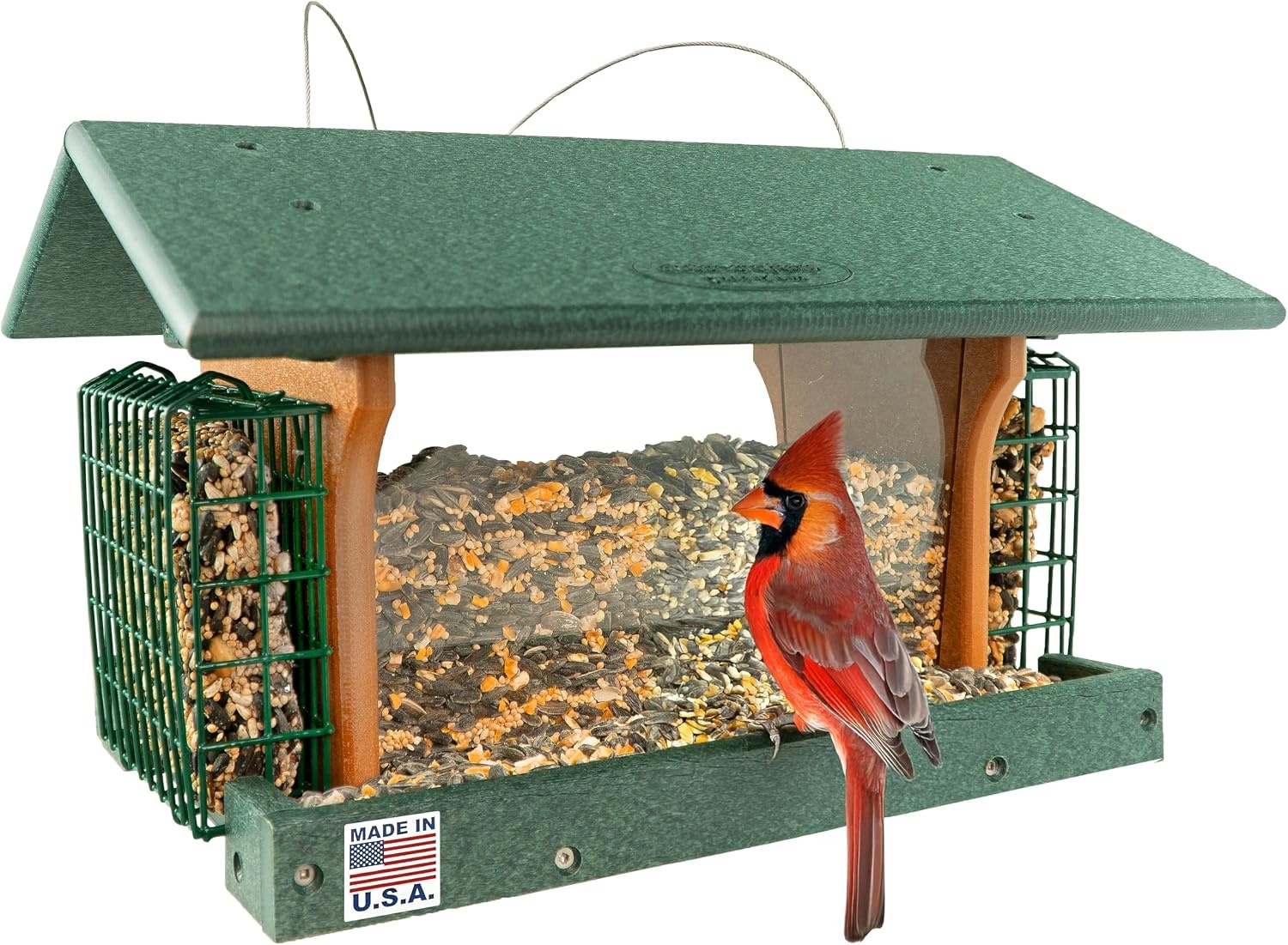
A hopper that does two jobs: DutchCrafters Poly Hanging Large Hopper Bird Feeder
Poly lumber is the first thing I look for in a feeder that has to sit outside in Wisconsin for four seasons. It does not rot, it does not crack the way cedar does after a freeze, thaw, freeze, and it does not need a fresh coat of anything in year three. This one is Amish made in the USA, in turf green and cedar, and it is a hanging hopper with two suet cake holder cages built into the design.
That combination matters more than it sounds. A hopper is a perch feeder: cardinals, house finches, jays, and the chickadees that never sit still long enough to be picky. Suet cages are for the clingers, the woodpeckers and nuthatches that feed sideways and upside down. Most yards end up with two hangers to cover both crowds. This one covers both on a single hook, which means one fewer pole, one fewer baffle, and one fewer thing to take apart on cleaning day.
What it does not claim to be is squirrel-proof, and I respect that. A hanging feeder is a squirrel conversation, not a squirrel solution. Hang it on a pole with a baffle, or from a line between two trees with a baffle at each end, or accept that you are feeding squirrels too. I have run that experiment three weeks at a time with a fox squirrel who treats my fence like a gymnasium, and the answer is always hardware, never marketing.
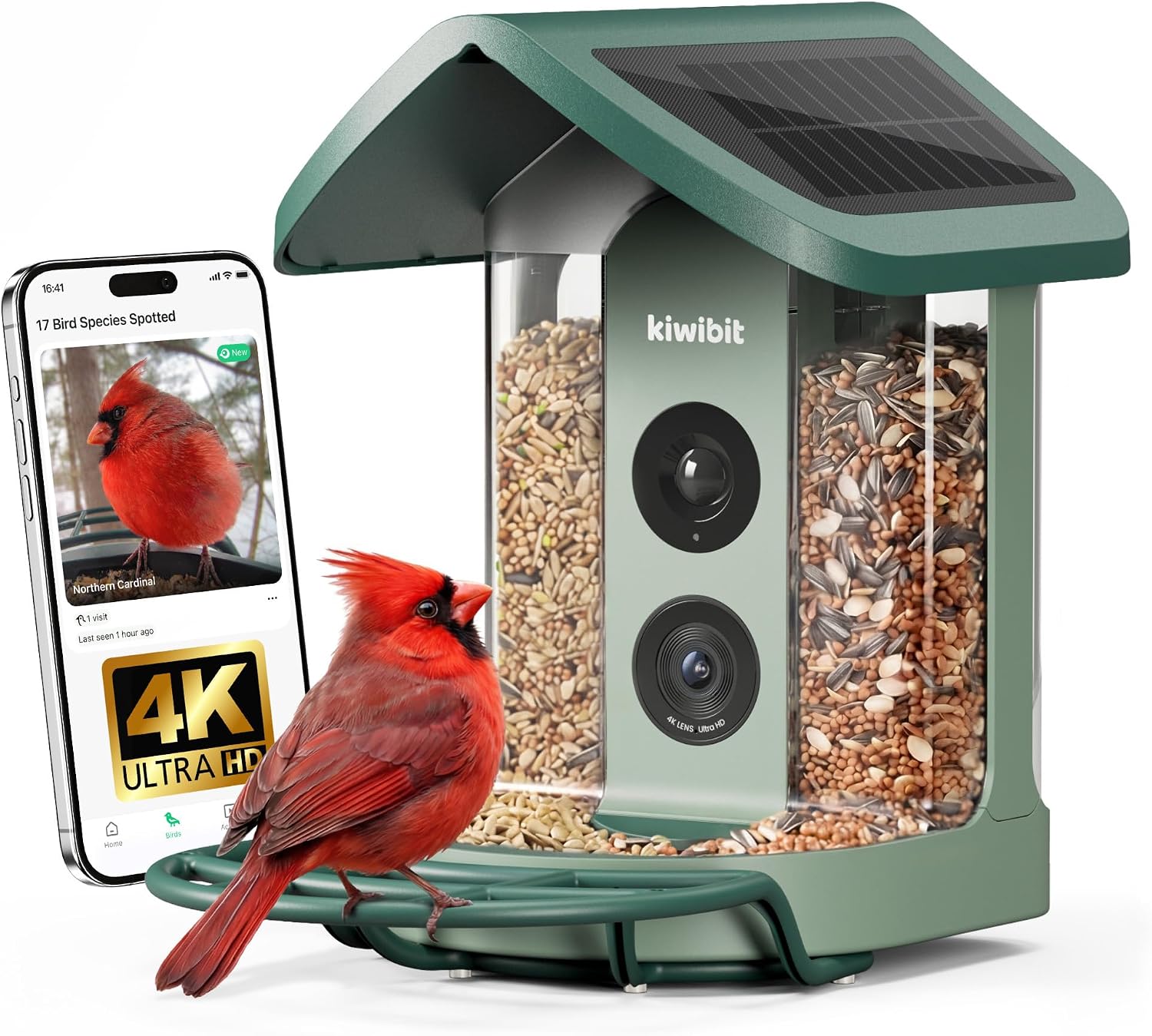
The 4K camera feeder: Kiwibit Solar Smart Bird Feeder with Camera
The Kiwibit is the camera feeder I would hang on the same pole as a hopper, because it answers a different question. The log tells me what visited. A camera feeder tells me when, and it does it with 4K HDR live video and AI bird ID, solar powered so it stays out there instead of coming inside to charge.
Here is where I am honest about camera feeders. AI bird ID is a starting point, not a verdict. It will get your northern cardinal and your blue jay every time. It will guess on the sparrows, the finch females, and anything in molt, and that is exactly where a 4K HDR frame earns its keep. Color nuance and bill shape are the whole identification on a house finch versus a purple finch, and a soft frame loses both of them.
Solar is the feature that decides whether you actually keep the thing running. A camera feeder you have to bring in to charge is a camera feeder that lives on the bench by December. Before I trust any of them, I check three things: whether the app wants a subscription for cloud clips, how the mount handles a February wind, and whether the notification stream is useful or just noise. A camera that pings me forty times about the same house sparrow is a camera I turn off.
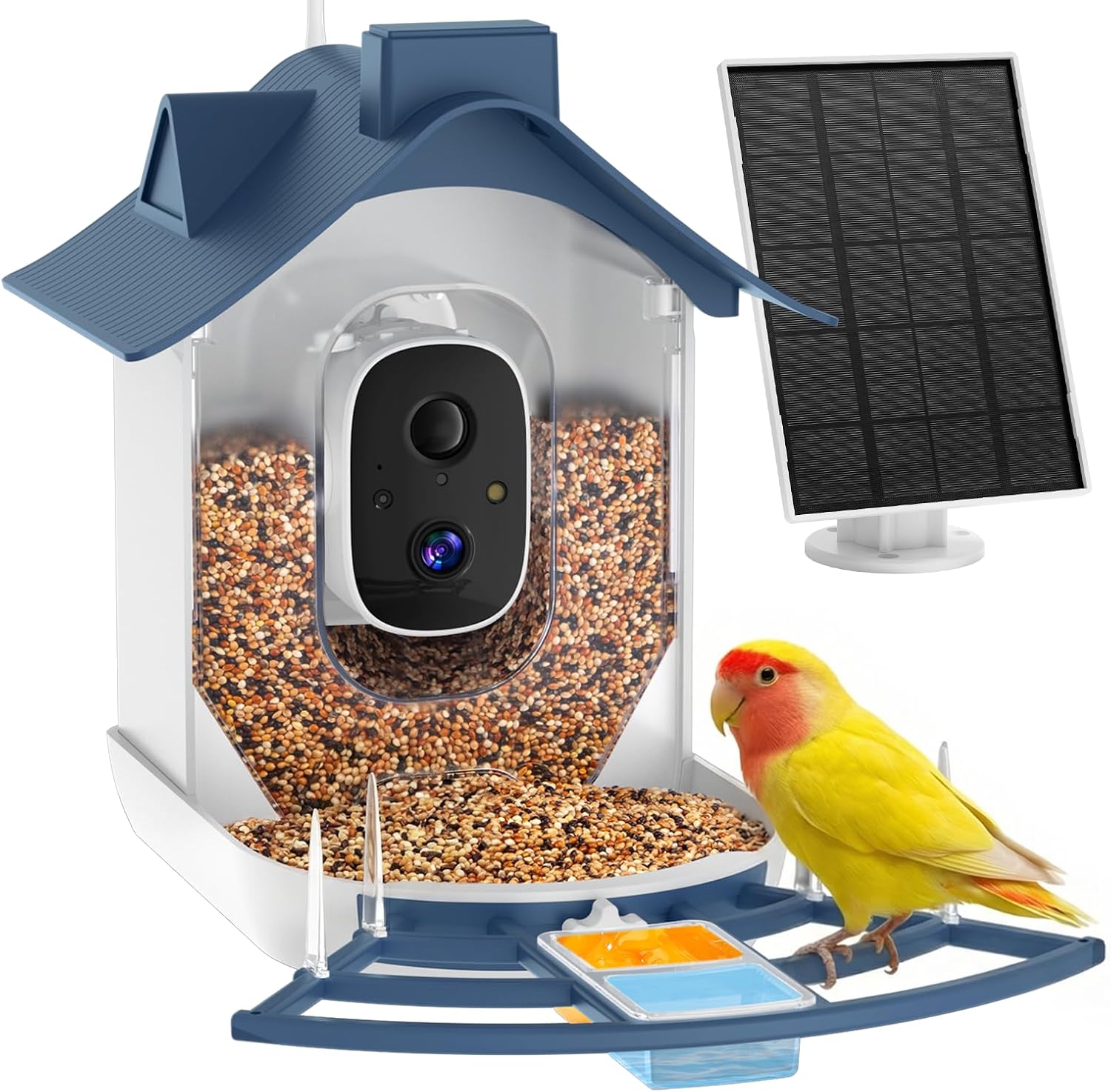
The entry point: Smart Bird Feeder with Camera, AI Bird Identification, Solar Powered
This is the other camera feeder on the list, and it is the lower-cost of the two. Solar powered, wireless, auto capture video, instant notifications, and AI bird identification, which is the same core feature set as the Kiwibit without the 4K HDR claim.
Who is it for? Someone who wants to know what is hitting the feeder at 6 a.m. while they are still in bed, and who is not sure yet whether they care about video quality. That is a real question, and it is worth answering with the cheaper camera before you spend Kiwibit money on an answer you might not need.
The risk with any entry-level camera feeder is the same risk as a cheap feeder: the mount, the housing, and the app support are where the corners get cut. Check the app's storage policy before you buy, because a subscription turns a cheap camera into an expensive one over three years. I would hang this one on a window-facing pole or a deck rail where I can also see the feeder with my own eyes. Half the value of a camera feeder is the record it keeps. The other half is that it makes you look.
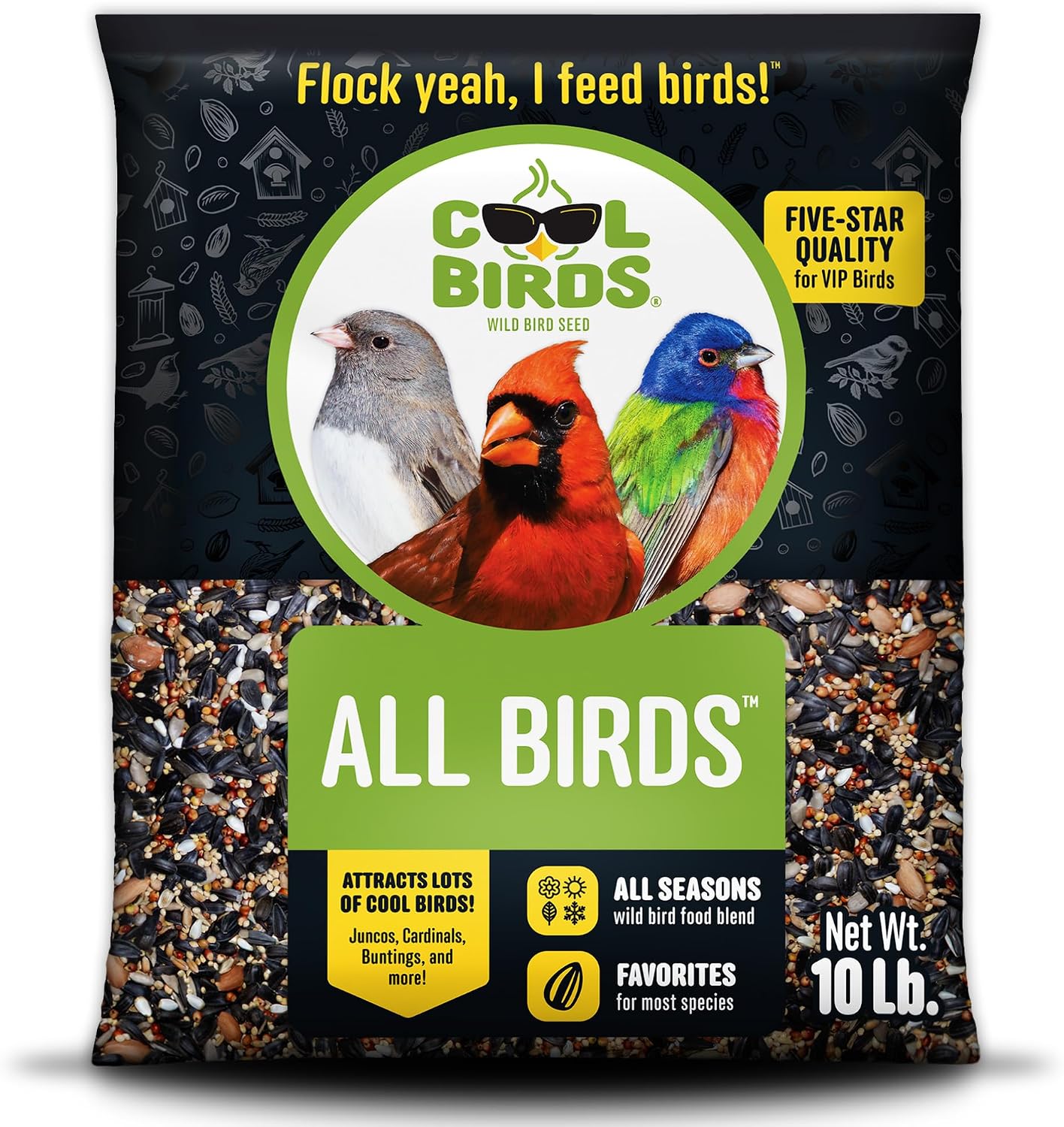
The seed: Cool Birds All Birds Wild Bird Seed, 10 lb
Seed is where most people lose the money they saved on a feeder. My rule has not changed in ten years: read the ingredient list before the bag goes in the cart. Black oil sunflower, sunflower hearts, peanuts, and white millet are worth paying for. Milo and red millet are filler. Filler sits in the tray, gets ignored, molds in the rain, and then I am scrubbing a platform twice as often as I should be.
This is a 10 lb all-purpose bag, and 10 lb is the right size for one hopper and one person who wants the seed to stay fresh. Seed goes stale, and a 40 lb bag that sits in a warm garage from June to October is not a bargain. If you are running three feeders and a platform, buy in bulk and store it in a sealed bin. If you are running one hopper and testing whether a blend works in your yard, start here and watch the tray. If the birds leave the same color of seed behind every single day, that is your answer about the blend.
How I judge a feeder before it earns a spot
Five questions, every time. Will the birds actually use it, or will it sit pretty on the pole? Can I take it apart and clean it in under ten minutes? What does a determined fox squirrel do to it in week one? Will it survive a Wisconsin February, freeze, thaw, freeze? Would I still hang it after four seasons?
Cleaning is the one people skip, and it is the one that matters most. I have seen house finch eye disease and salmonella in rehab intakes, and every case traced back to a feeder nobody had taken apart since fall. A hose spray is not cleaning. You take it apart, you scrub it, you rinse it, and you let it dry all the way before it goes back up. In warm weather that is a weekly job. A feeder that makes that job hard is a feeder that will not get cleaned, and a dirty feeder is a disease vector with a perch.
What the log says about feeder types
Match the feeder to the bird. Hoppers and platforms feed the perch birds: cardinals, jays, finches, doves. Suet cages and mesh feeders feed the clingers: woodpeckers, nuthatches, chickadees. Camera feeders feed the log, and they feed it with timestamps, which is the part I did not know I wanted until I had it.
And water. I say this in every one of these guides: water brings more species to a yard than any seed blend. From June to August, the bath gets more entries in my log than every feeder combined. If you have budget for one upgrade this fall and you already own a feeder, make it a heated bath before you make it a camera.
Placement, window strikes, and the three-foot rule
Placement decides more than the feeder does. A feeder three feet or closer to glass prevents window strikes, because a bird cannot build up speed across three feet. My first window feeder went up three feet from the dining room glass after a white-throated sparrow hit it and spent three days recovering in a shoebox in my laundry room. That bird is the reason I feed birds at all.
The other end of the yard matters too. Keep feeders either within three feet of glass or more than thirty feet from it, never in the middle distance where a startled bird has room to accelerate. Put the feeder where you can see it from a chair you actually sit in, because a feeder you do not watch is a feeder you do not clean. And keep a baffle on the pole, always, even the pole you think squirrels cannot climb.
The feeder reference table
This is the table I keep for the four products in this guide: what each one is, what it brings to the yard, and where to check it. I do not print prices here, because they move, and a number in a table is stale by the time you read it.
| Product | Type | Best for | Price |
|---|---|---|---|
 Visit on Amazon → Visit on Amazon →DutchCrafters Poly Hanging Large Hopper Bird Feeder |
Hanging hopper with two suet cages | Perch birds and clingers on one hanger; poly lumber for four-season weather | $154.00 |
 Visit on Amazon → Visit on Amazon →Kiwibit Solar Smart Bird Feeder with Camera |
Solar camera feeder | 4K HDR video and AI bird ID to timestamp the log | $239.99 |
 Visit on Amazon → Visit on Amazon →Smart Bird Feeder with Camera, AI Bird Identification |
Solar camera feeder | Auto capture video and instant notifications at the entry point | $32.99 |
 Visit on Amazon → Visit on Amazon →Cool Birds All Birds Wild Bird Seed, 10 lb |
Seed | One hopper, fresh seed, a blend test before you buy bulk | $15.09 |
The table is the short version. The long version is the log, and the log only cares about one thing: does the tray empty, and how fast.
Should you buy the Kiwibit Solar Smart Bird Feeder with Camera?
If you want your log to carry timestamps and you are willing to check the app's storage policy before you commit, yes. 4K HDR is not a spec sheet flex at feeder distance. It is the difference between identifying a finch and guessing at one, and solar power is what keeps the camera outside instead of on a bench waiting for a charge.
The honest caveat is the AI bird ID. Treat it as a first guess and verify against the frame, the same way I verify a rehab intake against Sibley before I write anything down. And decide up front whether the notification stream is a tool or a toy, because the birds do not care either way.
Should you buy the DutchCrafters Poly Hanging Large Hopper Bird Feeder?
If you want one hanger that feeds the perch birds and the clingers, and you want it to look the same in year five as it did on day one, yes. Poly lumber and Amish construction are the two things that make a hanging feeder last, and the two suet cake holder cages save you a second pole and a second cleaning job.
Hang it with a baffle. Keep it off the squirrel highway. Put it on the weekly cleaning schedule with everything else, because the feeder that never comes apart is the one that ends up in a rehab intake story. And if you are new to this, buy the seed first and the hardware second. The birds will tell you what they want, in cups per week, faster than any product page can.