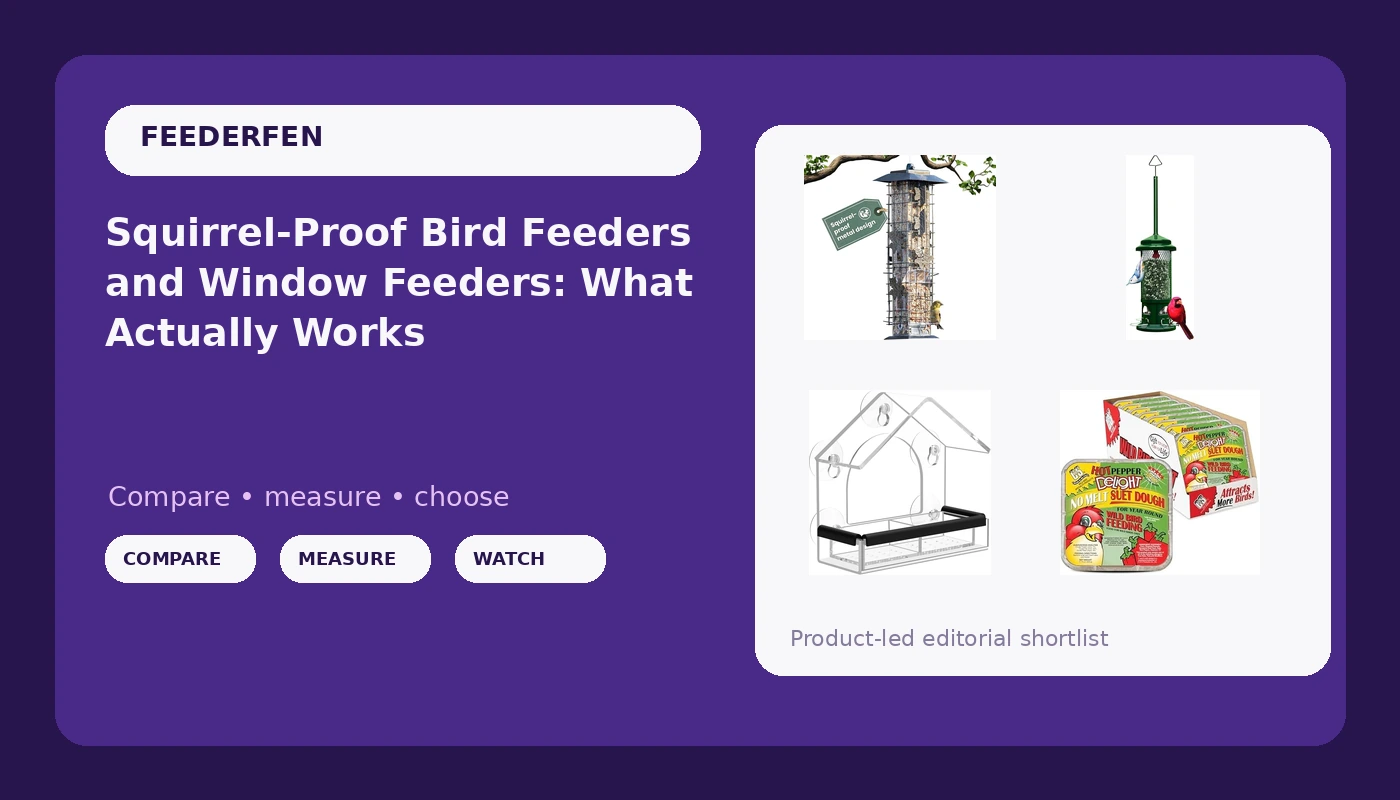
Most backyard feeding problems are not bird problems. They are engineering problems wearing feathers. A tube feeder on a pole gets emptied by a fox squirrel before lunch, a suction-mount window feeder holds for a season and then lets go in the first hard freeze, and a suet cake turns to grease by mid-February. By the time people write to me, they have already bought three feeders and taken one down out of frustration. The fix is not a prettier feeder. It is deciding what each feeder is for, then buying the version of that feeder that survives your winter. What follows is the honest version of that decision for a squirrel-proof bird feeder setup: two seed feeders with different jobs, one window feeder for close viewing, and one suet station for the birds that spend winter hammering bark. Each pick here carries a trade-off, and you should know the trade-off before you hang it.
Related: How to Clean a Bird Feeder So It Never Becomes a Disease Vector →
Quick answer
No single feeder solves a squirrel yard, and any product that claims otherwise is selling a word instead of a mechanism. The practical answer is a two-feeder defense: one weight-activated tube feeder hung where a squirrel has to put its weight on the feeder itself to reach the seed, plus a second feeder you are willing to risk. Around that, add a suet station for woodpeckers and nuthatches and a window feeder if you want birds close enough to identify without binoculars. Capacity matters less than draw. A feeder that empties in four days is being used; a feeder that still holds seed after two weeks is decoration. Cleanliness matters more than either, because a dirty feeder is a disease vector with a perch on it. Take it apart, wash it, dry it, repeat weekly.
Four useful options
| Model | Best fit | What stands out |
|---|---|---|
| Squirrel Buster Standard Squirrel-proof Bird Feeder w/4 Metal Perches, 1.3-pound Seed Capacity, garden green | Squirrel pressure on a pole | Weight-activated design, four metal perches, 1.3-pound capacity |
| Perky-Pet Squirrel-Be-Gone Bird Feeder, 2 lb Seed Capacity | More seed per refill | 2-pound capacity, squirrel deterrence built into the perch design |
| Clear Window Bird Feeder with 5 Extra Strong Suction Cups, DY-SKTY Sturdy and Durable Acrylic Birdfeeders for Viewing Wild Birds Outside, as a Bird Watching Gift, Outdoor Birdhouse Box, Garden Decor | Close viewing from indoors | Five suction cups spreading the load, clear acrylic body |
| C&S Hot Pepper Delight No Melt Suet Dough, Suet Cakes for Wild Birds | Winter suet for clinging birds | Hot pepper coating, no-melt dough formula |
The squirrel defense: Squirrel Buster Standard Squirrel-proof Bird Feeder w/4 Metal Perches, 1.3-pound Seed Capacity, garden green
The word "proof" in the product name is a claim, and what you are paying for is the mechanism behind it: a shroud that drops and shuts the seed ports when extra weight settles on the perches. That design only works if the squirrel has to put its weight on the feeder to reach the seed. If your pole sits within leaping distance of a fence, a shed roof, or a low branch, a squirrel can reach in from the launch point and the shroud never gets its chance. Fix the location first, then hang the feeder. The 1.3-pound capacity is the other trade-off. It is a small tube, and in a yard with a heavy winter flock you will be topping it up more often than a larger feeder. That is not a flaw if it means fresh, dry seed, but go in knowing it.
The bigger hopper: Perky-Pet Squirrel-Be-Gone Bird Feeder, 2 lb Seed Capacity
This is the option for someone who wants more seed per refill and a smaller outlay, and who understands what the name is. Squirrel-Be-Gone describes a style of weight-activated perch, not a guarantee about your particular squirrels. The 2-pound capacity is roughly half again what the 1.3-pound tube holds, and in January that difference is the difference between one trip outside and two. Read every squirrel claim on a box as a description of the mechanism plus a manufacturer's promise. The word "proof" should be earned, and the test is weeks of squirrel pressure, not a product photo. Resistant is a fine thing to own as long as you know that is what you bought.
The close-up view: Clear Window Bird Feeder with 5 Extra Strong Suction Cups, DY-SKTY Sturdy and Durable Acrylic Birdfeeders for Viewing Wild Birds Outside, as a Bird Watching Gift, Outdoor Birdhouse Box, Garden Decor
Window feeders are the best value in bird watching, because they turn your kitchen table into a blind. The trade-off is the mount. This one hangs on five suction cups against the glass, which spreads the load better than a single cup, and the clear acrylic means you look through the feeder rather than at it. Suction cups are still the weak point in a yard that freezes and thaws: the failure mode is not gradual, it is a tray on the porch one morning. Two habits reduce that risk. Mount it within three feet of the glass, the distance at which a bird cannot build enough speed to hurt itself if it startles toward the window, and reseat the cups every time you refill. A window feeder you check weekly is a window feeder. One that falls in a January cold snap is a lesson.
The winter station: C&S Hot Pepper Delight No Melt Suet Dough, Suet Cakes for Wild Birds
Suet is winter fuel for the birds that spend the cold months prying bark: downy and hairy woodpeckers, nuthatches, chickadees. No-melt dough is the version that survives a thaw, and the hot pepper is the useful trick. Capsaicin is something mammals taste and birds do not respond to in the same way, so the cakes stay uninteresting to squirrels and raccoons while the woodpeckers keep working them. You still need a cage. Suet without a feeder is a greasy stain on a branch, and a vinyl-coated basket is kinder on feet in a hard freeze than bare wire. Hang it where you can watch it from a window you actually sit at, because suet draws the most interesting birds of the winter list.
Prices and availability may change. Check the current listing for details before you buy.
What "squirrel-proof" actually means
Three mechanisms show up on feeders sold as squirrel-proof, and they fail in different ways.
Weight-activated ports close when extra weight lands on the feeder. That is the design behind the Squirrel Buster line and the Squirrel-Be-Gone perch. It works when the squirrel has to put its weight on the feeder, which means position does more for you than the cage does.
Baffles and cages are passive. A baffle above or below a pole blocks a climbing route. A cage around a tube keeps a squirrel's arms out of the seed. Baffles are cheap and effective on a pole that stands alone, and they stop working the moment a branch overhangs the feeder or a fence gives a squirrel a launch point.
Spinning and spring-loaded perches are the third family. They rotate or collapse under weight. They can work, and they usually cost less than a weight-activated tube.
None of this makes a feeder squirrel-proof, because squirrels are persistent and the word is marketing. What makes a feeder hold up in practice is the combination of a mechanism that closes the seed off and a location where a squirrel cannot reach it from something else. A pole planted well away from anything a squirrel can climb is a better investment than a more expensive feeder planted under a branch. That is also why capacity is a secondary spec. A feeder that holds a lot of seed and hands it all to the squirrels is a squirrel feeder.
How to plan a setup that lasts through winter
Before you buy anything, write down what each feeder is for. A yard with four feeders doing the same job is a yard with four squirrel targets and one species list.
- Assign a job to every feeder: one squirrel-defended seed feeder on a pole, one window tray for close viewing, one suet basket for clingers.
- Place for squirrel geometry first. Move the pole out of leaping range of fences, roofs, and low branches before you hang anything.
- Place for window safety second. Mount window feeders within three feet of the glass so a startled bird cannot build speed toward the pane.
- Match feed to hardware. Sunflower hearts and no-mess blends in tube feeders, suet cakes in a coated basket, nyjer in mesh for finches.
- Set the cleaning rhythm on day one. Full disassembly, hot soapy water, thorough dry, weekly, not when the feeder looks bad.
Placement, feed, and cleaning rules that decide the outcome
- Put a squirrel-defended feeder on a pole with clear air around it, not on a branch or a post next to a fence.
- Buy seed by ingredient list. Milo and red millet sit uneaten, mold in the rain, and cost you a second cleaning.
- Hang suet for clingers rather than perch birds, and expect woodpeckers on it within the first cold week.
- Take feeders apart to clean them. A hose spray is not cleaning, and it does not touch the seams where disease sits.
- Track how many cups each feeder draws per week. Draw is the only honest answer to whether a feeder is working.
Which option should you choose?
Choose the Squirrel Buster Standard Squirrel-proof Bird Feeder w/4 Metal Perches, 1.3-pound Seed Capacity, garden green when squirrels already own your pole and you want the feeder built around a weight-activated mechanism. Choose the Perky-Pet Squirrel-Be-Gone Bird Feeder, 2 lb Seed Capacity when refill trips are the thing that annoys you most and a 2-pound hopper with a weight-activated perch suits your budget. Choose the Clear Window Bird Feeder with 5 Extra Strong Suction Cups, DY-SKTY Sturdy and Durable Acrylic Birdfeeders for Viewing Wild Birds Outside, as a Bird Watching Gift, Outdoor Birdhouse Box, Garden Decor when identification from the couch matters more than capacity, and you will check the cups on a schedule. Choose the C&S Hot Pepper Delight No Melt Suet Dough, Suet Cakes for Wild Birds when you want a winter station for woodpeckers and nuthatches that holds its shape through a thaw.
One caveat applies to all four. No feeder is squirrel-proof in every yard, suction-mounted feeders depend on glass, temperature swings, and your own diligence, and the capacities printed on a box describe seed volume rather than how often you will actually refill. Judge results by your own draw, not by the claim.
The bottom line
Build the setup in the order the problems arrive. Squirrels first, because they are the reason most feeders come down. Start with a feeder whose mechanism closes the seed off and a pole planted where nothing gives a squirrel a shortcut, then add a suet station for the winter bark workers and a window feeder for the hours you would rather not stand outside. Keep the seed dry, keep the hopper honest by buying by ingredient list instead of by price per bag, and take everything apart once a week whether it looks dirty or not. Draw is what tells you the truth: if a feeder empties steadily, birds are using it, and if it sits full for two weeks, something about placement, feed, or cleanliness is wrong. Fix that before you buy a fifth feeder.