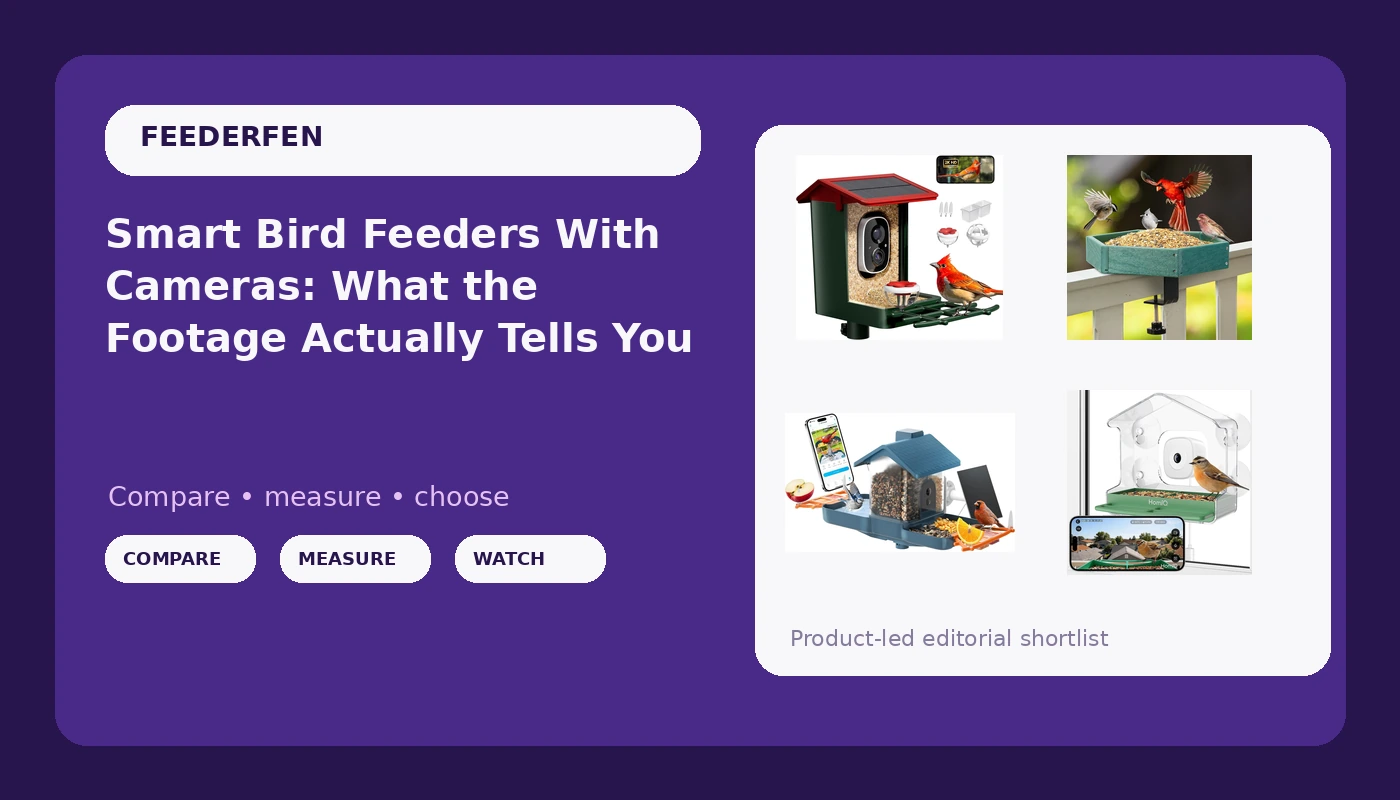
A smart bird feeder with camera promises something backyard birding has never really had: a dated record of every visit, with a timestamp and a suggested name attached. The catch is that the four feeders in this group solve that problem in four different ways, and almost none of the differences come down to image quality. They mount in different places, they draw power differently, and they ask different amounts of work from the person filling them. A camera feeder that loses its charge in a cold snap, or that has to be unbolted every time you clean it, stops being a camera feeder within a month and becomes a very expensive perch. This explainer covers what each style actually is, what the AI identification layer can and cannot do, and how to match the feeder to the spot you already have.
Related: How to Place a Window Feeder Without Inviting Window Strikes →
Quick answer
Match the mount and the power source to your yard before you compare camera specs. If your birdwatching happens from a chair at the glass, a window-mounted camera unit puts the lens where you already sit. If your feeding station is a pole out in the open, a solar-powered camera feeder is built for that exposure. If you rent, or your only outdoor space is a balcony rail, a clamp-on deck feeder needs no drilling at all. And if you want water and footage on a single mount, a solar camera feeder bundled with an outdoor bird bath covers both jobs.
Four useful options
| Model | Best fit | What stands out |
|---|---|---|
| Smart Bird Feeder with Window Camera | Viewing from inside at the glass | 2K HD window viewing, AI species recognition, Alexa compatible |
| Smart Bird Feeder with Camera Solar Powered | Poles and open mounting spots | Solar powered, 2K HD video, weatherproof design |
| Kingsyard Clamp-On Deck Bird Feeder for Balcony Railings, No Drill | Renters, balconies, small decks | Clamps to railings with no drilling |
| Smart Solar Bird Feeder with Camera & Outdoor Bird Bath | Yards that need water as well as seed | Solar camera feeder and bird bath on one setup |
Window mount: Smart Bird Feeder with Window Camera, 2K HD Camera for Window Viewing, AI BirdSpecies Recognition & Instant Alerts, Sturdy Acrylic Outdoor, Alexa Compatible, Gift for Bird Lovers
The appeal here is placement logic rather than hardware. A window feeder mounted close to the glass is the classic recommendation for reducing window strikes, because a bird leaving the feeder cannot build up the speed it needs to hurt itself on the pane behind it. Putting the camera on the same mount means the footage comes from the angle you already watch from, which is usually the best angle in the yard. The trade-offs are the ones that come with glass: reflections and interior light can wash out footage during bright afternoons, and a suction or bracket mount on a single pane gives you less flexibility about where the feeder hangs than a pole does. Acrylic is light and cleans easily, but it also scratches, so a soft brush matters more than it does on a powder-coated metal feeder.
Solar pole: Smart Bird Feeder with Camera Solar Powered, 2K HD Video, AI Bird Species Identification, Instant Arrival Alerts, Weatherproof Design for Effortless Birdwatching, Best Gift for , Red
Solar changes the daily math of a camera feeder. There is no cable to run and no battery to swap on a schedule, but the panel has to see sun, which is the same requirement a feeder on a shaded north wall will never meet. If your best feeding spot is under a maple canopy, a solar unit will spend the winter running at a deficit and the alerts will thin out accordingly. The other thing to think about is where the feeder sits relative to your Wi-Fi. A pole at the back of a quarter-acre lot is often right at the edge of reliable coverage, and a camera that drops its connection is a camera that misses the arrival it was supposed to catch. Weatherproof is the manufacturer's description of the housing, not a promise about how the seed inside it fares after three days of rain.
Railing clamp: Kingsyard Clamp-On Deck Bird Feeder for Balcony Railings, No Drill
This one is not a camera feeder, and that is the point. It solves the mounting problem that stops a lot of people before they get to the camera question: no drill, no bracket, no landlord conversation. Clamp feeders are also the easiest category to move, which matters if you are still learning where birds in your space actually want to feed. The honest limits are mechanical. A clamp is only as solid as the rail it grips, so a wide flat cap rail and a thin round metal rail are very different anchors, and a feeder that shifts in wind spills seed. Because there is no camera, this is the feeder you pair with binoculars, or with a camera unit hung separately, and it is the one to pick if you would rather spend the budget on glass and seed than on an app.
Camera plus water: Smart Solar Bird Feeder with Camera & Outdoor Bird Bath
Water is the piece most feeders skip, and it is the piece that brings in birds that never touch a seed tray, including many of the warblers and thrushes that pass through in migration. Combining a bath with a camera mount means one installation instead of two, and the camera gets a second subject: bathing behavior is genuinely different from feeding behavior, and it happens at different times of day. The cost of that convenience is maintenance. A bird bath needs emptying and scrubbing more often than a seed feeder does, because standing water grows algae fast in summer and freezes solid in winter, and a camera pointed at a scummy bath is not the footage anyone wants. If you go this route, plan on the bath being the thing you clean most often.
Prices and availability may change. Product images, names, and retailer links are matched to verified listings. No current price, rating, stock status, or measured result is stated here without current evidence.
What AI species identification can and cannot do
AI identification on a camera feeder works the way most image recognition works: the app compares frames against a trained model and returns the most probable match, usually with a confidence figure attached. That is genuinely useful for the common, distinctive visitors. A northern cardinal, a blue jay, a downy woodpecker, and an American goldfinch in breeding plumage are all easy calls, and the alerts are a real convenience when you are at work and want to know what showed up at 10 a.m.
Where it gets shaky is exactly where a serious list-keeper cares most. Female and immature birds are the classic failure point, because a lot of species identification depends on plumage that juveniles and females do not have. House finches and purple finches trip up both apps and humans, and so do Cooper's hawks and sharp-shinned hawks, whose separation depends on proportions and head shape rather than color. Motion blur, backlighting, a bird half-hidden behind a port, and a feeder visited by twenty house sparrows in ten minutes all produce confident wrong answers. Treat the AI label as a suggestion that starts your identification, not a record you file without checking. If you keep any kind of list, confirm anything unusual against a field guide before it goes in.
The other limit is structural: identification is only as good as the image, and the image depends on distance, light, and how still the bird holds. A camera that captures a clear frame at arm's length will outperform a higher-spec camera pointed down a long pole at a bird in shade.
Mounting, power, and cleaning: what outlasts the camera
Every camera feeder is three systems stacked on one mount, and they fail independently. The seed system fails when hulls clog the ports or when moisture turns the bottom of the hopper into a cake. The camera system fails when the battery runs down, the panel is shaded, or the Wi-Fi drops. The mount system fails when the clamp loosens, the suction lets go, or the pole leans. Only one of those three is the fun part, which is why the boring decisions deserve the first pass.
Cleaning is the one that affects bird health rather than your convenience. Feeders concentrate birds, and concentrated birds share pathogens. House finch eye disease and salmonella outbreaks in backyard birds trace back to feeders that were not taken apart and disinfected on a schedule. If a feeder cannot be disassembled and scrubbed, it will be cleaned less often than it should be, and that is a welfare problem, not a hobby preference. A weekly routine with a diluted bleach solution, a thorough rinse, and full drying before refilling is the standard, and it applies to camera feeders exactly as it applies to a ten-dollar tube.
- Decide where the feeder hangs before you look at cameras, because mount point eliminates most options immediately.
- Confirm the power path: direct sun for a solar unit, or an outlet and cable route for anything that needs charging indoors.
- Check Wi-Fi strength at the exact mounting spot with your phone, not from the kitchen window.
- Verify that the seed hopper and the bath, if included, come apart for cleaning without tools.
- Set a cleaning schedule you will actually keep, and write the first date on the calendar before the feeder goes up.
Practical guidance for the first month
- Hang the feeder where you can see it from a chair you already use, or you will stop checking the app.
- Keep window-mounted feeders close to the glass rather than far from it, since distance is what gives a bird room to build speed.
- Expect a settling period: new feeders often sit untouched for days before the first bird commits, and the log rarely shows a same-day arrival.
- Start with black-oil sunflower or sunflower hearts, which most feeder species take and which leave less waste than blends padded with milo and red millet.
- Clean and refill on the same day each week, and take the feeder down entirely if you see a sick bird at it.
Which option should you choose?
Choose the Smart Bird Feeder with Window Camera, 2K HD Camera for Window Viewing, AI BirdSpecies Recognition & Instant Alerts, Sturdy Acrylic Outdoor, Alexa Compatible, Gift for Bird Lovers when your birdwatching happens from indoors and you want the camera at the glass. Choose the Smart Bird Feeder with Camera Solar Powered, 2K HD Video, AI Bird Species Identification, Instant Arrival Alerts, Weatherproof Design for Effortless Birdwatching, Best Gift for , Red when your feeding station is a pole or post in open sun and you would rather not run power to it. Choose the Kingsyard Clamp-On Deck Bird Feeder for Balcony Railings, No Drill when you rent, have only a railing, or want to spend the budget on optics instead of a camera. Choose the Smart Solar Bird Feeder with Camera & Outdoor Bird Bath when you want water in the yard and footage of the birds using it.
One caveat applies to all four: the specifications here come from the listings, not from a season of observation. Solar performance, weather resistance, clamp grip, and AI accuracy all depend on your light, your climate, your rail, and your local species mix, and none of that can be settled by a product page. Buy for the mount and the power source you can actually support, then judge the camera on the footage you get.
The bottom line
A camera feeder is a mounting decision wrapped around a battery decision, with a camera attached. Get those two right and the AI identification is a bonus that saves you time on common birds and occasionally embarrasses itself on the hard ones. Get them wrong and you will own a feeder that needs a ladder, an extension cord, or a subscription you resent. Pick the mount that fits the space you have, the power source that fits the light you get, and the cleaning routine that fits your week, then let the footage accumulate. The interesting part is not the first clip. It is the pattern that shows up after a month of them.