Most people build this backwards. They buy the camera feeder first because it is the fun half, hang it off a branch with whatever hardware came in the box, and spend the next month watching squirrels empty it while the app sends notifications about nothing. A squirrel-proof bird feeder with camera only works when the boring hardware underneath it is doing its job: a pole, a baffle, a placement decision, and a cleaning routine you will actually keep.
I have been feeding backyard birds in Madison, Wisconsin for twelve years and keeping the log for ten of them. The log is a spreadsheet where I record every species that visits, first-of-season dates for migrants, and how many cups of seed each feeder draws per week. Thirty-eight species have hit my feeders, out of a county life list of 214. I also work part-time at a small animal clinic and run the songbird side of a county wildlife rescue out of my garage, which means I see the other end of feeder problems: house finch eye disease, salmonella intakes, window strikes. Nearly all of it traces back to something the owner could have controlled.
So here is the order that works, from the ground up.
Why you should trust me
I weigh rehab birds in grams on the kitchen counter and count feeder draw in cups, and those two habits are the whole reason I write about this at all. "The birds seem to like it" is not data. Cups per week is data. A feeder that empties in three days in January tells you more about a seed blend than any product photo ever will.
The other half of my bias comes from the clinic. When a house finch comes in with crusty eyes, or a goldfinch with salmonella, the first question is always about the feeder it came from. Not the seed brand. Not the neighborhood. The feeder, and how long it has been since someone took it completely apart. That is why every recommendation I make has to survive a cleaning check before it survives anything else.
And I am not neutral about squirrels. Squirrel-proof is a marketing word. Squirrel-resistant is a real thing, and the difference gets measured in weeks, not in the claim printed on the box.
How I picked and how I tested
Before anything earns a spot on my fence, it goes through the same five questions. Will birds actually use it, or will it sit pretty on the pole? Can I take it apart and clean it in under ten minutes? What does a determined fox squirrel do to it in week one? Will it survive a Wisconsin February, meaning freeze, thaw, freeze, with a wind chill that peels the paint off a deck rail? And would I still hang it after four seasons?
For squirrel resistance specifically, my protocol is three weeks of neighborhood fox squirrels working the feeder before I will write the word "proof" about it. If a squirrel reaches seed even once, the write-up says resistant. That standard is why the short list in this article is short.
Two feeders cover the two jobs here, and they do not compete. One protects the seed. One takes the pictures. The setup instructions below assume you own both, or that you own one and want to know where the other fits.
Placement and the pole come before the feeder
Pick the pole location before you buy anything else, because moving a feeder after birds have learned it costs you weeks. My rules, in order:
Keep it either within three feet of a window or more than thirty feet out. A window feeder three feet from the glass prevents strikes, because a bird cannot build up speed in three feet. A feeder twenty feet out is the worst of both worlds. My first window feeder went up the year a white-throated sparrow hit my dining room glass and spent three days in a shoebox, and that placement rule has not changed since.
Stay eight to ten feet away from the nearest tree branch or fence line. Squirrels launch. A feeder at the end of a long pole with nothing within jumping distance is a feeder that stays full.
Put a baffle on the pole below the feeder. Even a weight-activated feeder benefits, because the baffle stops the squirrel before it ever touches the hardware.
Run water nearby. From June through August the bath gets more entries in my log than every feeder combined. It is the cheapest way to add species to a yard.
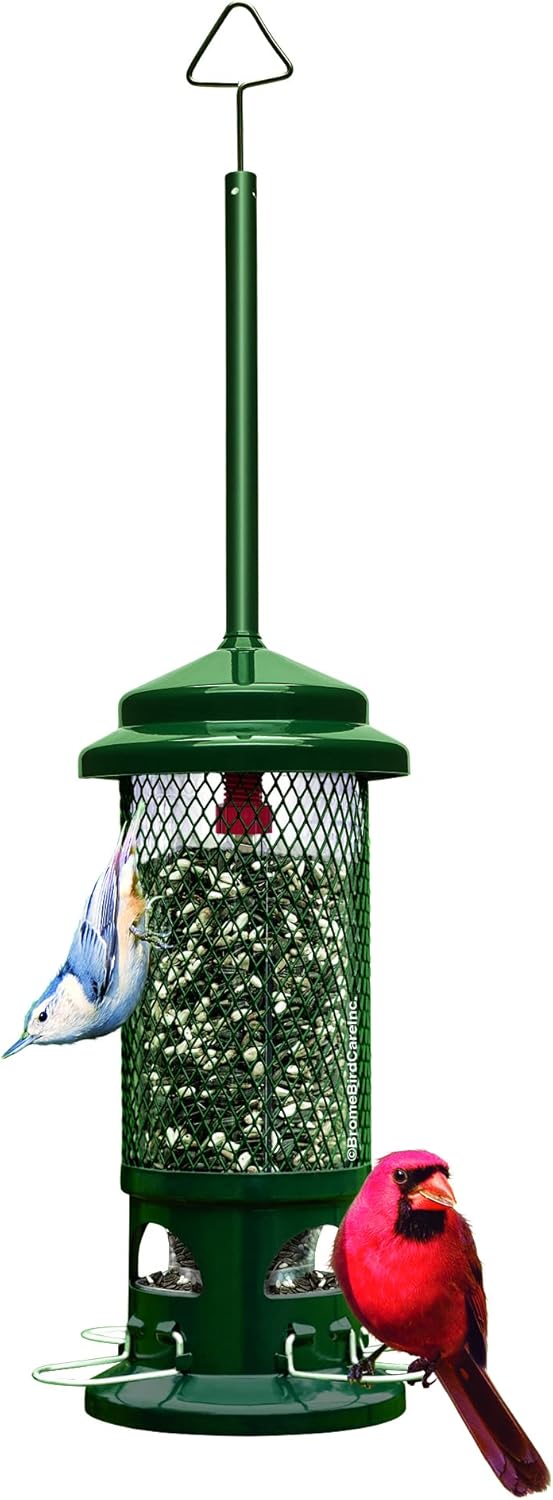
The squirrel-resistant anchor: Squirrel Buster Standard Squirrel-proof Bird Feeder w/4 Metal Perches, 1.3-pound Seed Capacity, garden green
 Visit on Amazon →
This is the feeder that protects the seed, and the mechanism is the reason I recommend it. The shroud is weight activated. A squirrel puts its weight on the perch collar, the shroud drops, the ports close, and the animal gets nothing for its trouble. It is the design that made me stop calling the whole category a gimmick.
Four metal perches matter more than they sound like they should. Metal does not crack at -10°F the way plastic does, and perches are the part that fails first on cheap tubes. The 1.3-pound seed capacity is honest about what this feeder is: a songbird tube, not a platform. In a busy May, with migrants moving through, that capacity means refilling every few days, and I consider that a feature rather than a flaw, because it forces me to look at the seed and the ports on a regular schedule.
The name says squirrel-proof. My three-week squirrel protocol is what decides whether I repeat that word, and the honest version is this: on a baffled pole, this is as close to proof as the category gets. Hanging it from a branch with a bit of twine and no baffle is not the same product.
Flaws but not dealbreakers: The shroud that stops squirrels also bounces larger birds. Cardinals and blue jays often will not commit to the perches without an add-on ring, so if cardinals are the reason you feed, plan on buying that ring or hanging a separate platform feeder. It is a real tradeoff, not a defect.
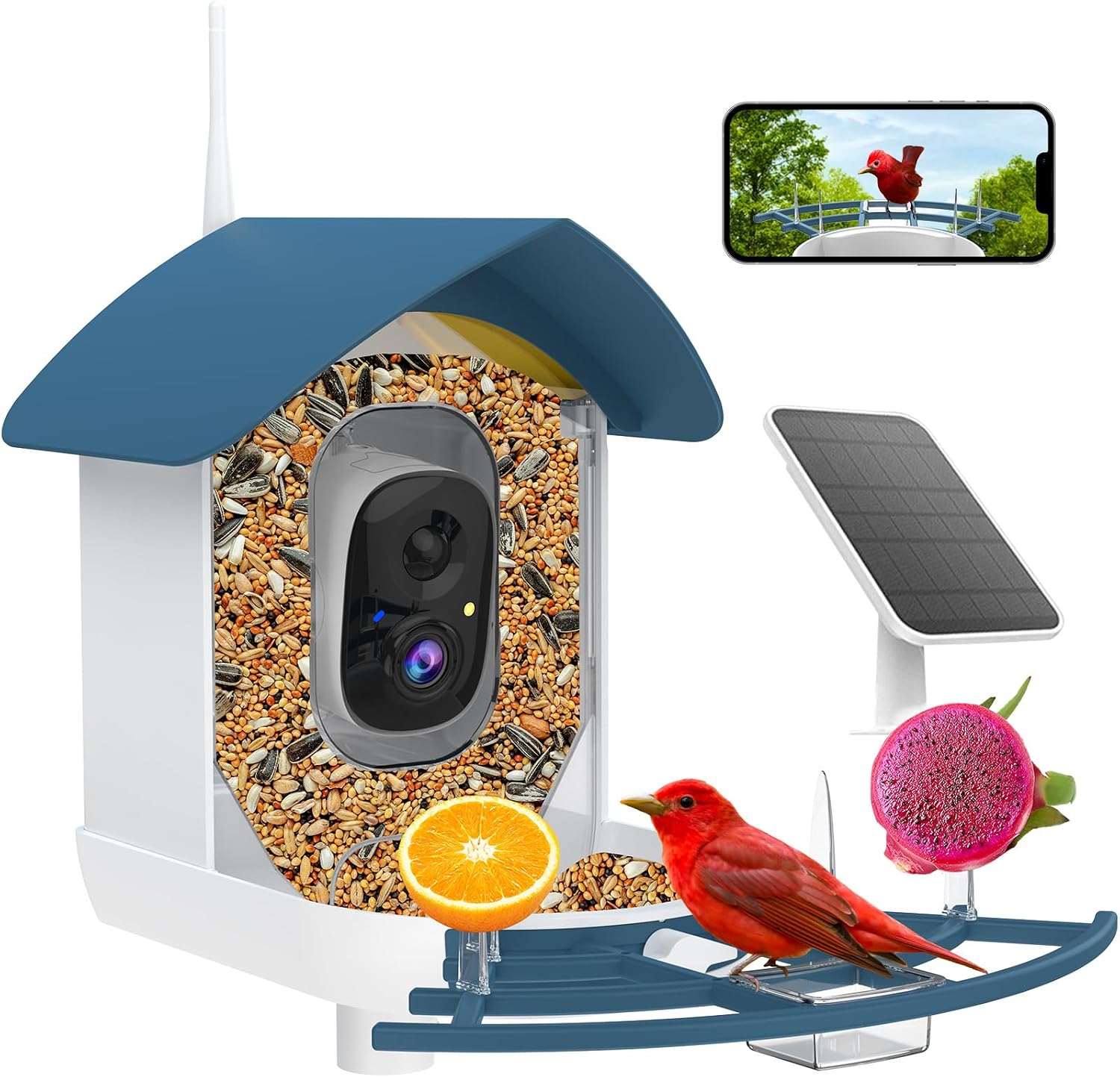
The camera feeder: Fazoxo Bird Feeder with Camera,Birds House Camera,Solar Powered,AI Bird ID
 Visit on Amazon →
This is the fun half, and it is the half that gets people into the hobby in the first place. The house shape puts a roof over the seed, the camera is built into the structure rather than clipped on, and solar power means you are not running out to swap batteries every week in February, which is the failure mode that kills most camera feeders in cold climates.
Three things decide whether a camera feeder works for you. First, sun. A solar panel in shade is a dead battery with extra steps, so mount it where the panel faces the southern sky and gets direct light for most of the day, even if that means the camera looks at your least photogenic shrub. Second, Wi-Fi. Before you commit to a pole location, stand there with your phone and check the signal, because a feeder that cannot reach the network is a birdhouse with a lens in it.
Third, treat the AI bird ID as a starting point, not an answer. Automatic identification is genuinely useful for sorting the chickadees from the titmice in a pile of overnight notifications, and it is genuinely wrong sometimes on sparrows and on females of anything. Cross-check the interesting ones against Sibley before they go in the log. I have had more than one "rare" notification turn out to be a house finch at an unflattering angle.
Flaws but not dealbreakers: The lens gets dirty the same way a window does, and a smeared lens turns every photo into a watercolor. Add a lens wipe to your cleaning kit. And keep this feeder on a baffled pole like any other, because the camera does not make the seed any less interesting to a squirrel.
The actual setup workflow
Step one: pick the pole spot. Three feet from glass, or more than thirty feet. Eight to ten feet from the nearest launch point. Sun for the solar panel if you are hanging the camera feeder, and shade in the afternoon if you are in a hot climate, because seed bakes in direct summer sun.
Step two: set the pole and the baffle. Baffle goes below the feeder, high enough that a squirrel cannot reach over it from the ground and low enough that it cannot jump past it from a nearby branch. If a squirrel can touch the pole above the baffle, the baffle is decoration.
Step three: hang the anchor feeder. Fill the tube about two-thirds with black-oil sunflower or sunflower hearts, not a bargain blend. Check the ingredient list and put it back on the shelf if milo or red millet shows up near the top. Filler sits in the tray uneaten, molds after rain, and doubles your cleaning schedule. Sunflower hearts cost more per pound and produce no hull litter, which matters if you have a deck or an HOA.
Step four: hang the camera feeder and check the network. Same pole or a second pole, but check the signal at the actual mounting height, not from your kitchen. Then aim the camera at the perch the birds use most, which is usually the one facing away from the prevailing wind.
Step five: expect a slow first two weeks. New feeders take time. Birds find food by watching other birds, and a yard with no traffic stays quiet until one brave chickadee breaks the ice. Do not move the feeder because nothing showed up in three days. That restarts the clock.
Step six: clean on a schedule, not on a feeling. Every two weeks in warm weather, every three to four in winter. Take the feeder completely apart. Scrub with a dilute bleach solution, rinse thoroughly, and let it dry in the sun before refilling. A hose spray is not cleaning. Every salmonella case I have seen in rehab traced back to a feeder nobody took apart since fall, and house finch eye disease spreads at crowded, dirty ports.
Step seven: keep the log. Write down cups per week per feeder, plus first-of-season dates. Two months of that and you will know more about your yard than any review can tell you, including which blend your birds actually eat and which feeder the squirrels have learned to beat.
Step eight: winterize. Check the hanging hardware for fatigue before the first hard freeze, make sure the baffle is still true, and add a heated bath if you want open water when everything else is ice. Check the wattage and the thermostat before you buy any heated bath. A bath that runs hot in December is a hazard, not a feature.
The competition and why it lost
Platform feeders are the most democratic feeder you can hang and the worst choice for a camera setup. They hold a crowd, they hold rain, and they hold hulls, which means you clean them constantly. Great for ground feeders and doves, wrong for this article.
Nyjer socks and mesh finch feeders are excellent for goldfinches and useless for a camera, because the birds cling sideways and give you a photo of a tail. Suet cages are the winter workhorse and belong on a separate pole, since suet and sunflower draw different crowds and the woodpeckers do not want to share.
Window feeders are wonderful and I hang them every year, but only the ones with a metal bracket that bolts through the sill. Suction cups are for screened porches. I had one cup let go at -6°F and the tray hit the porch, and I have not trusted a suction cup since.
And any feeder advertised as squirrel-proof with a plastic body and a two-week warranty is a feeder you will replace. The word on the box is not the word I use.
What this all costs
The honest cost breakdown is not the feeder, it is the infrastructure and the seed. The anchor feeder is the cheaper half of the pair. The camera feeder costs more, and it is the one with a solar panel and a network connection that you will want to keep out of deep shade. The baffle, the pole, and the seed add up to more than either feeder over a year, especially if you are buying sunflower hearts in bulk instead of bargain blends with filler in them.
Check current Amazon price on both listings before you commit, because these prices move, and compare that against the cups-per-week math. A feeder that empties in three days is a feeder birds are actually using. A feeder that sits full for two weeks is a decoration.
The real cost is the fifteen minutes a week you spend taking things apart and rinsing them. That is the part that keeps birds healthy, keeps the camera lens clear, and keeps the log worth reading ten years from now. Everything else is hardware.