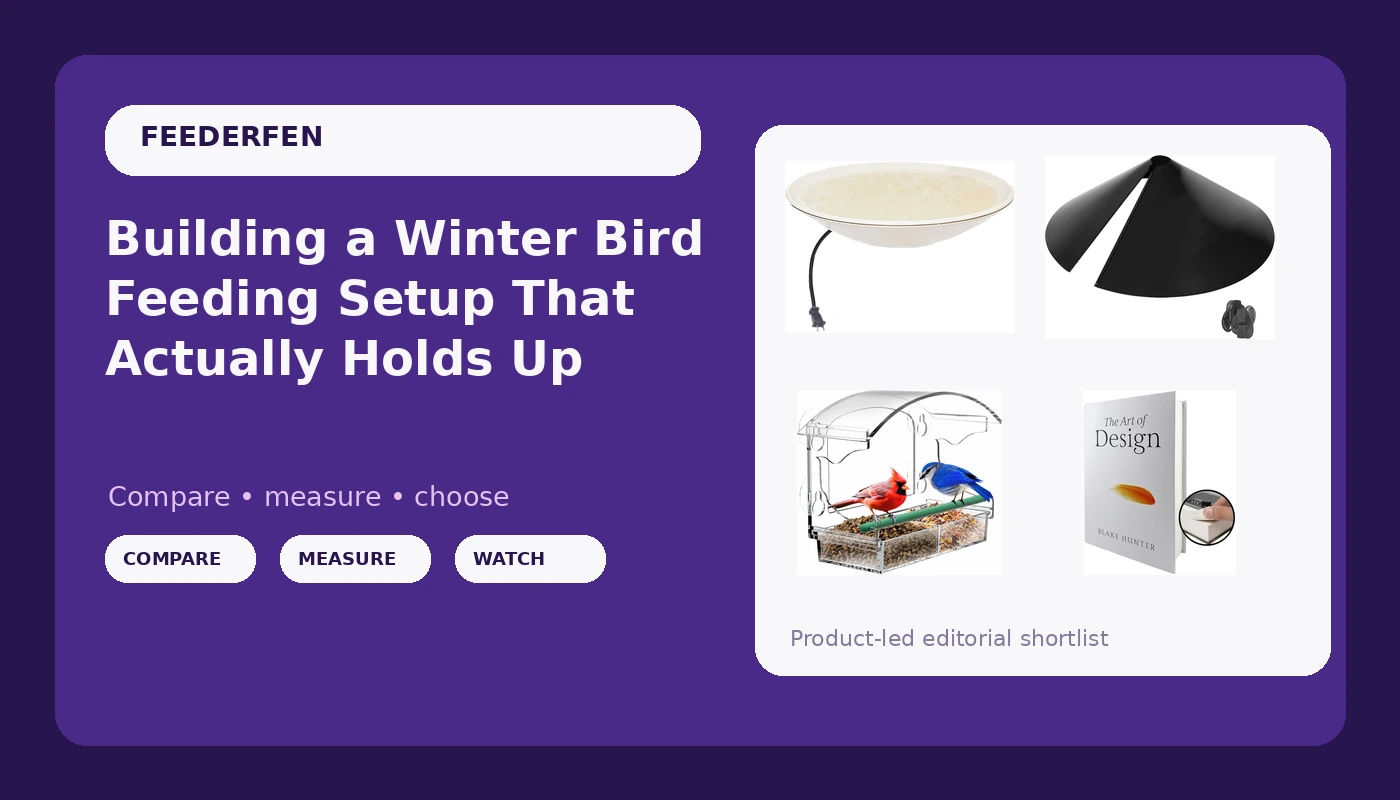
Most backyard bird feeding setups fail for unglamorous reasons: the water freezes solid by December, the feeder hangs too far from the glass to watch anything, and a squirrel clears a tube of sunflower hearts before the coffee is done. A backyard bird feeding setup that survives a real winter is really four separate jobs, and each one has its own spec sheet: open water, close-range viewing, a physical barrier between squirrels and seed, and a dry place to keep the season's records and the cash set aside for bulk seed. This explainer covers what each job actually requires, which of these four items handles it, and where each one has a limit worth knowing before you spend.
Related: How to Keep a Heated Bird Bath Ice-Free All Winter →
Quick answer
Water first, viewing second, squirrel defense third, storage last. A heated bath keeps drinking and bathing water open when every natural source in the yard is locked under ice, and open water pulls in species that rarely touch a seed tray. A window-mounted feeder puts birds at arm's length, and placed close to the glass it also keeps them from building up the speed that makes a window strike dangerous. A wrap-around baffle on a pole blocks the ground-level approach, as long as there is no nearby launch point. The book-shaped safe is not a bird product at all. It is a plain-sight place to keep log pages, seed receipts, and the money you set aside for a bulk order.
Four useful options
| Model | Best fit | What stands out |
|---|---|---|
| Allied Precision Industries API 600 Heated Bird Bath Bowl | Yards that freeze hard | Heated 20-inch bowl, light stone color, no stand required |
| Clear Acrylic Window Bird Feeder | Close-up viewing from indoors | Highly transparent acrylic, detachable seed tray, four suction cups |
| More Birds Squirrel-X Wrap Around Baffle | Pole-mounted feeders | 18-inch wrap-around metal baffle |
| Real Paper Diversion Book Safe | Records and seed money | Combination lock, real paper pages, disguised as a book |
The water source: Allied Precision Industries API 600 Heated Bird Bath Bowl
Water is the piece most feeders skip, and it is the piece that changes a yard list. Birds drink year round and bathe year round, and in freezing weather both habits get expensive for them: a bird that cannot find liquid water has to spend body heat it does not have to spare. A heated bowl keeps a shallow pan open through freeze-and-thaw cycles, which is exactly the window when natural puddles disappear. The trade-offs are real. Anything heated needs a cord, an outlet, and a plan for how the cord crosses the deck. Check the wattage and whether the unit thermostats rather than running full power constantly, because a bath that runs hot in a mild spell is a hazard rather than a feature. And keep the basin shallow; songbirds want to wade, not swim.
The close-range feeder: Clear Acrylic Window Bird Feeder
Window feeders do two jobs at once, and the second one is the one people forget. The obvious job is viewing: a tray stuck to the kitchen glass turns a feeder into a scope, and you start noticing things you never caught at thirty feet. The less obvious job is safety. Glass kills birds when they hit it at speed, and the standard advice is to place feeders either very close to the window or well beyond it. At close range, a bird leaving the feeder never builds enough velocity to hurt itself, and a bird approaching it is slowing down to land. The honest caveat on this design is the mounting system. Suction cups are the weak link in hard freezes, so check them, reseat them when the temperature drops, and clean the glass before you press them on. In a climate that spends weeks below freezing, a bracket-mounted feeder is the more durable answer, and the cup-mounted box is best treated as a seasonal or sheltered-surface tool.
The squirrel defense: More Birds Squirrel-X Wrap Around Baffle
A baffle is not a magic force field, and it is worth understanding what it physically does. It works by making the pole unclimbable and by adding a wide lip that a squirrel cannot reach around from below. That means it protects feeders mounted on a pole, and only when the squirrel has to come up that pole. Put the feeder where a squirrel can leap onto it from a branch, a fence rail, a shed roof, or a picnic table, and no baffle on the market will matter. Squirrels jump several feet horizontally and vertically without much effort. So the install matters as much as the hardware: set the pole out in the open, keep the baffle clear of anything a squirrel can launch from, and accept that the honest word is squirrel-resistant. A determined squirrel will spend weeks looking for the exception.
The odd one out: Real Paper Diversion Book Safe
This one does not belong in a bird-feeding cart, and pretending otherwise would be dishonest. It earns a place in this explainer because the paperwork side of feeding is real: log printouts, receipts from a bulk seed order, and the cash some people keep set aside for a season's worth of sunflower hearts all need a home that is not a kitchen drawer. A book-shaped box slides onto the same shelf as your field guides and looks like one more reference volume, which is the entire point of a diversion safe. Be clear about what it is, though. It is a disguised container with a combination lock, not a rated security safe. It will not survive a fire, and it is not going to stop anyone who already knows what it is and decides to walk off with it. Treat it as concealment, and it does that job well.
Prices and availability may change. Verify current details on the retailer page before buying, and match the exact product you intend to order.
Why open water outdraws seed in a cold snap
Seed gets all the attention, but water is the harder resource to find in a northern winter. Natural sources, from puddles to pond edges to gutter drips, lock up for weeks at a time, and the birds that stay through the cold still need to drink. Feather maintenance matters too: birds bathe to keep plumage in condition, and clean, well-ordered feathers are part of how a small body holds heat. A heated bath that keeps a shallow pan just above freezing gives them both without turning the yard into a steam room.
Two practical notes follow from that. First, shallow beats deep. Songbirds want a basin they can stand in and splash out of, and a deep bowl wastes water and creates a drowning risk. Second, open water gets dirty faster than people expect, because it concentrates birds in one spot. Empty it, wipe it, and refill on a schedule, the same way you would a feeder. Standing water plus bird traffic is a hygiene problem in the same way a neglected seed tray is.
What a baffle can and cannot do
A baffle is a physical obstacle, and it only works against the approach it was designed to block. Squirrels reach feeders four ways: up the pole, down from above, across from a nearby launch point, and by simply knocking the whole thing until seed falls out. A wrap-around baffle addresses the first of those. It does nothing about the second and third, and it cannot help with the fourth.
That is why the placement conversation comes before the purchase. Mount the pole in the open, keep every branch and rail well clear of the baffle, and check that the baffle's collar matches your pole's diameter so it actually seats rather than wobbling. Skip the old tricks, too. Greasing a pole collects grit and feathers, and it is a mess to handle. A wide metal collar that a squirrel cannot grip is a cleaner solution, and the honest expectation is that it buys you most of your seed back, not all of it.
- Choose the window you actually sit at, then plan the feeder placement around that sight line rather than around the yard's symmetry.
- Get water open before the first hard freeze, not after, so birds have a reliable source from the first cold snap onward.
- Set the pole and fit the baffle before the feeder goes up, because retrofitting a baffle around a full pole is a worse afternoon.
- Walk the yard and find every launch point within jumping distance of the feeder, then move the pole or prune the branch.
- Write cleaning and refilling into the week as fixed tasks, because both slip the moment they become optional.
Practical guidance
- Clean feeders and baths on a schedule you can keep. Disassemble the parts, wash with hot soapy water, rinse, and dry before refilling. A feeder nobody has taken apart since fall is a disease vector with a perch.
- Skip seed blends padded with milo and red millet. The birds kick it to the ground, it molds in the rain, and you end up cleaning the platform twice as often for the same money.
- Black oil sunflower and sunflower hearts are the reliable core of a winter menu. Hearts cost more per pound but leave no hull litter under the feeder.
- Never put red dye in hummingbird nectar, and in winter do not bother with nectar at all in a freezing climate. Sugar water freezes and ferments, and it is not a cold-weather food.
- Check the mechanical weak points after every hard freeze: suction cups, cords, brackets, and baffle collars. Winter does its damage at the joints, not in the middle of the parts.
Which option should you choose?
Choose the Allied Precision Industries API 600 Heated Bird Bath Bowl when your winters freeze hard and you want to add the resource that brings in the widest range of species. Choose the Clear Acrylic Window Bird Feeder when your priority is watching birds from a few feet away and your mounting surface can carry suction cups reliably. Choose the More Birds Squirrel-X Wrap Around Baffle when your feeder is on a pole in the open and squirrels are emptying it from the ground up. Choose the Real Paper Diversion Book Safe when you want the season's log pages, receipts, and seed money out of a drawer and off a desk, and you understand that it is concealment rather than a security container.
None of these four is a complete feeding station by itself. The bath ships without a stand, the window feeder depends entirely on the surface it sticks to, and the baffle is only as good as the clearance around your pole. Buy them as pieces of a system, and match each one to the job it was built for.
The bottom line
A backyard bird feeding setup holds up when you stop treating it as one purchase and start treating it as four. Open water first, because it is the scarcest resource in a frozen yard and the one that pulls in species a seed tray never will. A close-range feeder second, because it puts birds where you can actually see them and keeps them slow near the glass. A baffle third, mounted on a pole with real clearance and no launch points nearby. And a plain-sight place for the season's records last, so the log, the receipts, and the seed money are not scattered across the house. Get the order right and the yard stays busy from the first hard freeze through the first spring migrants.
Prices and availability may change. Verify current details on the retailer page before buying.