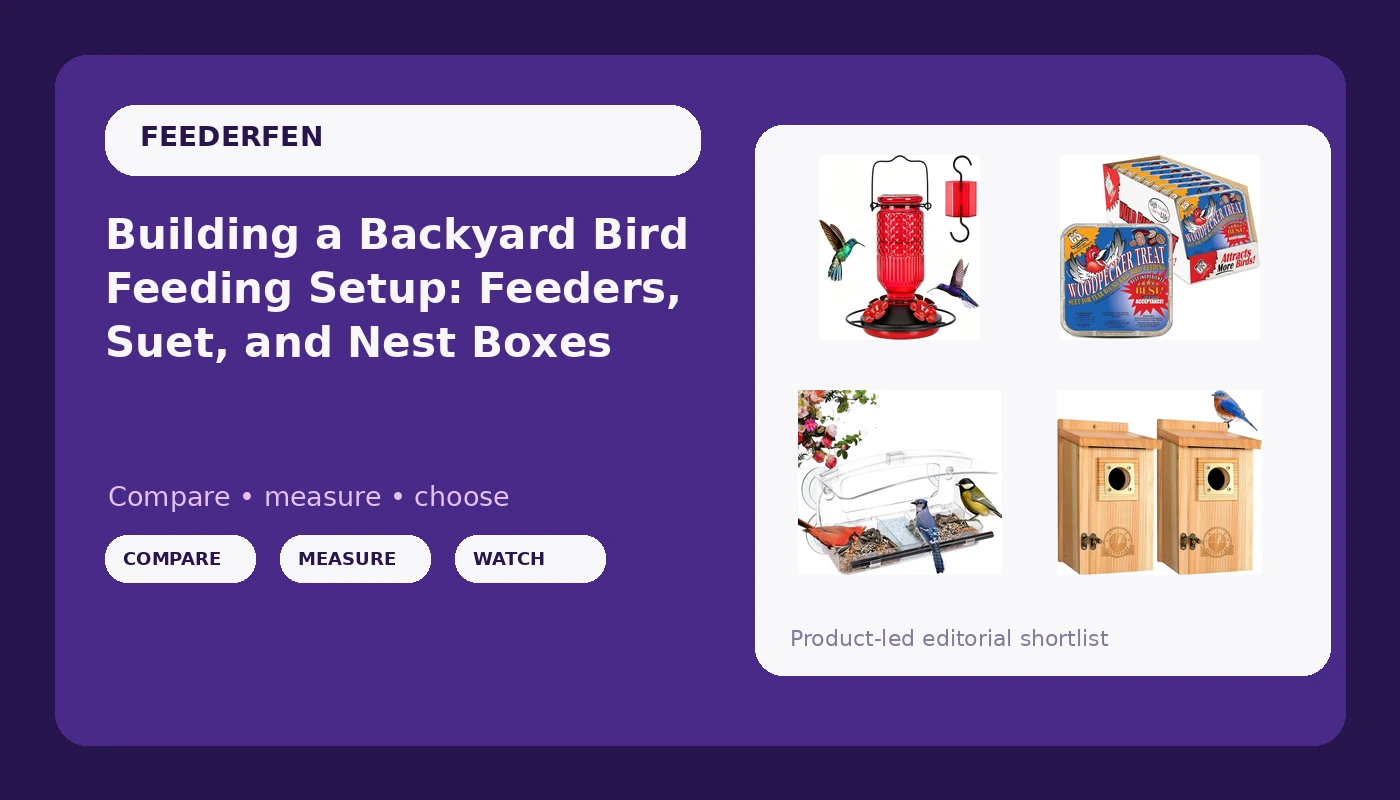
A backyard bird feeding setup is not one feeder on one pole. It is a small system, and every part of it serves a different group of birds. Nectar feeders serve hummingbirds. Suet serves the clingers that work a cage from the side and rarely touch a seed tray. A window-mounted tray serves the birds you want to watch at eye level from indoors. A nest box serves cavity nesters that never eat seed at all.
This explainer covers four products that fill four separate slots in that system: a glass hummingbird feeder, a suction-cup window feeder, an eight-pack of woodpecker suet cakes, and a two-pack of bluebird houses. It is written for someone building a first station, or filling a gap in one that already exists. None of these four competes with the others, and none of them is a replacement for water, which brings more species into a yard than any food you can hang.
Related: Suet Cages and Cakes: What Woodpeckers Actually Visit →
Quick answer
The four products fill four different roles, so the right first purchase depends on which group of birds your yard is missing. For most yards, start with the hummingbird feeder in the warm months and the suet cakes once temperatures drop, because nectar and suet both draw species that seed alone will not bring in. The window feeder is a viewing tool rather than a bird-attracting one, and the bluebird houses are for nesting, not feeding, so treat them as a separate project you add once the food stations are running. Buy in that order, and let what shows up in your own yard decide what you add next.
Four useful options
| Model | Best fit | What stands out |
|---|---|---|
| FEED GARDEN Glass Hummingbird Feeder for Outdoors Hanging, 16 oz Leak-Proof Nectar Feeder with Bee Guards & Ant Moat, 4 Metal Flower Feeding Ports, 360° Perch Ring, Easy Refill & Clean, Red | Hummingbirds, spring through fall | 16 oz glass reservoir, four metal flower ports, bee guards, an ant moat, and a 360° perch ring |
| Window Bird Feeder with 4 Strong Suction Cup | Close-up viewing at a window | Mounts to glass with four suction cups, no pole or bracket needed |
| C&S Woodpecker Suet Treat, Outdoor Wild Bird Food for Woodpeckers, Flickers and More, 8 Pack | Woodpeckers and other clinging birds | Eight cakes sized for a standard suet basket |
| SISTERBIRD 2 Pack Bluebird Houses for Outside, Warming Gifts Bluebird House | Cavity nesters in spring | Two boxes in one order, which suits pairs that defend separate territories |
The nectar station: FEED GARDEN Glass Hummingbird Feeder for Outdoors Hanging, 16 oz Leak-Proof Nectar Feeder with Bee Guards & Ant Moat, 4 Metal Flower Feeding Ports, 360° Perch Ring, Easy Refill & Clean, Red
Nectar is the one food in this set that comes with a maintenance clock. A sugar solution at roughly one part white sugar to four parts water spoils faster than any seed, and in hot weather a feeder left up for a week becomes a mold and bacteria problem rather than a food source. The glass body and the wide fill opening are what make a rinse-and-refill routine realistic, since the feeder has to come apart easily enough that you will actually do it.
The perch ring deserves a note. Hummingbirds can feed while hovering, but a perch lets them sit between visits, which tends to mean longer and more relaxed feeding sessions on the feeder. The bee guards and ant moat address the two most common complaints about nectar feeders. The ant moat still needs to be refilled with water to keep working, and that is the one piece of upkeep people forget.
The viewing station: Window Bird Feeder with 4 Strong Suction Cup
Suction cups are the part of any window feeder that decides how the whole thing goes. They hold well on clean glass in mild weather, and they are the first component to let go when temperatures swing below freezing, which is why a window feeder is best treated as a warm-season and shoulder-season station in cold climates. Check the cups when the forecast turns, and lift the tray inside before a hard freeze rather than finding it on the porch.
Placement is where a window feeder earns its keep beyond the entertainment value. Glass that birds can see through and fly toward is a strike risk, and a feeder mounted within about three feet of a window removes the approach run that builds up fatal speed. The birds either land on the feeder or bounce off at low speed. This is the same reason a window feeder is often the first feeder people hang, and the reason it should stay up even if the birds using it are common ones.
The winter station: C&S Woodpecker Suet Treat, Outdoor Wild Bird Food for Woodpeckers, Flickers and More, 8 Pack
Suet is the food that adds a whole category of birds to a yard that only offers seed. Woodpeckers, nuthatches, and chickadees are clingers: they feed while gripping a vertical surface, so a flat tray on a pole is the wrong shape for them. A suet cage hanging from a branch, a pole arm, or the side of a post gives them something to hold onto, and a cake like this one drops straight in.
Suet is also seasonal in a way seed is not. In warm weather, plain suet softens and can turn rancid, which is why most people run suet from late fall through early spring and switch to a no-melt or insect-based cake in summer if they want to keep a cage up. Keeping the spare cakes somewhere cool until they are needed is the simplest way to avoid a mess in the basket. If you already have a cage, this eight pack is the cheapest way to keep it full through a winter.
The nesting project: SISTERBIRD 2 Pack Bluebird Houses for Outside, Warming Gifts Bluebird House
The reason to buy two boxes rather than one is territorial. Bluebirds defend a nesting territory, and a single box in an open lawn often gets claimed by a house sparrow or a starling before a bluebird pair finds it. Pairs of boxes mounted a short distance apart, facing away from each other, give a bluebird pair one box and usually leave the other for a tree swallow, so both native cavity nesters get a chance instead of fighting over the same entrance.
Placement matters more with a nest box than with any feeder. Bluebirds want an open area with a perch nearby and low grass, and they want the box mounted at roughly chest height on a pole or post rather than swinging from a tree branch where predators and house sparrows have the advantage. Put boxes up in late winter, check them between nesting attempts rather than during, and clean them out at the end of the season so the next pair starts with an empty cavity.
Prices and availability may change. Product images, names, and retailer links must be matched by verified ASIN. Do not state a current price, rating, stock status, or measured result without current evidence.
Why the station matters more than the product
Species lists are decided by food type and station shape, not by finish or brand. A tube feeder full of sunflower seed draws house finches, chickadees, and cardinals. A suet cage draws woodpeckers, nuthatches, and flickers. A nectar feeder draws hummingbirds and, occasionally, an oriole. A nest box draws bluebirds, tree swallows, and wrens. Those are four different groups, and a yard with only one station will only ever see one or two of them, no matter how much seed goes into it.
The second variable is placement. Feeders set close to cover get used faster than feeders in the middle of an open lawn, because birds need a safe place to retreat to between visits. At the same time, feeders set too far from a window invite strikes, and feeders set within about three feet of glass prevent them. Water is the third variable, and in warm months a birdbath will pull in more species than every feeder in the yard combined, including birds that never eat at a feeder at all.
Matching a product to the bird you are missing
Work backwards from the birds you already see, then add the station that serves the group you are not seeing yet.
- Write down what visits now. If you see finches, chickadees, and cardinals, your seed and suet slots are covered and your gap is somewhere else.
- Identify the missing group. No hummingbirds means you need nectar. No woodpeckers means you need suet and a cage for it. No bluebirds means you need a box and open ground.
- Match the mount to the yard. A window feeder needs clean glass and a window you sit near. A suet cage needs a branch, pole arm, or post. Nest boxes need open space, not deep shade.
- Set a cleaning rhythm before you hang anything. Nectar every few days in heat, seed feeders every couple of weeks with a full disassembly, nest boxes at the end of the season.
- Add water. A shallow bath with a stone or two for footing will outdraw the feeders during the hottest weeks and costs nothing to maintain beyond a refill.
Practical guidance for a first season
- Mix nectar at one part white sugar to four parts water, and skip red dye entirely. A red feeder does the same job without putting anything extra in the solution.
- Rinse a hummingbird feeder every two to three days in hot weather. A feeder that is a chore to take apart is a feeder that gets left up too long.
- Hang suet from late fall through early spring, and keep spare cakes somewhere cool so they go into the cage firm.
- Mount a window feeder on glass you can reach from inside, and press each suction cup down firmly on a clean pane before letting go.
- Put bluebird boxes on a post in the open, at about chest height, and face pairs away from each other rather than side by side.
- Refill the ant moat on a nectar feeder when you refill the nectar, since a dry moat is how ants reach the ports.
Which option should you choose?
Choose the FEED GARDEN Glass Hummingbird Feeder when you want nectar on the fence from spring through fall and you want a feeder you can rinse out quickly. Choose the Window Bird Feeder with 4 Strong Suction Cup when the birds you most want to watch are the ones already in your yard, and you would rather see them at eye level than from across the lawn. Choose the C&S Woodpecker Suet Treat, 8 Pack when you already have a suet cage or plan to add one, and you want to bring in woodpeckers and other clingers through the cold months. Choose the SISTERBIRD 2 Pack Bluebird Houses when your food stations are running and you are ready for a nesting project that needs boxes, open ground, and patience rather than seed.
The honest caveat is that none of these four products attracts birds on its own. A station that is dirty, placed in the open, or left dry in August will underperform the same product hung properly, and suction-cup mounting in particular is weather dependent in cold climates. Judge these products on how easily you can take them apart and keep them clean, because that is the variable you control.
The bottom line
A backyard bird feeding setup gets better by adding food types, not by adding more of the same food. Nectar covers hummingbirds, suet covers woodpeckers and other clingers, a window tray covers your viewing, and nest boxes cover cavity nesters that never visit a feeder at all. Start with the station that fills the gap in your own yard, keep it clean on a schedule you can actually hold, and put water out while you are at it. The species list follows the food type and the placement far more than it follows the packaging.