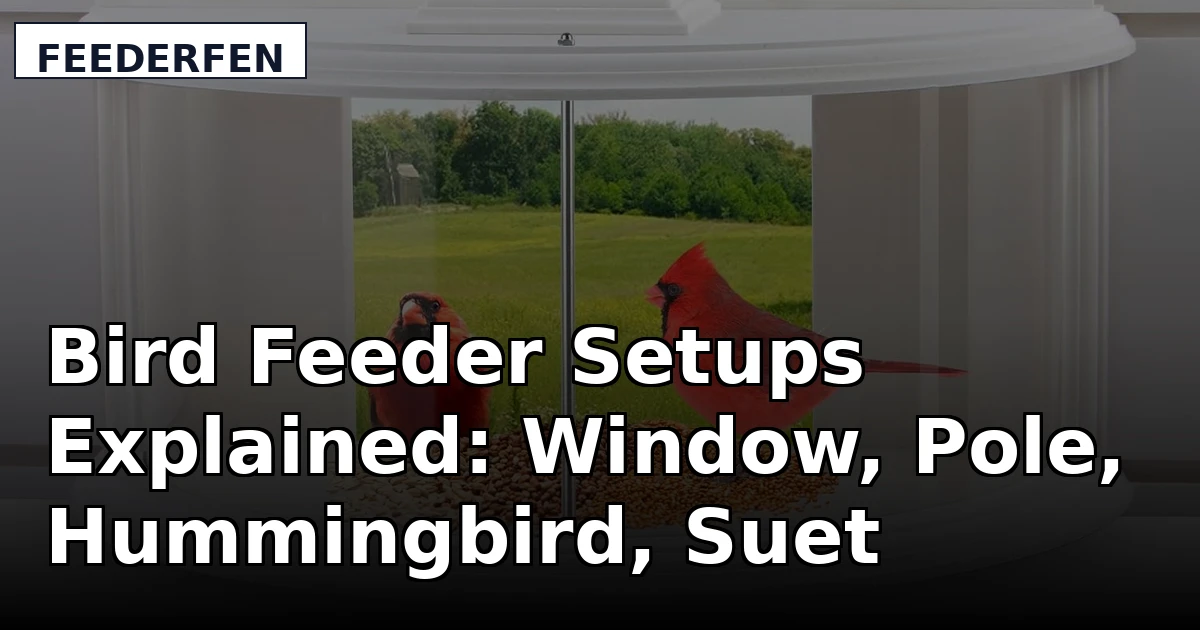
Most backyard bird feeder setups fail for one of three reasons: the feeder hangs in the wrong place, it is the wrong type for the birds that actually visit, or it is enough of a chore to clean that it quietly stops getting cleaned. A backyard bird feeder setup is a small system, not a single purchase. A window feeder at the glass shows you birds at arm's length. A pole moves seed away from the fence line and the squirrel route. A saucer of nectar serves hummingbirds in summer. A suet cage feeds the birds that cling sideways instead of perching. Match the feeder to the job you want done, and the yard usually tells you within two weeks whether you got it right.
Related: How to Clean a Bird Feeder So It Stops Being a Disease Vector →
Quick answer
There is no single feeder that covers every yard, so match the feeder to the job. For watching birds up close through glass, a window-mounted feeder is the practical choice, and placing it within three feet of the glass is the standard recommendation for reducing window strikes. For holding several feeders and keeping seed off the ground, a pole with a baffle does more work than any single feeder. Saucer hummingbird feeders cover nectar season, and a suet cage covers the clinging birds that never settle onto a perch feeder. Start with the one that matches the birds you already see, keep it clean, and add the next one only when you know what your yard is missing.
Four useful options
| Model | Best fit | What stands out |
|---|---|---|
| JOYSEUS Window Bird Feeder | Watching birds through glass | 180 degree clear view, mounted at the window |
| eWonLife 92 Inch Squirrel Proof Bird Feeder Pole | Holding several feeders off the ground | 92 inch pole, 9 prong base, baffle and birdbath tray included |
| Kingsyard 2 Pack 6 Ports Saucer Hummingbird Feeders | Nectar season | Two saucer feeders, six ports each |
| Gbekery Wooden Bird Feeder with Double Suet Metal Cage | Suet and clinging birds | Wooden body with two metal suet cages |
Window feeder: JOYSEUS Window Bird Feeder
A window feeder is the one feeder that changes how much you actually see. Everything else in the yard is watched through binoculars; a window feeder is watched over a coffee cup. The trade-off is capacity and exposure. A window feeder holds less seed than a tube or a hopper, it is more affected by wind and weather, and it needs to come down often enough that the mounting system has to be something you are willing to work with every week.
Placement matters more here than anywhere else. A feeder mounted within three feet of the glass is the arrangement that reduces window strikes, because a bird leaving the perch cannot build up enough speed to hit the pane hard. Mounted far out in the yard, a feeder becomes a launch point toward the window rather than a shield against it. If you have ever had a bird hit your glass, this is the placement to fix first. Cleaning is the second thing to plan for, because a window feeder is small and empties slowly, which means seed sits in it longer than it would in a busy tube.
Pole system: eWonLife 92 Inch Squirrel Proof Bird Feeder Pole
A pole is the piece of hardware that decides how much of your seed reaches birds. Hanging feeders from a branch puts them on the squirrel's home turf. A pole with a baffle moves the food into open air, and a baffle is only as good as its position: the common guidance is roughly five feet off the ground and ten feet away from anything a squirrel can leap from, including a fence, a deck rail, a shrub, or a low roof edge. Get those two numbers right and the baffle works. Get them wrong and you have built a squirrel ladder.
The name on this pole says squirrel proof. Treat that the way you would treat any squirrel claim, as a description of intent rather than a guarantee, and judge it by how the baffle is mounted and how much reach the pole gives you. The 92 inch height and the 9 prong base are the parts that do the real work: height buys distance from the ground, and a wide base keeps the whole assembly upright when the soil softens. The included birdbath tray is worth taking seriously for a different reason. Water draws birds that never touch seed, and a tray on the same pole is one less thing to carry out to the yard.
Hummingbird feeder: Kingsyard 2 Pack 6 Ports Saucer Hummingbird Feeders
Hummingbird feeders are the highest-maintenance feeders in the yard, and the two-pack format is the part that makes them manageable. Nectar is sugar water, and sugar water spoils. In hot weather the working rule is to change it every two days, and any feeder that has gone cloudy or stringy comes down immediately. That schedule is much easier to hold when a second feeder is already clean and dry on the shelf, which is the practical argument for buying two at once rather than one at a time.
Mix the nectar yourself at one part plain white sugar to four parts water. Skip the red dye. Color is not what brings hummingbirds in, and the dye adds something to the diet that the birds do not need. Saucer-style feeders have a design advantage in rain, since the ports sit above the nectar rather than in a tube that can collect water, and the feeding surface is easy to rinse. Whatever you hang, the test is the same: if you cannot take it apart and rinse it in under a minute, it will not get cleaned as often as it should.
Suet and seed feeder: Gbekery Wooden Bird Feeder with Double Suet Metal Cage
Suet is the winter feeder that reaches birds a seed feeder never touches. Woodpeckers, nuthatches, and chickadees are clingers: they hang sideways or upside down and work at a cake from the side, which is exactly what a cage is built for. A double cage means two cakes, and it also means a spare position when one cake is finished and you have not made it back out to the store. Hanging a suet cage near a seed feeder usually increases traffic at both, since the same birds move between them.
Two details decide whether a suet setup works. The first is the cage material: vinyl-coated wire is easier on feet than bare metal, especially in freezing weather. The second is the fat itself. Plain rendered suet softens and turns rancid in warm weather, so once daytime temperatures climb, switch to a no-melt cake or take the cage down until fall. A wooden body with metal cages is a reasonable middle ground for a yard that wants one hanging feeder doing two jobs, seed on one side and suet on the other, from a single hook.
Prices and availability may change. Product images, names, and retailer links must be matched by verified ASIN. Do not state a current price, rating, stock status, or measured result without current evidence.
How placement changes what you see
Placement decides more outcomes than product choice does, and the same feeder can be a success or a waste of seed depending on where it hangs. Three distances are worth measuring before you drill, hook, or drive anything into the ground.
The first is the window. Feeders within three feet of glass reduce strikes, because birds leaving the perch cannot accelerate into the pane. Feeders placed ten to thirty feet out are the risky arrangement, since that is enough distance to build speed and not enough to change course.
The second is cover. Birds want a perch to retreat to and to scan from before they commit to a feeder, usually a shrub or a tree within a short flight. A feeder in the middle of open lawn gets used, but it gets used more slowly and by fewer species than one with a retreat nearby.
The third is squirrel reach. Measure from the baffle to the nearest launch point: fence, rail, branch, roofline, trash can, anything. If a squirrel can stretch from that object to the feeder or drop onto it from above, the baffle is decoration. Squirrel-resistant is the honest term for hardware that survives contact, and resistant is usually enough if the geometry is right.
One more placement note that gets ignored: keep feeders where you can see them from a window you actually sit near, and keep the ground below them clear enough to sweep up hulls. Seed that accumulates and stays wet is how a feeding station turns into a mold patch.
Matching the feeder to the bird and the season
Different birds feed in different ways, and the feeder type has to match the technique. Perch feeders with small ports suit finches, sparrows, and chickadees. Clingers need mesh, cages, or a rough surface to hang from. Hummingbirds need nectar and a port they can reach without perching. Ground feeders, including juncos and many sparrows, mostly want what falls below the pole.
Seed choice matters just as much, and the ingredient list is where you check it. Black oil sunflower and sunflower hearts draw the widest range of species and leave less waste than blends padded with milo and red millet, which most birds ignore and which molds once it gets wet. No-mess blends cost more per pound and produce no hull litter, which matters on a deck or under an HOA. Suet covers the cold months and nectar covers the warm ones. Feeding year round is the approach that produces the most interesting records, because spring migration and late summer bring birds that a winter-only setup never sees.
- Write down which birds you actually see in your yard, and at what height they move.
- Pick the location first, using the three distances: window, cover, and squirrel reach.
- Choose the feeder type that matches how those birds feed, perching, clinging, or hovering.
- Plan the cleaning routine before the feeder goes up, including where it will be taken apart and dried.
- Add one feeder at a time, and give it two weeks before deciding whether it stays.
Keeping a setup working through the year
- Clean and dry feeders on a schedule, not on a feeling. A feeder that comes apart easily gets cleaned more often.
- Rinse hummingbird feeders and replace nectar every two days in heat, and skip red dye entirely.
- Store seed in a sealed container in a cool, dry place, and discard anything that smells sour or clumps.
- Expect the seed draw to change with the season. A feeder that empties slowly in July may empty in two days during spring migration.
- Keep water available year round. A birdbath, including a tray on a pole, brings in species that never visit seed.
Which option should you choose?
Choose the JOYSEUS Window Bird Feeder when you want birds close to the glass and you are willing to mount it within three feet of the window, where it also helps reduce strikes. Choose the eWonLife 92 Inch Squirrel Proof Bird Feeder Pole when you want to hang more than one feeder, get seed off the ground, and add a baffle and a water tray in one footprint. Choose the Kingsyard 2 Pack 6 Ports Saucer Hummingbird Feeders when nectar season is the goal and you want a clean feeder ready while the other one dries. Choose the Gbekery Wooden Bird Feeder with Double Suet Metal Cage when the birds you want to attract are clingers and you want seed and suet on the same hook.
One caveat applies to all four: no feeder compensates for a bad location or a cleaning routine that never happens. The hardware is the easy part. Placement and maintenance are what determine how many species show up.
The bottom line
A yard does not need four feeders to work, but it usually needs the right one first. Start with the position you can see from indoors, put the feeder within three feet of that glass if it mounts to the window, or on a baffled pole if it hangs, and commit to taking it apart and cleaning it on a schedule you will actually keep. Add the nectar feeder when hummingbirds arrive and the suet cage when the first hard freeze lands. Then watch what shows up, and let that decide the next purchase rather than the other way around.